
System Design Coaching vs YouTube: Which One Actually Helps You Crack Senior Tech Interviews?

You’re about to spend weeks preparing for
system design coaching vs YouTube
learning—but which path actually gets senior engineers hired?
If you’re interviewing for senior, staff, or lead roles, you’ve seen the free content explosion. Ex-FAANG engineers post detailed walkthroughs daily.
Premium courses
promise frameworks. Paid coaches offer mock interviews.
If you’re also evaluating a structured curriculum versus DIY, see:
System Design Course vs Self-Study – What Works for Senior Developers?.
But here’s what most engineers discover too late: the gap between watching solutions and performing under pressure is massive—and only one of these approaches actually closes it.
Last updated: Feb. 2026
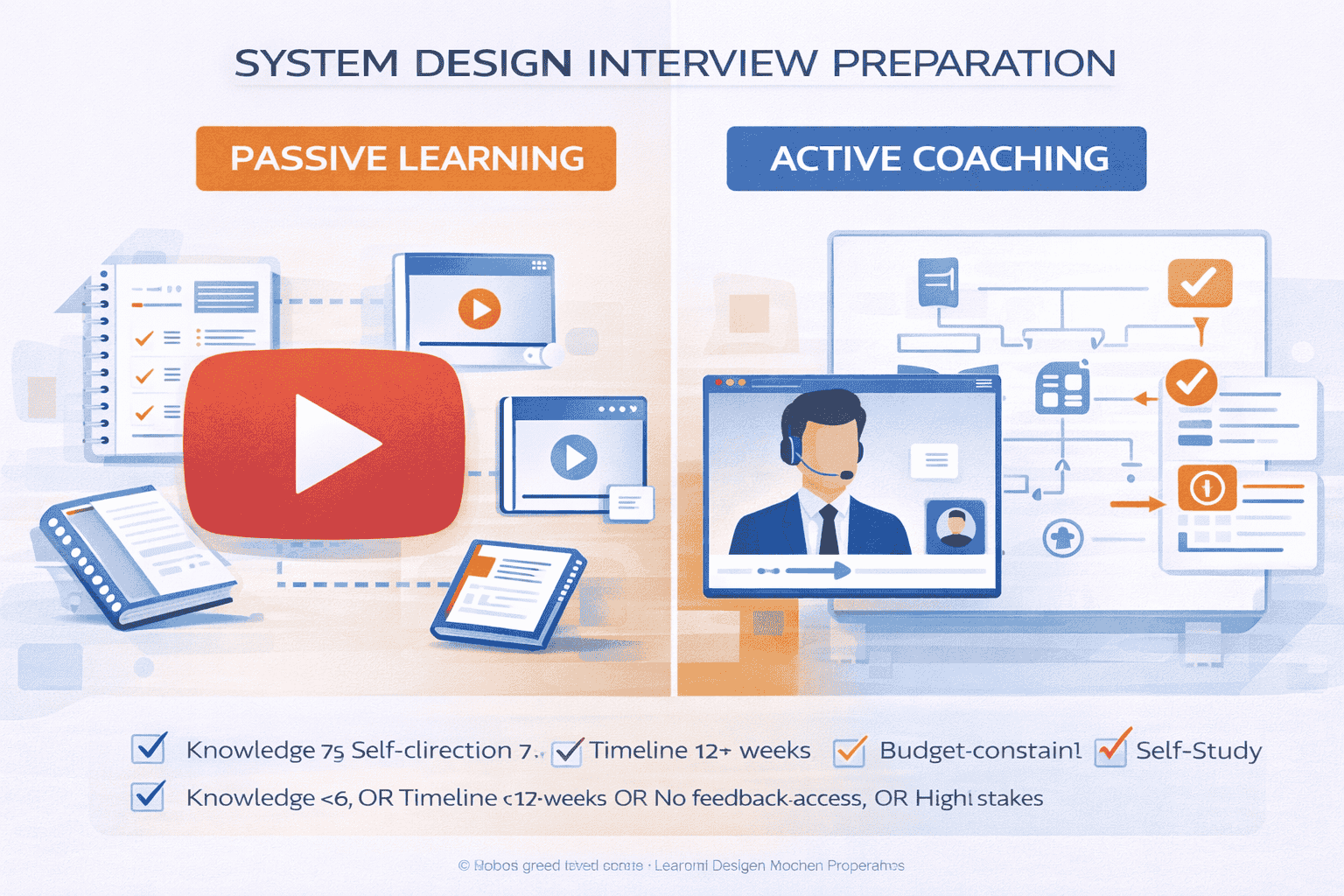
Table of Contents
-
1. Why Senior Engineers Ask This Question
-
2. How Most Candidates Actually Use YouTube
-
3. What Changes With System Design Coaching
-
4. Side-by-Side Reality Check
-
5. Decision Scenarios (Be Honest With Yourself)
-
6. Why Many Senior Engineers Still Fail
-
7. The Smart Hybrid Approach
-
8. Your Decision Framework
-
9. Making the Right Choice for Your Timeline
-
10. FAQs
Contents







Why Senior Engineers Ask This Question
This isn’t a beginner question.
When you’re five, eight, or twelve years into your career, you don’t wonder
what
system design is. You’ve built distributed systems. You’ve debugged race conditions at 3 AM. You’ve scaled services from thousands to millions of users.
The question you’re actually asking is different:
“Given my timeline and stakes, which preparation method gets me past the interview threshold without wasting months on the wrong approach?”
The False Binary Nobody Talks About
Most discussions frame this as
free versus paid
.
That misses the real distinction. YouTube isn’t just free—it’s passive. Coaching isn’t just paid—it’s interactive.
The actual choice is between
consumption and performance
.
What Makes This Decision High-Stakes
For senior-level roles,
system design interviews
aren’t advisory. They’re binary gates.
One weak round eliminates you from consideration—even if your coding rounds were perfect. Even if the hiring manager loved your resume. Even if you would’ve been brilliant on the team.
This creates an asymmetric risk profile:
-
Wrong preparation approach:
Months wasted, confidence damaged, opportunities closed -
Right preparation approach:
Clear execution path, predictable improvement, interview readiness
The decision compounds because most senior engineers are time-constrained. You’re balancing current job demands, family commitments, and limited interview windows.
Why Experience Doesn’t Automatically Translate
Here’s the uncomfortable truth: building production systems and explaining system design in interviews require different skill sets.
In your day job, you rarely need to:
- Verbalize every assumption before writing code
- Justify technology choices under questioning
- Pivot designs mid-explanation when constraints change
- Communicate complex tradeoffs to someone evaluating your thinking process
Real-world engineering happens in Slack threads, pull request comments, and design documents over days or weeks. Interviews compress that process into 45 minutes of live communication under scrutiny.
This is why many senior engineers fail their first system design rounds despite strong technical backgrounds. The disconnect isn’t knowledge—it’s execution format.
The Core Question This Guide Answers
This article doesn’t argue that one approach is universally superior.
Instead, it provides a decision framework based on:
- Your current interview timeline (4 weeks vs 4 months matters significantly)
- Your failure patterns (if you’ve failed system design rounds before, that changes the calculation)
- Your communication style under pressure (some engineers freeze, others ramble—both need different interventions)
- Your learning preferences and available preparation time
By the end, you’ll understand exactly which approach fits your situation—and why mixing elements from both might be the smartest strategy.
How Most Candidates Actually Use YouTube
Let’s be specific about what YouTube learning actually looks like in practice.
It’s not just “watching videos.” The pattern is more nuanced—and more problematic.
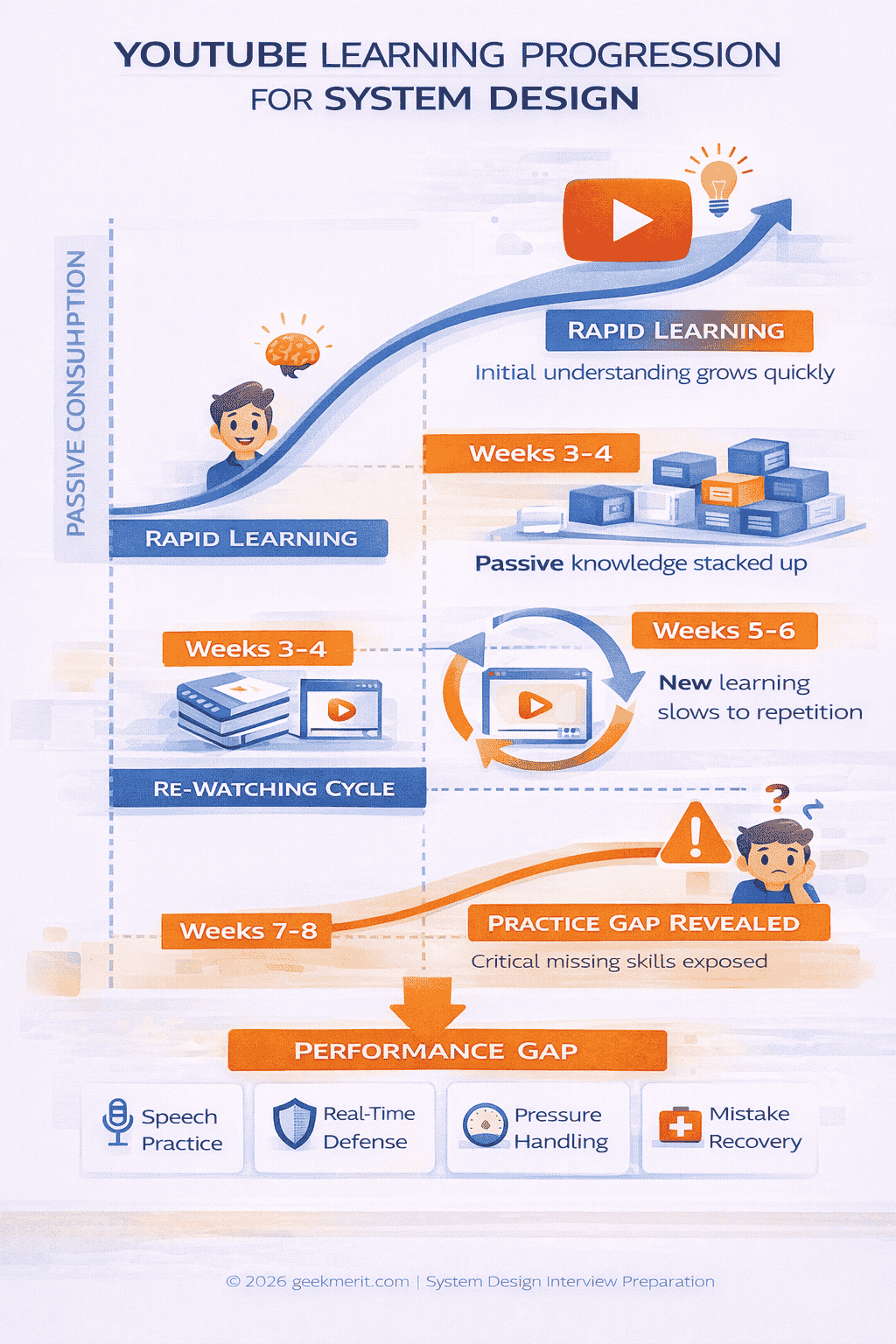
The Typical YouTube Learning Pattern
Here’s how most engineers use YouTube for system design preparation:
Week 1-2:
Discover a popular channel (Alex Xu, Gaurav Sen, System Design Interview). Watch introductory videos on common problems. Feel encouraged by clear explanations.
Week 3-4:
Jump between different creators based on specific topics. One instructor for database selection, another for caching strategies, a third for load balancing. Take notes on each approach.
Week 5-6:
Re-watch videos before practice sessions. Pause frequently to screenshot architecture diagrams. Copy terminology and component names into note-taking apps.
Week 7-8:
Attempt practice problems alone. Get stuck. Search for that
specific
problem on YouTube. Watch the solution. Feel relief at seeing the answer. Move to next problem.
Notice what’s missing?
Never speaking the solution out loud. Never defending choices. Never handling real-time pushback.
What YouTube Does Extremely Well
To be fair, YouTube serves critical functions in system design learning:
Breadth of exposure:
You can see hundreds of different problems solved across multiple architectural styles. This builds pattern recognition faster than any single course or book.
Multiple teaching styles:
If one instructor’s explanation doesn’t click, you can find five others covering the same concept from different angles. This flexibility helps diverse learners.
Visual learning:
System design is inherently visual. Watching diagrams being drawn in real-time helps many engineers internalize component relationships better than reading text.
Terminology acquisition:
You’ll hear industry-standard terms used in context repeatedly, which accelerates vocabulary building for interview discussions.
Free and accessible:
No financial barrier means you can explore broadly without commitment, which matters when you’re early in your preparation journey.
The Critical Gap YouTube Cannot Fill
Here’s where the limitation becomes severe:
Passive consumption creates a false sense of competence.
Watching someone solve a problem feels like understanding. Your brain processes their explanation. You nod along. The solution makes sense. You might even think, “I could’ve designed that.”
But when the interviewer asks, “Design Instagram’s newsfeed,” and you’re facing a blank whiteboard with 40 minutes on the clock, passive knowledge evaporates.
The specific skills YouTube doesn’t build:
-
Thinking out loud coherently:
Verbalizing your design process in real-time while someone listens -
Prioritization under constraint:
Deciding what to discuss in depth versus what to mention briefly, given time pressure -
Handling interviewer questions mid-design:
“What happens if that cache fails?” requires immediate, coherent response—not pausing the video -
Recovering from mistakes gracefully:
Realizing your initial approach won’t work and pivoting without losing composure -
Calibrating depth for seniority level:
Knowing when you’ve said “enough” versus when you’re glossing over expected details
YouTube shows you
what
the answer looks like. It doesn’t train you to
perform
under evaluation.
The YouTube Plateau Effect
Most engineers hit a wall around week 6-8 of YouTube-only preparation.
You’ve watched dozens of videos. You recognize patterns. You can identify when to use consistent hashing versus rendezvous hashing. You know CAP theorem trade-offs.
But in mock interviews (if you even do them), you freeze. Or ramble. Or jump to implementation details too quickly. Or fail to ask clarifying questions that seem obvious in retrospect.
This plateau happens because
YouTube optimizes for teaching concepts, not training performance
.
It’s the difference between watching Olympic sprinters and actually running against a stopwatch yourself. Both have value. But only one prepares you for race day.
What Changes With System Design Coaching
System design coaching isn’t “YouTube with a person.”
The difference is fundamental—and it addresses precisely the gaps that passive learning creates.
The Core Coaching Mechanism
Here’s what actually happens in effective system design coaching:
You speak first.
The coach gives you a problem. You start designing. Out loud. In real-time. While someone listens and evaluates.
This one shift—speaking instead of listening—changes everything.
Your brain engages differently when producing versus consuming. You discover gaps in your understanding immediately. You can’t hide behind “I sort of get it.”
The Three Mechanisms That Make Coaching Effective
Mechanism 1: Immediate Pattern Recognition Feedback
When you say something unclear, contradictory, or incomplete, the coach interrupts. Right then. Not after you finish. Not in a comment section days later.
“Wait—you said you’d use a relational database for user data, but then mentioned eventual consistency. Those conflict. Which did you mean?”
This immediate correction prevents you from reinforcing bad habits. With YouTube, you might repeat the same unclear explanation pattern in ten practice sessions before realizing it’s problematic.
Mechanism 2: Calibrated Difficulty Progression
Good coaches don’t give you random problems from YouTube playlists.
They start with foundational problems to establish your baseline. Then incrementally increase complexity—but only after you’ve demonstrated competence at the current level.
For example:
-
Session 1:
Design a URL shortener (establishes whether you can handle database selection, API design basics, and scale estimation) -
Session 2:
Design a rate limiter
(adds distributed systems concepts and algorithm selection) -
Session 3:
Design Instagram (tests ability to handle multiple components, prioritization, and trade-offs simultaneously) -
Session 4:
Design a distributed cache (focuses on consistency models and failure scenarios)
Each problem builds on demonstrated skills while exposing new challenges at the right pace.
Mechanism 3: Pressure Inoculation
Interviews create performance anxiety. Even senior engineers with years of experience report feeling nervous during system design rounds.
Coaching provides controlled exposure to evaluation pressure. You practice thinking clearly while someone watches, questions, and judges your approach.
This isn’t about memorizing answers. It’s about training your nervous system to function effectively under scrutiny—which YouTube simply cannot simulate.
What Good Coaching Actually Corrects
Let’s be specific about the exact failure patterns coaching addresses:
The “Requirements Skipping” Pattern
Many engineers jump straight to architecture without clarifying requirements. They assume functional requirements, then get derailed when the interviewer asks about scale or specific features.
A coach forces you to ask clarifying questions
before
designing. Every time. Until it becomes automatic.
The “Over-Engineering” Pattern
Senior engineers often design for massive scale immediately—because that’s interesting and demonstrates knowledge.
But interviews reward appropriate scoping. If the requirement is “100,000 users,” suggesting a multi-region deployment with custom distributed consensus shows poor judgment, not expertise.
Coaches calibrate your instinct for “how much is enough” at different seniority levels.
The “Implementation Dive” Pattern
Talking about data structures, algorithms, or code-level details too early signals weak system design instincts.
Effective coaching trains you to stay at the right altitude—discussing components, interfaces, and trade-offs first, only descending into implementation when explicitly prompted.
The “Rambling Monologue” Pattern
Some engineers talk continuously for 20 minutes without pausing for feedback or questions. This feels productive but actually signals poor communication skills.
Coaches interrupt you. They ask questions mid-design. They teach you to pause, invite input, and collaborate rather than presenting.
The “Freeze Under Pressure” Pattern
Other engineers go silent when questioned about trade-offs or edge cases. They need thinking time but don’t know how to verbalize uncertainty productively.
Coaching provides scripts for productive uncertainty: “That’s a good question. Let me think through the trade-offs between X and Y…” becomes automatic.
📊 Table: Coaching Impact on Specific Failure Patterns
This table breaks down the most common system design interview failures and how coaching specifically addresses each one. These patterns often remain invisible during YouTube-only preparation because there’s no feedback loop to expose them.
| Failure Pattern | Symptom in Interviews | YouTube Approach | Coaching Correction | Time to Fix |
|---|---|---|---|---|
|
Requirements Skipping |
Designing before understanding scope; getting derailed by interviewer questions 10 minutes in | Watch videos emphasizing requirements gathering; try to remember to do it | Coach stops you every time you skip clarification until it becomes automatic habit | 2-3 sessions |
|
Over-Engineering |
Suggesting complex distributed solutions for modest scale requirements | Assume bigger is better; videos often showcase impressive architectures | Coach calibrates “appropriate complexity” for stated requirements and seniority level | 3-4 sessions |
|
Implementation Diving |
Discussing data structures and algorithms before high-level architecture | Not clear when videos switch between levels; no feedback on your altitude | Coach redirects focus to components and interfaces; saves implementation for explicit prompts | 2-3 sessions |
|
Rambling Monologue |
Speaking for 15+ minutes without pausing; missing interviewer cues | Videos show smooth presentations; doesn’t reveal collaboration skill gaps | Coach interrupts frequently; teaches collaboration rhythm and pause discipline | 4-5 sessions |
|
Freezing Under Pressure |
Going silent when questioned about edge cases or trade-offs | Can pause video to think; pressure never simulated | Coach asks challenging questions in real-time; provides thinking-aloud scripts | 5-6 sessions |
|
Weak Trade-off Defense |
Stating choices without justification; crumbling when challenged | Videos explain trade-offs but don’t practice defending them under questioning | Coach challenges every design choice; requires articulated justification | 3-4 sessions |
The Speed Difference
Here’s the timeline comparison most engineers experience:
YouTube-only preparation to interview readiness:
Typically 10-16 weeks of consistent practice, including significant plateau periods and self-doubt phases.
Coaching-accelerated preparation to interview readiness:
Typically 4-8 weeks with focused practice, assuming baseline system design knowledge exists.
The difference isn’t intelligence or effort. It’s feedback density.
With YouTube, you might practice ten problems before discovering you’re consistently making the same communication mistake. With coaching, you discover it in the first session—and correct it in the second.
This matters enormously when you have limited interview windows or need to move quickly due to job market timing.
What Coaching Doesn’t Magically Fix
To be clear about limitations:
Coaching doesn’t replace foundational learning. If you don’t understand what a load balancer does or why databases have different consistency models, coaching sessions will be frustrating and inefficient.
You still need conceptual knowledge first. That’s where YouTube actually excels—building that initial understanding.
Coaching also doesn’t work if you don’t practice between sessions. The value comes from applying feedback repeatedly until new patterns replace old ones.
And coaching quality varies dramatically. A coach who simply watches you design and says “good job” provides minimal value. Effective coaching involves active questioning, pattern recognition, and progressive difficulty calibration.
Side-by-Side Reality Check
Let’s compare these approaches on the dimensions that actually matter for interview success.
Not vague generalities—specific, measurable differences.
The Comparison Framework
We’re evaluating on six critical dimensions:
-
Learning structure:
How content is organized and sequenced -
Feedback mechanism:
How you discover what you’re doing wrong -
Interview simulation fidelity:
How closely practice matches real conditions -
Speed to interview readiness:
Typical timeline from start to confident performance -
Senior-level calibration:
Understanding “enough depth” for your target role -
Cost-benefit profile:
What you’re actually paying for in each approach
📊 Table: System Design Coaching vs YouTube—What Actually Matters
This comparison focuses exclusively on interview performance factors. Both approaches have value, but they excel at different things. Use this table to identify which gaps you need to close based on where you are now.
| Dimension | YouTube Learning | System Design Coaching | Impact on Interview Success |
|---|---|---|---|
|
Learning Structure |
Self-directed, creator-dependent; requires curation discipline | Guided progression based on demonstrated competence |
Medium. Structure helps but isn’t success-determining |
|
Feedback Mechanism |
None (self-assessment only) | Immediate, personalized, pattern-correcting |
Critical. Fastest differentiation factor between approaches |
|
Interview Simulation |
Passive observation; no pressure simulation | Realistic evaluation pressure with questioning |
Critical. Performance under pressure determines pass/fail |
|
Speed to Readiness |
10-16 weeks (high variance) | 4-8 weeks (with baseline knowledge) |
High. Matters significantly with tight interview timelines |
|
Senior Calibration |
Guesswork; videos rarely specify seniority expectations | Explicit calibration to target level (senior/staff/principal) |
High. Wrong depth signals misleveling; can disqualify strong candidates |
|
Breadth of Exposure |
Unlimited problems and architectural patterns | Limited by session count and coach expertise |
Medium. Breadth helps but isn’t sufficient alone |
|
Cost |
Free (time investment only) | $100-300/hour typically |
Context-dependent. Depends on opportunity cost and timeline pressure |
|
Best For |
Building foundational knowledge; exploring breadth; long preparation timelines | Fixing execution gaps; high-stakes interviews; tight timelines; previous failures |
Use case determines value. Not one-size-fits-all |
Why “Interview Simulation Fidelity” Matters Most
Of all dimensions, this one predicts success most reliably.
System design interviews test your ability to perform under observation. Not your ability to understand concepts in private. Not your ability to study effectively. Your ability to
think clearly and communicate coherently while being evaluated
.
This is a distinct skill.
Athletes practice under game conditions. Musicians rehearse in front of audiences before performances. Surgeons train with simulations before operating on patients.
The same principle applies here. YouTube gives you knowledge. Coaching gives you performance training.
Neither is complete without the other—but if you only have time or budget for one approach, your timeline and risk tolerance should determine the choice.
The Hidden Variable: Your Starting Point
These comparisons assume you’re starting from roughly the same baseline knowledge in both scenarios.
But that’s not always true.
If you’re completely new to system design concepts, coaching will be frustrating. You’ll spend expensive session time learning definitions that YouTube could teach you for free.
Conversely, if you already understand concepts but struggle with interview execution, YouTube becomes increasingly inefficient. You’re not learning new information—you’re trying to fix performance gaps that passive content can’t address.
The right approach depends heavily on where you are now, not just where you want to go.
Decision Scenarios (Be Honest With Yourself)
Here’s how to make this decision based on your actual situation.
Not aspirational goals. Not what you
should
be. Your current reality.
Choose YouTube as Primary Approach If:
Scenario 1: You’re Early in Your System Design Journey
You’re still building mental models for distributed systems concepts. Terms like “consistent hashing,” “sharding,” and “eventual consistency” are new or fuzzy.
YouTube excels at foundational teaching. Watch systematically. Take notes. Build understanding before worrying about performance.
Scenario 2: You Have 6+ Months Before Interviews
Long timelines favor breadth-first learning. You can afford to explore different architectural patterns, watch multiple explanations of the same concept, and let understanding develop gradually.
Use YouTube for the learning phase. Add coaching later when interviews approach.
Scenario 3: You’re Building General Knowledge, Not Interview Prep
Maybe you’re not interviewing soon. You just want to understand how large-scale systems work—for your current job, for career development, or for intellectual curiosity.
YouTube serves this goal perfectly. No need for expensive coaching when you’re not optimizing for interview performance.
Scenario 4: Budget Constraints Are Absolute
If paying for coaching would create financial stress, don’t do it. YouTube plus disciplined self-practice can work—it just takes longer and requires more self-direction.
The stress of financial strain will hurt your interview performance more than coaching would help.
Choose Coaching as Primary Approach If:
Scenario 1: You’re Interviewing in the Next 4-8 Weeks
Short timelines require high-density feedback. You need to identify and fix failure patterns quickly—before your interview window closes.
Coaching compresses learning cycles. The efficiency gain justifies the cost when time is scarce.
Scenario 2: You’ve Failed System Design Rounds Before
Repeated failures signal execution problems, not knowledge gaps. You likely understand concepts but struggle with communication, pacing, or trade-off articulation.
These are performance issues. Watching more YouTube videos won’t fix performance issues—you need someone to identify and correct your specific failure pattern.
Scenario 3: You Struggle to Explain Designs Clearly Under Pressure
Some engineers think clearly but communicate poorly during evaluation. You know what to design but freeze, ramble, or lose coherence when someone’s watching.
This is fixable—but only with simulated pressure and immediate feedback. YouTube can’t provide either.
Scenario 4: The Opportunity Cost of Failure Is High
If this interview is for your dream company, a significant compensation increase, or a critical career move, the downside of failure outweighs coaching costs.
Think in expected value terms: If coaching increases your success probability from 40% to 70%, what’s that 30 percentage point difference worth in outcomes?
Scenario 5: Self-Directed Learning Hasn’t Worked Previously
If you’ve tried YouTube-based preparation before and hit a plateau, repeating the same approach expecting different results is inefficient.
Coaching provides the external structure and accountability that some engineers need to maintain progress.
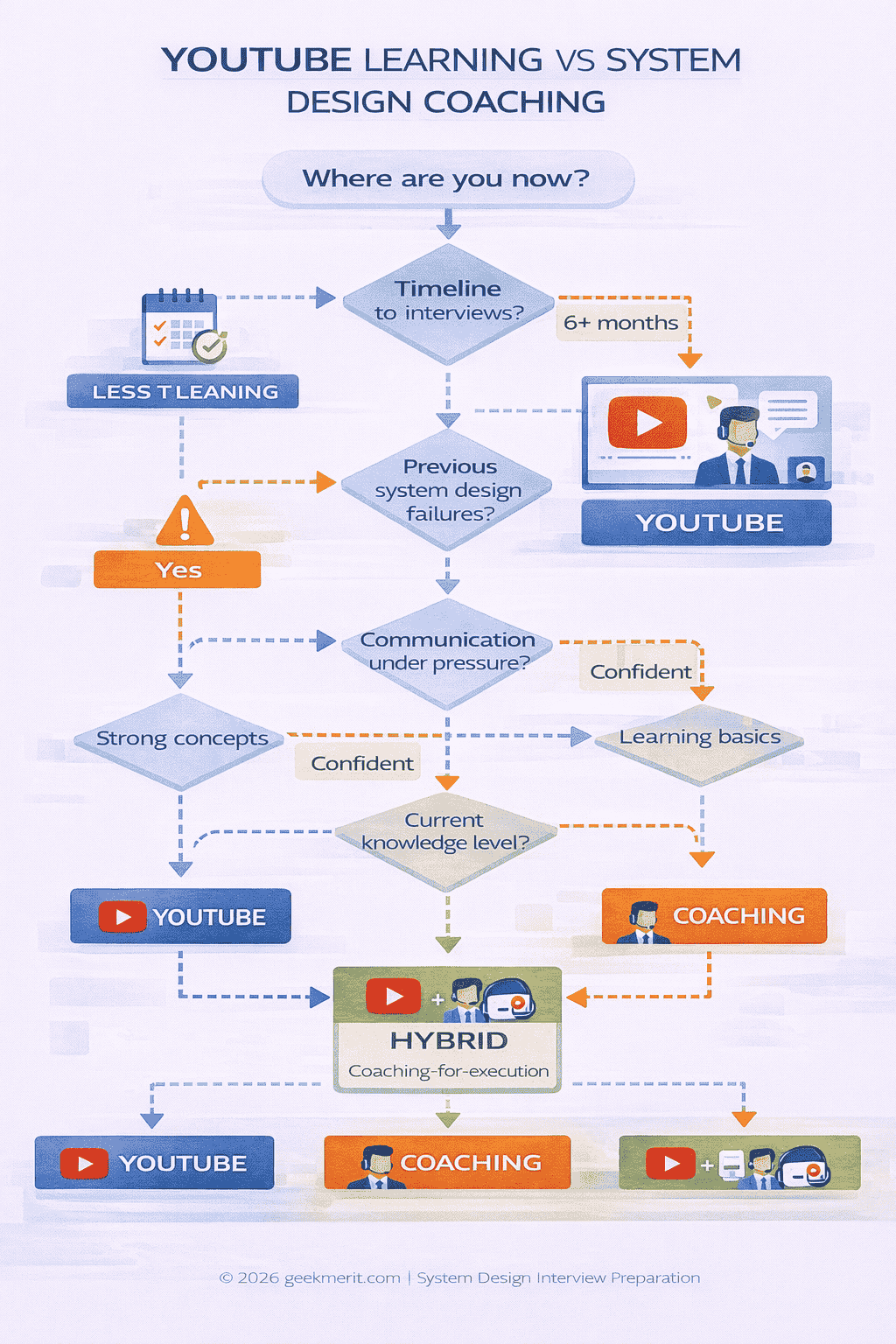
Choose a Hybrid Approach If:
Most engineers actually benefit from combining both methods strategically:
Phase 1 (Weeks 1-4): YouTube for Foundation
- Watch systematic courses on system design fundamentals
- Build vocabulary and pattern recognition
- Understand common architectural components
- Take notes on design trade-offs
Phase 2 (Weeks 5-8): Coaching for Execution
- Book 4-6 coaching sessions to practice real problems
- Get feedback on communication style and pacing
- Identify and correct failure patterns
- Build confidence under simulated pressure
Phase 3 (Weeks 9-12): YouTube for Breadth, Coaching for Refinement
- Use YouTube to explore new problem types
- Use final coaching sessions for polish and edge case handling
- Alternate between learning and performance practice
This hybrid model optimizes cost-effectiveness. You don’t pay for coaching when YouTube suffices (conceptual learning), but you invest in coaching when it provides maximum value (execution training).
Why Many Senior Engineers Still Fail
Let’s address the uncomfortable pattern nobody talks about openly.
Experienced engineers—people who’ve built real distributed systems, who’ve been promoted multiple times, who’ve led teams—
fail system design interviews
regularly.
This isn’t about intelligence or capability. It’s about execution mismatch.
The Experience Paradox
Here’s what creates the problem:
Real-world system design happens over weeks or months. You write design documents. You iterate in code reviews. You discuss trade-offs asynchronously in Slack threads. You have time to research unfamiliar technologies before choosing them.
Interview system design happens in 45 minutes. You verbalize assumptions immediately. You defend choices under real-time questioning. You make technology decisions without Google. You communicate your entire thought process while someone evaluates every word.
These are fundamentally different activities.
Your production experience doesn’t automatically translate because the
format
is different, even though the
content
overlaps significantly.
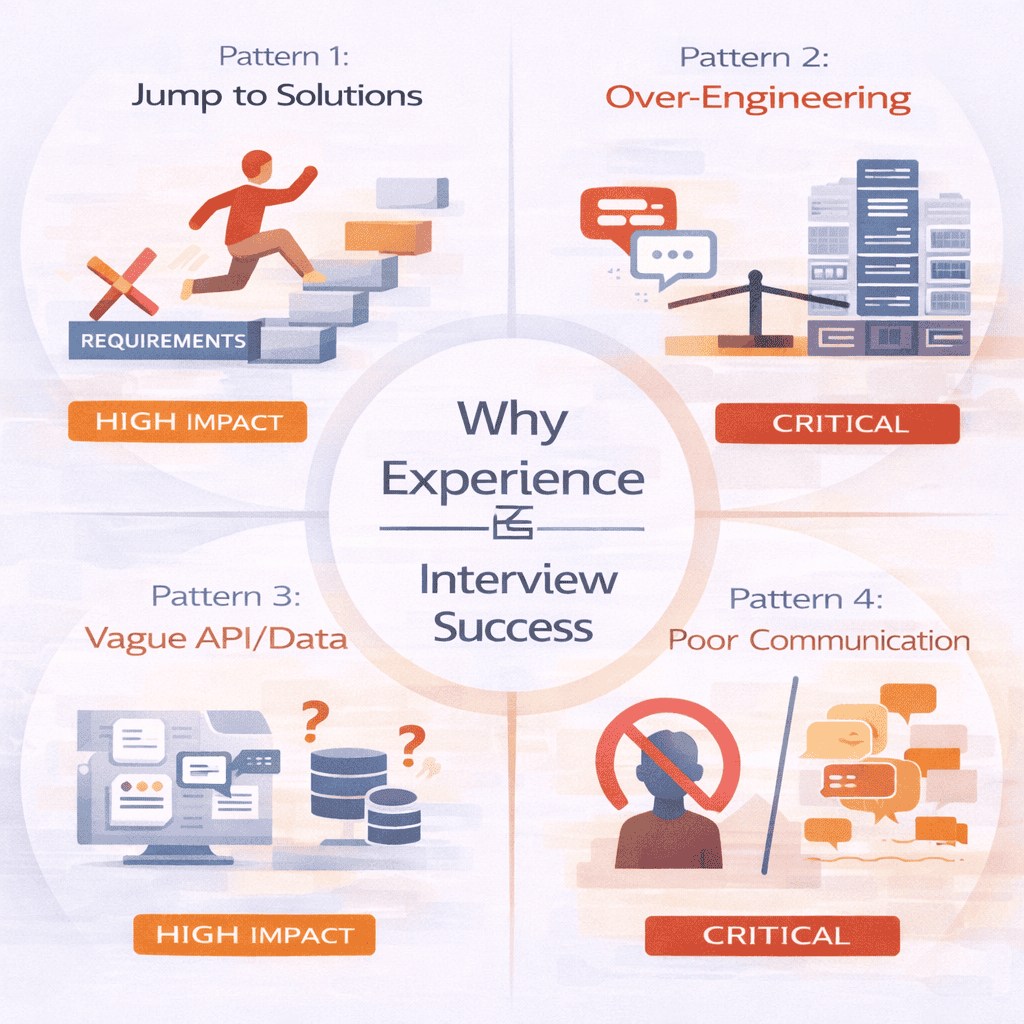
The Four Common Failure Patterns
Pattern 1: Jumping to Solutions Too Fast
Senior engineers have built systems before. When you hear “design Twitter,” your brain immediately recalls similar architectures you’ve worked on.
So you start designing. Microservices, message queues, caching layers—you’re drawing boxes and arrows within three minutes.
But you skipped the requirements clarification phase entirely. The interviewer wanted to focus on the newsfeed ranking algorithm, but you’ve already designed the entire infrastructure stack.
This signals poor communication instincts, not strong technical skills.
Pattern 2: Over-Designing Without Constraints
You’ve worked at companies handling millions of requests per second. You know what real scale looks like.
So when the problem says “1 million daily active users,” you design for 100 million. Because you can. Because it’s more interesting. Because it demonstrates knowledge.
But the interviewer is evaluating your judgment, not your knowledge of advanced techniques.
Designing appropriate solutions for stated requirements shows better engineering instincts than over-engineering for unstated scale.
Pattern 3: Weak API and Data Model Explanations
Many senior engineers gloss over API design and data modeling, treating them as obvious or unimportant.
“We’ll have a REST API for posting tweets, and we’ll store them in a database.”
But interviewers expect specificity here:
- What are the exact API endpoints?
- What fields does the tweet object contain?
- What indexes does the database need?
- How do you handle tweet editing versus versioning?
Vague handwaving in this area suggests shallow thinking, even if your infrastructure design is sophisticated.
Pattern 4: Poor Communication Flow
This is the subtlest but most common failure mode.
You know what to design. You understand the trade-offs. But you communicate in one of two broken patterns:
-
The Silent Thinker:
You design mentally for 5-10 minutes with minimal verbalization, then present a complete solution. The interviewer has no visibility into your thought process and can’t guide you if you’re heading in an unproductive direction. -
The Stream-of-Consciousness Speaker:
You verbalize every thought as it occurs, jumping between abstraction levels, backtracking frequently, and never establishing clear structure. The interviewer struggles to follow your logic.
Neither pattern demonstrates the collaborative communication that senior roles require.
Why These Patterns Persist
Here’s why experienced engineers struggle to self-correct:
Invisible Feedback Loops
In your job, bad communication eventually surfaces through code reviews, design discussions, or project retrospectives. You get feedback, but it’s delayed and indirect.
In interviews, you get binary feedback: hired or not hired. You rarely learn which specific behavior caused the rejection.
Without visibility into failure causes, you can’t systematically improve.
Success in Other Contexts
You’ve been successful in your career. Your architecture decisions work in production. Your teams respect your technical judgment.
This creates confirmation bias: “I’m good at system design” becomes “I should be good at system design interviews.”
But the interview format requires different skills than day-to-day engineering—and success in one doesn’t guarantee success in the other.
Practice Without Correction
Many engineers practice by solving problems alone, then comparing their solution to YouTube videos.
But if you have a communication problem (talking too much, talking too little, poor structure), solo practice reinforces the bad habit. You’re getting repetitions, but you’re practicing the wrong thing.
This is why YouTube-only preparation can plateau. You’re refining an approach that’s fundamentally flawed for the interview context.
The Specific Gaps YouTube Cannot Address
Let’s be explicit about what passive learning misses:
Real-Time Calibration
When you over-engineer a solution, you need someone to interrupt you
while you’re doing it
and say: “Stop. This is too complex for the stated requirements. Scale back.”
YouTube can’t do this. You watch entire solutions that might be overbuilt, but you don’t get real-time correction on your own tendency to over-engineer.
Pressure-Induced Mistakes
Some mistakes only surface under evaluation pressure. You might communicate clearly when practicing alone, but freeze or ramble when someone’s watching.
YouTube practice is zero-pressure. It doesn’t reveal how you perform when stakes are real.
Blind Spot Identification
Everyone has communication blind spots—patterns they can’t see in themselves. Maybe you use jargon excessively. Maybe you skip logical steps. Maybe you fail to summarize before diving into details.
These patterns are invisible to you but obvious to external observers. YouTube provides no mechanism for blind spot discovery.
The Smart Hybrid Approach
Most successful candidates don’t choose one method exclusively.
They use YouTube and coaching strategically—each for what it does best.
The Optimal Preparation Sequence
Here’s the timeline that minimizes wasted effort and maximizes interview readiness:
Weeks 1-3: Foundation Building (YouTube Primary)
Focus on conceptual understanding:
-
Watch systematic courses on
distributed systems fundamentals
- Learn component vocabulary (load balancers, caches, databases, message queues)
- Understand basic scaling patterns (vertical vs. horizontal, sharding, replication)
- Study CAP theorem and consistency models
- Review common architectural patterns (microservices, event-driven, CQRS)
Goal: Build enough knowledge that you can discuss components and trade-offs without constantly googling basic concepts.
Don’t worry about performance yet. Just absorb information.
Weeks 4-5: Self-Practice (YouTube + Solo Work)
Start attempting problems independently:
- Choose 5-7 common problems (URL shortener, rate limiter, newsfeed, chat system)
- Design solutions alone, speaking out loud to yourself
- Compare your approach to YouTube solutions
- Note gaps in your thinking versus expert solutions
Goal: Identify where your understanding is solid versus shaky. Build initial pattern recognition.
You’ll likely discover that watching solutions is easier than creating them. That’s expected.
Weeks 6-8: Coaching Intensive (Primary Focus Shift)
Now invest in 4-6 coaching sessions:
-
Session 1:
Baseline assessment. The coach identifies your specific failure patterns. -
Session 2-3:
Targeted correction. Practice problems chosen to fix identified weaknesses. -
Session 4-5:
Progressive difficulty. More complex problems as execution improves. -
Session 6:
Mock interview under realistic conditions. Final calibration before real interviews.
Between sessions, practice alone applying feedback. The coaching value multiplies when you actively work to correct identified patterns.
Weeks 9-12: Refinement (Hybrid Balance)
Final preparation phase:
- Use YouTube to explore edge cases and less common problems
- Schedule 1-2 additional coaching sessions for specific weak areas
- Practice with peers if possible (mutual mock interviews)
- Review common mistakes and your personal failure patterns before each real interview
Goal: Polish existing skills rather than learning new concepts. Focus on consistency and confidence.
📥 Download: 12-Week Hybrid Preparation Roadmap
This downloadable roadmap breaks down the optimal hybrid approach week by week, showing exactly when to use YouTube versus coaching, what topics to focus on at each stage, and how to transition from learning to performance training. Print it out and track your progress as you prepare.
Cost Optimization Strategy
Coaching is expensive. Here’s how to maximize value per dollar:
Don’t Waste Sessions on Conceptual Learning
Never book a coaching session to “learn what a load balancer does.” That’s a $200+ mistake.
Use YouTube for concept introduction. Use coaching only when you already understand concepts but need execution feedback.
Batch Questions Between Sessions
During solo practice, accumulate specific questions:
- “I’m unsure whether to discuss database replication in depth or mention it briefly—what’s appropriate for senior level?”
- “When the interviewer asks ‘how do you handle failures?’ how much detail should I provide?”
- “I keep forgetting to ask about latency requirements—how do I make this automatic?”
Address multiple targeted questions per session rather than general “coach me on system design” requests.
Record Sessions and Review
Most coaches allow recording (ask permission first). Review recordings to identify patterns:
- Do you use filler words excessively?
- How long do you speak before pausing?
- Are your explanations clear or meandering?
- Do you handle questions confidently or defensively?
One session’s recording can provide feedback for weeks of self-practice.
Use Group Coaching When Available
Some coaches offer group sessions at reduced rates (often $50-100 instead of $200-300). You get less individual attention but still benefit from:
- Watching others make mistakes and get corrected
- Learning from peers’ questions
- Simulated interview pressure with audience observation
Consider 2-3 individual sessions plus 2-3 group sessions as a cost-effective hybrid.
When to Use Each Resource
Here’s the decision framework for any given preparation activity:
📊 Table: YouTube vs Coaching—Task-Specific Decision Guide
Use this reference whenever you’re deciding whether to use YouTube or book a coaching session for a specific preparation activity. The right choice depends on what you’re trying to accomplish.
| Activity | Best Resource | Reasoning |
|---|---|---|
| Learning what consistent hashing is |
YouTube |
Conceptual understanding; no performance component; free resource suffices |
| Understanding when to choose SQL vs NoSQL |
YouTube |
Knowledge acquisition; can learn through multiple examples at your own pace |
| Practicing explaining your database choice out loud |
Coaching |
Performance skill; requires real-time feedback on clarity and justification |
| Seeing how to design a URL shortener |
YouTube |
Pattern learning; watching expert solutions builds mental models |
| Practicing designing a URL shortener yourself |
Solo practice |
Application of knowledge; do this before coaching to identify gaps |
| Getting feedback on YOUR URL shortener design |
Coaching |
Correction and calibration; coach identifies specific improvements |
| Understanding different caching strategies |
YouTube |
Conceptual learning; multiple video explanations help build understanding |
| Learning when you’ve explained “enough” about caching |
Coaching |
Calibration skill; requires external perspective on appropriateness |
| Discovering what questions to ask at interview start |
YouTube |
Framework learning; many videos cover clarifying questions |
| Building habit of asking clarifying questions automatically |
Coaching |
Behavior training; requires repetition with accountability |
| Seeing tradeoff discussions in expert solutions |
YouTube |
Example observation; builds vocabulary and pattern awareness |
| Practicing defending YOUR tradeoff choices under questioning |
Coaching |
Performance under pressure; requires adversarial questioning |
| Exploring breadth of problem types |
YouTube |
Exposure building; YouTube’s unlimited content enables broad exploration |
| Identifying your specific failure pattern |
Coaching |
Blind spot discovery; requires external expert observation |
The Peer Practice Middle Ground
Between YouTube and paid coaching exists another option:
peer mock interviews
.
Find other engineers preparing for interviews (through communities like Blind, Reddit’s r/cscareerquestions, or company Slack channels). Schedule reciprocal mock interviews.
What peer practice provides:
- Simulated pressure of speaking to another person
- Practice handling interruptions and questions
- Exposure to different communication styles
- Accountability and structure
- Zero financial cost
What peer practice lacks:
- Expert pattern recognition (your peer might not spot your failure modes)
- Seniority-level calibration (peer might not know what “enough depth” means)
- Progressive difficulty sequencing (random problem selection)
- Consistent quality (depends entirely on peer’s skill and commitment)
Use peer practice as a supplement, not a replacement. It bridges the gap between YouTube and coaching but doesn’t fully substitute for either.
Your Decision Framework
Here’s how to make this decision systematically, based on your specific situation.
Not general advice. Your actual constraints and goals.
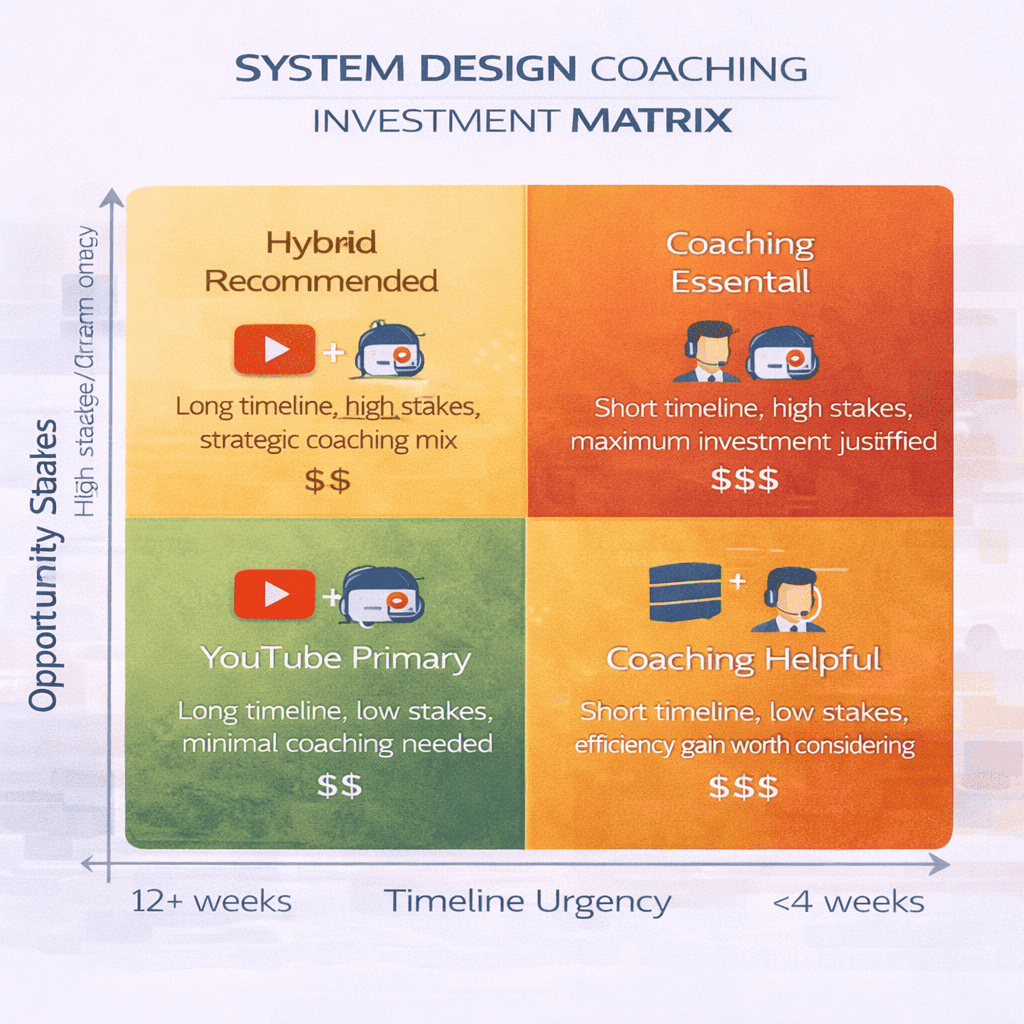
The Four-Question Decision Model
Question 1: What’s Your Interview Timeline?
This is the highest-weighted factor in the decision.
-
Less than 4 weeks:
Coaching becomes essential unless you’re already interview-ready. YouTube alone won’t close execution gaps fast enough. -
4-8 weeks:
Hybrid approach optimal. YouTube for breadth, coaching for targeted correction. -
8-12 weeks:
YouTube primary with coaching in final 4 weeks. Time allows thorough conceptual learning first. -
12+ weeks:
YouTube sufficient for most of preparation. Add coaching in final month for polish and confidence.
Timeline pressure changes the calculation because coaching provides faster feedback density. When time is abundant, you can afford slower self-directed learning.
Question 2: Have You Failed System Design Rounds Before?
Previous failures are the strongest signal that your approach needs intervention.
-
No previous failures:
YouTube-heavy approach reasonable. You haven’t proven that execution is your bottleneck. -
1 previous failure:
Consider coaching for pattern identification. One failure might be interview-specific bad luck, but it’s worth investigating. -
2+ previous failures:
Coaching highly recommended. Repeated failures indicate systematic execution problem that passive learning won’t fix.
Each failure likely reflects the same underlying pattern (communication, pacing, depth calibration). Coaching identifies that pattern explicitly.
Question 3: How Well Do You Communicate Under Evaluation Pressure?
Honest self-assessment here is critical:
-
Confident communicator:
You speak clearly in meetings, present to executives comfortably, handle tough questions well. YouTube-heavy approach works. -
Situational confidence:
You’re fine in familiar contexts but uncertain under evaluation. Coaching helps build interview-specific confidence. -
Struggle under pressure:
You freeze, ramble, or lose coherence when being evaluated. Coaching becomes high-priority for pressure inoculation.
Many engineers underestimate this factor. Technical knowledge is necessary but not sufficient—interview success requires clear communication under scrutiny.
Question 4: What’s the Opportunity Cost of Failure?
Think in expected value terms:
-
Low stakes:
Exploratory interview, not your dream company, other opportunities available. YouTube-only acceptable. -
Medium stakes:
Good opportunity but not unique. Hybrid approach balances investment with return. -
High stakes:
Dream company, major compensation increase, or limited interview chances. Coaching cost is rounding error compared to downside of failure.
If passing this interview is worth $50K+ in compensation difference, spending $1-2K on coaching is asymmetrically favorable.
Calculating Your Coaching ROI
Here’s how to think about coaching cost versus benefit:
Direct Financial Comparison
Typical coaching investment: $1,200-1,800 for 6 sessions
Typical compensation impact of passing vs. failing senior+ interview: $30,000-100,000+ (base salary difference, equity, bonus)
If coaching increases your success probability by even 10-20 percentage points, the expected value is massively positive.
Time Value Consideration
YouTube-only preparation: 12-16 weeks average to interview readiness
Coaching-accelerated preparation: 6-10 weeks average to interview readiness
Time saved: 6-8 weeks of evenings and weekends
For senior engineers, that time has significant opportunity cost—either in current job performance, side projects, or personal life quality.
Confidence Premium
This is harder to quantify but real: entering interviews confident versus anxious changes performance.
Coaching provides external validation that you’re ready. YouTube-only preparation often leaves lingering doubt: “Have I practiced enough? Am I doing this right?”
Reduced anxiety improves interview performance independent of skill level.
Red Flags: When NOT to Choose Coaching
Coaching isn’t always the right answer. Avoid it if:
You Haven’t Done Basic YouTube Learning
Don’t pay $200-300/hour to learn what a CDN is. That’s inefficient resource allocation.
Build foundational knowledge first through free resources, then use coaching for execution training.
You’re Not Willing to Practice Between Sessions
Coaching accelerates improvement, but only if you apply feedback through deliberate practice.
If you won’t practice between sessions, you’re wasting money. The learning happens in application, not just in session exposure.
Financial Stress Outweighs Interview Stakes
If coaching cost creates genuine financial hardship, don’t do it. The stress will hurt your interview performance more than coaching helps.
YouTube plus disciplined self-practice can work—it just requires more time and self-direction.
You’re Shopping for Interview Answers
Some candidates want coaches to give them memorizable solutions to common problems.
That’s not what good coaching provides. Coaches teach thinking processes and communication patterns, not answer templates.
If you want answer scripts, YouTube actually serves that goal better (and cheaper).
Making the Final Call
Use this scoring system if you’re still uncertain:
📊 Table: Coaching Decision Scorecard
Score each factor honestly, then add your total. This quantifies your decision instead of relying on gut feel.
| Factor | Your Situation | Points |
|---|---|---|
|
Interview Timeline |
Less than 4 weeks 4-8 weeks 8-12 weeks 12+ weeks |
+5 +3 +1 0 |
|
Previous Failures |
2+ system design failures 1 previous failure No previous failures |
+5 +2 0 |
|
Communication Under Pressure |
Freeze or ramble when evaluated Situational confidence Always communicate clearly |
+4 +2 0 |
|
Opportunity Stakes |
Dream company / major comp increase Good opportunity, not unique Exploratory, many alternatives |
+4 +2 0 |
|
Self-Directed Learning Success |
Struggle with structure/discipline Moderate success solo Excel at teaching yourself |
+3 +1 -2 |
|
Budget Flexibility |
Coaching cost creates hardship Manageable but significant Easily affordable |
-5 0 +2 |
|
YOUR TOTAL SCORE: |
___ |
|
Score Interpretation:
-
15+ points:
Coaching highly recommended. Your situation strongly favors investment. -
10-14 points:
Coaching beneficial. Consider 4-6 sessions in hybrid approach. -
5-9 points:
Hybrid approach. Mostly YouTube with 1-3 coaching sessions for specific gaps. -
0-4 points:
YouTube primary. Self-directed learning appropriate for your situation. -
Negative points:
YouTube only. Financial constraints or learning style make coaching inefficient.
Implementation Timeline
Once you’ve decided on your approach, here’s how to execute:
If You Chose YouTube Primary:
- Select 2-3 systematic YouTube courses (not random videos). Follow them sequentially.
- Create a study schedule with specific topics per week. Treat it like a course.
- Practice problems alone after learning each concept. Build the habit of speaking out loud.
- Join online communities for peer practice opportunities in weeks 8-10.
- Consider 1-2 coaching sessions in final 2 weeks for calibration check.
If You Chose Coaching Primary:
- Complete 2-3 weeks of YouTube fundamentals first. Don’t waste coaching time on basic concepts.
- Book initial coaching session for baseline assessment. Ask coach to identify your specific failure pattern.
- Schedule remaining sessions weekly with practice days between. Spacing aids retention.
- After each session, practice the specific correction 3-5 times before next session.
- Use YouTube between sessions to explore problems similar to coaching topics.
If You Chose Hybrid Approach:
- Weeks 1-3: YouTube foundation building. 1-2 hours daily, systematic curriculum.
- Week 4: Self-practice 5-7 problems. Document where you struggle.
- Week 5: Book first coaching session. Come with specific questions from self-practice.
- Weeks 6-8: Alternate coaching sessions with focused practice days. Apply feedback immediately.
- Weeks 9-10: YouTube for breadth, final coaching session for mock interview.
Making the Right Choice for Your Timeline
This decision isn’t about which resource is “better.”
Still deciding whether paying for coaching makes sense in your situation?
Read Is System Design Interview Coaching Worth It?.
It’s about which tool fits your specific situation: timeline, failure history, communication confidence, and opportunity stakes.
What This Guide Showed You
YouTube teaches concepts. Coaching teaches performance.
Both have value. Neither is complete alone.
The engineers who succeed fastest use both strategically—YouTube for knowledge breadth, coaching for execution depth.
The Core Insight
System design interviews don’t test what you know. They test how clearly you think and communicate under evaluation pressure.
Passive learning builds knowledge. Active feedback builds performance.
If your interview is months away, you have time to learn through exposure. If your interview is weeks away, you need targeted correction now.
Your Next Step
Don’t overthink this decision. Choose based on your honest answers to the four key questions:
- How much time do you have?
- Have you failed system design rounds before?
- How well do you communicate under pressure?
- What’s at stake if you fail?
Your answers determine the right path.
If you’re still uncertain, default to the hybrid approach: YouTube for foundations,
coaching for execution training
in the final 4-6 weeks before interviews.
This balances cost efficiency with performance optimization—and it’s how most successful candidates actually prepare.
Resources to Get Started
Regardless of which path you choose, these resources will help:
For YouTube-focused preparation:
- Start with systematic courses (Alex Xu, Gaurav Sen, System Design Interview channel)
- Create a study schedule and stick to it—random video consumption is inefficient
- Practice speaking solutions out loud even when alone
- Join system design practice communities for peer feedback
For coaching-focused preparation:
- Complete basic YouTube learning before first session to maximize coaching value
- Come to sessions with specific questions from self-practice
- Record sessions (with permission) and review to identify patterns
- Practice daily between sessions—feedback only helps if you apply it
For both approaches:
- Focus on execution quality over problem quantity
- Build the habit of clarifying requirements before designing
- Practice explaining trade-offs, not just making design choices
- Simulate realistic time pressure in final preparation weeks
The path matters less than consistent execution. Choose your approach, commit to it, and work the process systematically.
Final Thought
Most senior engineers underestimate how different interview performance is from day-to-day engineering.
Your production systems work. Your technical judgment is sound. Your teams trust your designs.
But interviews test communication and structured thinking under time pressure—not just technical knowledge.
Understanding this distinction is the first step. Addressing it systematically through the right preparation method is the second step.
You now have the framework to make that decision intelligently.
Choose based on your situation, not on generic advice. Execute consistently. Trust the process.
The right preparation approach, applied diligently, will get you through system design interviews—regardless of which resource mix you choose.
Frequently Asked Questions
Can I pass senior-level system design interviews using only YouTube for preparation?
Yes, but it typically takes longer (10-16 weeks versus 6-10 weeks with coaching) and requires strong self-discipline. YouTube excels at teaching concepts and patterns, but you’ll need to create your own feedback mechanisms through peer practice or recording yourself to identify communication gaps. The success rate is lower for engineers who struggle with speaking clearly under pressure or who have failed previous system design rounds.
How many coaching sessions do I actually need to be interview-ready?
Most engineers benefit from 4-6 sessions spread over 3-4 weeks, assuming baseline system design knowledge already exists. The first session identifies your specific failure pattern, sessions 2-4 correct that pattern through targeted practice, and sessions 5-6 provide progressive difficulty and mock interview experience. Fewer sessions work if you only need calibration; more sessions help if you’re starting with significant communication or structural issues.
What if I can’t afford coaching—does that mean I’ll fail interviews?
Absolutely not. Budget constraints don’t determine interview outcomes—execution quality does. Focus on YouTube for conceptual learning, practice problems while speaking out loud, record yourself to identify communication patterns, and find peer practice partners through online communities. The YouTube-only path takes longer and requires more self-direction, but it’s completely viable. Thousands of engineers pass senior system design interviews every year using only free resources.
How do I know if my failure pattern is something coaching can actually fix?
Coaching addresses execution problems: unclear communication, poor pacing, weak trade-off articulation, freezing under pressure, over-engineering, or inadequate depth calibration. If you understand system design concepts but struggle to explain your thinking clearly during interviews, coaching helps significantly. If you lack fundamental distributed systems knowledge (don’t understand what load balancers or databases do), start with YouTube learning first—coaching won’t fix knowledge gaps efficiently.
Is watching YouTube creators who are ex-FAANG engineers as good as paying for coaching from them?
No, because the format creates different learning outcomes. Watching their YouTube content teaches you what expert solutions look like—valuable for pattern recognition. Coaching from the same person forces you to perform under their observation and gives you immediate correction on your specific execution problems. The YouTube version is passive consumption; the coaching version is active performance training with personalized feedback. Both have value, but they develop different skills.
Should I wait until I’ve watched all YouTube content before starting coaching sessions?
No—that’s inefficient. Complete 2-3 weeks of foundational YouTube learning (enough to understand core components, scaling patterns, and common trade-offs), then start coaching. Coaching identifies your failure patterns early, which makes subsequent YouTube learning more targeted—you’ll watch content specifically addressing your weak areas. Waiting until you’ve consumed all YouTube content before getting feedback means potentially reinforcing bad habits for months.
Citations
Content Integrity Note
This guide was written with AI assistance and then edited, fact-checked, and aligned to expert-approved teaching standards by
Ram Arun
. Ram has over 10 years of experience coaching software developers through technical interviews at top-tier companies including FAANG and leading enterprise organizations. His background includes conducting 500+ mock system design interviews and helping engineers successfully transition into senior, staff, and principal roles. Technical content regarding distributed systems, architecture patterns, and interview evaluation criteria is sourced from industry-standard references including engineering blogs from Netflix, Uber, and Slack, cloud provider architecture documentation from AWS, Google Cloud, and Microsoft Azure, and authoritative texts on distributed systems design.

