
System Design Interview Communication: The Complete Guide to Explaining Your Design Clearly

You know how to design scalable systems. But when you step into a system design interview communication scenario your mind…
Here’s the uncomfortable truth most senior engineers fail system design interviews not because they lack technical knowledge but because they…
This guide teaches you a repeatable communication framework that works under pressure helping you sound deliberate and senior-level regardless of…
Last updated: Feb. 2026
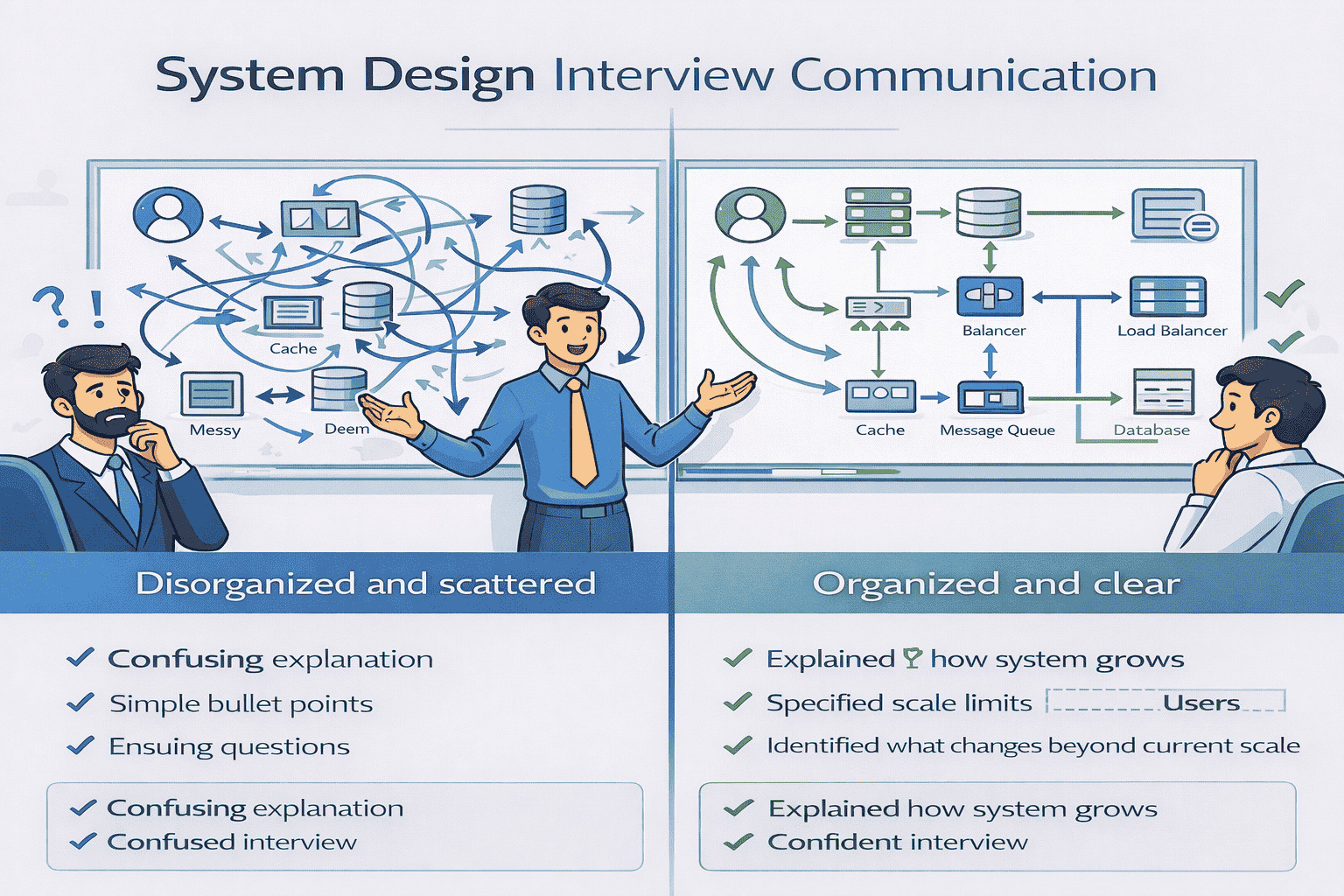
Table of Contents
- 1. Why Technically Strong Engineers Struggle to Communicate Design
- 2. Step 1: Clarify the Problem Before You Design Anything
- 3. Step 2: Set the Design Context Out Loud
- 4. Step 3: Explain the High-Level Design First
- 5. Step 4: Introduce APIs and Data Flow Clearly
- 6. Step 5: Communicate Trade-Offs Deliberately
- 7. Step 6: Handle Scalability and Bottlenecks Out Loud
- 8. Step 7: Respond to Follow-Up Questions Without Losing Structure
- 9. Step 8: Close the Design with a Clear Summary
- 10. FAQs
Contents








Why Technically Strong Engineers Struggle to Communicate Design
System design interviews test communication far more than they test architecture knowledge Interviewers already assume you understand distributed systems databases and caching strategies…
Most engineers approach these interviews backward They believe mastering technical depth learning Kafka internals studying CAP theorem edge cases memorizing…
They know what to design. They cannot explain how they got there.
The Communication Gap: What Actually Happens
You walk into the interview The interviewer asks you to design a URL shortener Simple enough You’ve built similar systems…
Then the interviewer interrupts: “How will you handle 10,000 writes per second?”
You freeze Not because you don’t know the answer you’ve implemented write-heavy systems before but because you haven’t structured your…
The interviewer looks confused. You lose confidence. The interview spirals.
Why This Happens to Experienced Engineers
Senior developers often struggle more than mid-level engineers in system design interviews This sounds counterintuitive until you understand the root…
In production work you solve problems iteratively You spike solutions run experiments refactor based on metrics You have time to…
Interviews reverse this You must narrate your thinking in real-time while designing synchronously You cannot pause to research You cannot…
Production problem-solving and interview problem-solving are fundamentally different skills.
???? Table: Production Work vs Interview Communication
Understanding the stark differences between how you work in production and how you must communicate in interviews helps explain why…
| Aspect | Production Work | Interview Context |
|---|---|---|
| Time Pressure | Days or weeks to design | 35-40 minutes total |
| Communication Style | Written docs, async reviews | Live verbal explanation |
| Decision Validation | Experiments, metrics, spikes | Hypothetical reasoning only |
| Interruptions | Minimal during deep work | Constant constraint changes |
| Completeness | Iterative, can refactor later | Must seem complete in one pass |
| Collaboration | Team consensus over days | Real-time dialogue with interviewer |
What Interviewers Are Actually Evaluating
When you walk into a system design interview the interviewer has a mental scorecard They’re not just checking whether you…
1. Structured Thinking: Can you break down ambiguous problems into clear requirements Do you ask the right clarifying questions before…
2. Narrative Clarity: Can you explain a complex system in a logical sequence Do you walk through components one at…
3. Trade-Off Articulation: When you make architectural decisions can you explain what you’re gaining and what you’re sacrificing Do you…
4. Collaborative Adaptability: When the interviewer adds constraints or questions your choices can you pivot gracefully Do you defend your…
5. Appropriate Depth: Do you know when to go deep and when to stay high-level Can you gauge what the…
Notice what’s missing from this list deep technical knowledge The interviewer assumes you already have it What they’re testing is…
The Core Problem: Implicit vs Explicit Communication
In production much of your architectural reasoning stays implicit You sketch a diagram in Confluence You mention we’ll use Redis…
In interviews everything must be explicit You cannot assume the interviewer knows why you chose Redis over Memcached You cannot…
This shift from implicit to explicit communication is exhausting. It feels unnatural. But it’s the entire game.
What This Guide Teaches You
If your current plan is mostly videos + random practice, compare your options here: System Design Coaching vs YouTube for Interview Prep.
This guide provides a step-by-step communication protocol for system design interviews It treats communication as a technical skill you can…
Each section answers one question: What exactly should I say, and in what order?
You’ll learn:
- A repeatable clarification framework that prevents misalignment before you start designing
- Exact phrasing templates for explaining components, data flow, and trade-offs
- Techniques for handling interruptions and constraint changes without losing your structure
- A closing summary protocol that leaves a strong, confident final impression
By the end you’ll have a communication playbook you can apply to any system design interview regardless of the specific…
Step 1: Clarify the Problem Before You Design Anything
The first 5-7 minutes of a system design interview determine everything that follows This is when you establish shared understanding with your interviewer This is when you prevent…
Most candidates rush this phase They hear design Twitter and immediately start drawing boxes They lose the interview in the…
Here’s what happens they design a full-featured social network with feeds mentions and trending topics The interviewer wanted a simplified…
Why Clarification Determines Interview Success
System design problems are intentionally ambiguous. “Design a URL shortener” could mean:
- A simple key-value store with redirect logic
- A link analytics platform with click tracking and geography data
- An enterprise-grade system supporting custom domains and expiration policies
Which version should you design? You cannot know without asking. The interviewer will not clarify unless you explicitly request it.
Candidates who skip clarification make two fatal mistakes First they solve the wrong scope wasting precious time on features the…
The Clarification Framework: What to Ask and When
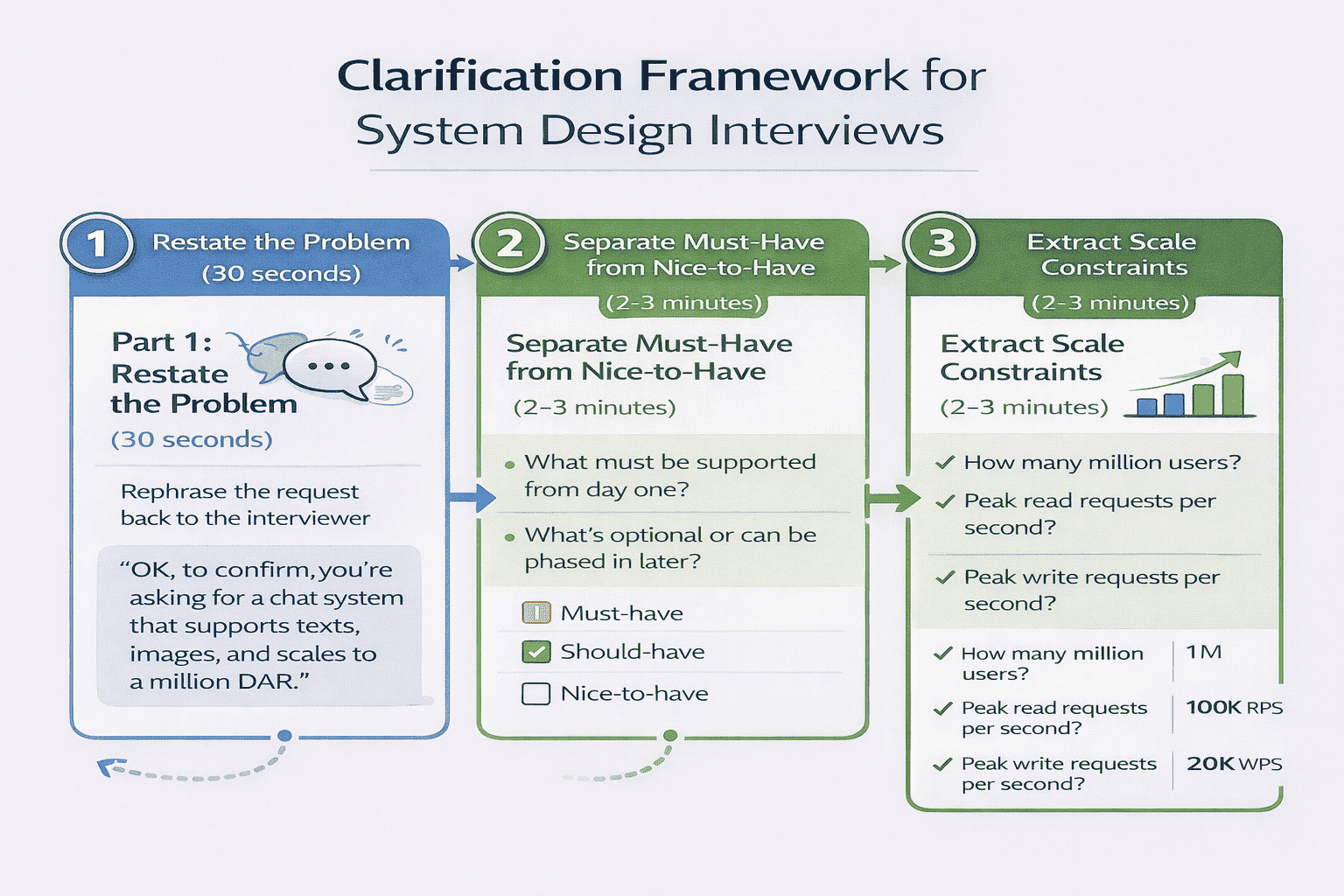
Use this three-part structure every time. It takes 5-7 minutes but saves the entire interview.
Part 1: Restate the Problem in Simple Terms (30 seconds)
Start by paraphrasing what you heard This forces you to slow down and gives the interviewer a chance to correct…
Example Just to make sure I understand correctly we’re designing a system that takes long URLs generates short codes and…
This sounds obvious Most candidates skip it They assume they understood the problem correctly and jump straight to asking about…
Part 2: Separate Must-Have from Nice-to-Have Features (2-3 minutes)
System design problems always have a minimum viable version and optional extensions. You need to know which is which.
Ask directly: “For this interview, which features are required, and which can we treat as extensions if we have time?”
Then list specific features Should we support custom short codes or is random generation sufficient Do we need expiration policies…
The interviewer will tell you what to prioritize This clarity prevents you from over-engineering features that don’t matter or under-designing…
Part 3: Extract Scale and Performance Constraints (2-3 minutes)
Numbers matter A system handling 100 requests per second looks completely different from one handling 100 000 requests per second…
Ask specific questions What’s the expected read-to-write ratio How many URLs will we create daily How many redirects per second…
If the interviewer says assume Twitter scale don’t accept that Push for numbers Twitter scale could mean different things are…
This accomplishes two things First you get the data you need to make design decisions Second you demonstrate that you…
Example Clarification Dialogue: URL Shortener
Here’s how the clarification phase sounds when executed well.
Candidate: Just to make sure I’m understanding correctly we’re building a service that takes long URLs generates short unique codes…
Interviewer: “Yes, exactly.”
Candidate: Great Before I start designing I want to make sure I’m solving the right scope Which of these features…
Interviewer: “Focus on random generation and basic redirect. We can treat analytics as a stretch goal if we have time.”
Candidate: Perfect Now for scale what kind of traffic should I design for How many new URLs are we creating…
Interviewer: Let’s assume 100 million new URLs per month so roughly 40 writes per second on average Read-heavy system maybe…
Candidate: Got it So 40 writes per second 4 000 reads per second sub-100ms latency for redirects and no custom…
Interviewer: “Yes, let’s proceed.”
Notice what just happened The candidate confirmed scope ruled out features that would complicate the design extracted specific numbers and…
Step 2: Set the Design Context Out Loud
After clarifying requirements most candidates immediately start drawing boxes They sketch a client an API gateway a few microservices and…
They’re making a critical mistake. They skipped establishing context.
Before you propose any architecture you must communicate the constraints that shape your design You must verbalize the scale parameters…
Why Context Matters More Than Components
Imagine two candidates designing a video streaming platform Both draw the same components CDN origin servers encoding pipeline metadata database…
Candidate A jumps straight to drawing Candidate B spends 90 seconds establishing context first We’re optimizing for a read-heavy system…
Which candidate sounds senior Candidate B Why Because they demonstrated that every architectural decision flows from system constraints not arbitrary…
Context separates engineers who design systems from engineers who assemble components.
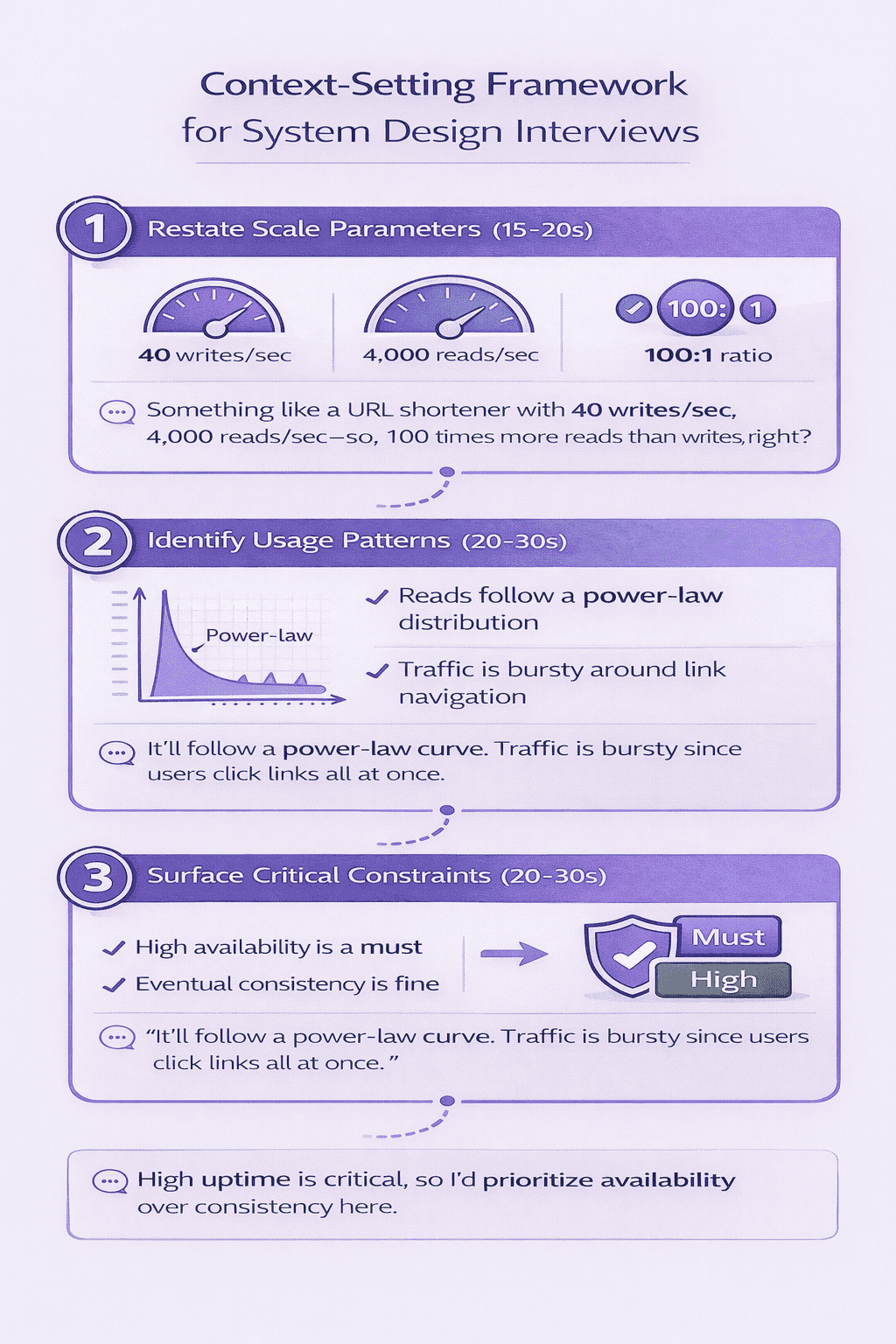
The Context-Setting Framework : What to Verbalize
Use this structure immediately after clarification and before drawing anything It takes 60-90 seconds but completely changes how the interviewer…
1. Restate Scale Parameters (15-20 seconds)
Repeat the numbers you extracted during clarification but frame them as design inputs Based on our discussion we’re designing for…
This accomplishes two things First it confirms you captured the requirements correctly Second it signals that these numbers will drive…
2. Identify Usage Patterns (20-30 seconds)
Describe how the system will actually be used Are requests evenly distributed or bursty Is data accessed uniformly or does…
For a URL shortener URL creation will likely be bursty marketing campaigns social media events Redirects will follow a power-law…
Notice how this sets up architectural decisions before you propose them You just explained why caching makes sense power-law distribution…
3. Surface Critical Constraints (20-30 seconds)
Call out the system characteristics that create the hardest design challenges Is availability more important than consistency Must the system…
For a URL shortener The biggest challenge here is ensuring globally distributed redirects stay fast while handling viral traffic spikes…
You just previewed the hard problems your design will solve. The interviewer now knows you’re thinking about the right challenges.
Example Context-Setting Dialogue
Here’s how this sounds in a real interview after you’ve completed clarification.
Candidate: Before I start designing let me set the context we’re working with We’re building for 40 writes per second…
Candidate: I’m assuming URL creation will be bursty especially during marketing campaigns or viral events Redirects will likely follow a…
Candidate: The critical constraint here is high availability If this service goes down every shortened link breaks which is catastrophic…
Candidate: “Does that context align with what you’re looking for?”
Interviewer: “Yes, that’s exactly right. Go ahead and design.”
Total time 75 seconds What just happened You eliminated ambiguity previewed your architectural thinking and got explicit buy-in before drawing…
Common Context-Setting Mistakes
Candidates who understand the importance of context still make execution errors. Avoid these three patterns.
Mistake 1: Stating Context as Solutions
Weak: “We’ll need caching because this is read-heavy.”
Strong The 100 1 read-to-write ratio and power-law access pattern suggest we’ll need aggressive caching I’ll design the read path…
The difference is subtle but critical The weak version jumps to a solution caching without connecting it to constraints The…
Mistake 2: Over-Specifying Numbers
Don’t invent precise numbers the interviewer didn’t give you If they said high traffic don’t claim approximately 47 000 requests…
If you need more specificity ask When you say high traffic should I assume hundreds thousands or hundreds of thousands…
Mistake 3: Skipping the Verbal Step
Some candidates mentally understand context but never say it out loud They think through scale and patterns internally then start…
Verbalizing context accomplishes three things First it confirms your assumptions with the interviewer Second it demonstrates that you think in…
Always speak your context out loud, even if it feels redundant.
Adapting Context to Different Problem Types
The context-setting framework applies to every system design problem but the emphasis shifts based on the problem type Here’s how…
For Data-Intensive Systems (e.g., Analytics Platform, Search Engine):
Emphasize data volume query patterns and data freshness requirements Example We’re processing 10TB of log data daily with queries running…
For User-Facing Applications (e.g., Social Feed, Chat System):
Emphasize user experience expectations and consistency models Example Users expect their own posts to appear immediately in their feed but…
For Infrastructure Systems (e.g., Rate Limiter, Distributed Cache):
Emphasize reliability performance SLAs and failure modes Example The rate limiter must operate even during partial system failures A false…
The pattern is consistent identify what matters most for this specific system state it explicitly and preview the design tensions…
Step 3: Explain the High-Level Design First
You’ve clarified requirements You’ve established context Now you’re ready to design This is where most candidates make their biggest communication…
The solution is counterintuitive. Design less. Explain more.
Start with the simplest possible architecture that satisfies the core requirements Explain it clearly Only then add complexity This approach…
Why High-Level Design Matters
When you present a complete detailed system all at once the interviewer cannot follow your reasoning They see 15 boxes…
When you present the high-level design first maybe 4-6 boxes the interviewer builds a mental model Then when you add…
Think of it like explaining a building You don’t start with plumbing diagrams and HVAC schematics You start with three-story…
The High-Level Design Framework
Follow this structure every time. It works for any system design problem.
Step 1: Draw the Absolute Minimum Viable Architecture (30-45 seconds)
Start with the fewest boxes that could possibly work For a URL shortener client API server database That’s it Three…
Don’t add caching yet Don’t add load balancers Don’t add message queues Draw the simplest possible system that performs the…
Step 2: Narrate the Core Flow (30-45 seconds)
Walk through what happens for the main use case. Describe it as a story, not a technical specification.
For URL creation When a user submits a long URL the client sends a POST request to our API server…
For URL redirect When a user visits a short URL the client sends a GET request with the short code…
Notice three things First you’re using present tense the server generates not future tense the server will generate This makes…
Step 3: Explicitly State What’s Missing (15-20 seconds)
This step separates strong candidates from exceptional ones. After presenting your minimal design, acknowledge what you intentionally left out.
This basic architecture works but has obvious problems No caching means every redirect hits the database No load balancing means…
Why does this matter Because it shows you’re thinking ahead It demonstrates that your simple design isn’t naive it’s a…
???? Download: High-Level Design Communication Checklist
This one-page checklist walks you through the exact steps for presenting a high-level design clearly Print it and practice with…
Download PDFExample High-Level Design Dialogue
Here’s how this sounds in practice.
Candidate draws three boxes: Client, API Server, Database.
Candidate: Let me start with the simplest architecture that satisfies our core requirements We have clients making requests an API…
Candidate: For URL creation the flow is straightforward A user submits a long URL to the client The client sends…
Candidate: For redirects a user visits the short URL The client sends a GET request with the short code to…
Candidate: This minimal design works functionally but has clear limitations Every redirect requires a database query which won’t meet our…
Candidate: “Does this high-level structure make sense before I add those layers?”
Interviewer: “Yes, go ahead.”
Total time about 90 seconds What just happened You established a clear foundation The interviewer understands the basic flow You…
Component Explanation Pattern: One at a Time
When you introduce each component in your high-level design follow this pattern name it define its responsibility explain why it…
Weak: “Here’s the API server.”
Strong The API server handles all business logic short code generation validation and database interactions We need a stateless middle…
The strong version answers three questions immediately: What is it? What does it do? Why does the design need it?
Apply this pattern to every component. It creates clarity and demonstrates thoughtful design decisions.
Step 4: Introduce APIs and Data Flow Clearly
After presenting your high-level design the interviewer understands the major components Now they need to understand how those components communicate…
Most candidates handle this poorly They say the client calls the API without specifying endpoints request formats or response structures…
Strong candidates make the invisible visible They define specific APIs describe request and response payloads and narrate data transformations step…
Why API Clarity Demonstrates Seniority
API design reveals whether you think about systems from first principles or just memorize patterns When you define clear APIs…
Saying POST shorten versus POST api v1 urls signals different design thinking The first is vague The second shows you’re…
Describing the request payload The client sends JSON with a url field and an optional custom_code field shows you’re thinking…
Specifying the response The server returns 201 Created with the short URL in the response body or 400 Bad Request…
These details take 20 extra seconds to verbalize but dramatically elevate your explanation.
The API Definition Framework
For each major API in your system, provide this structure.
1. Endpoint and HTTP Method (5 seconds)
State the endpoint path and HTTP verb clearly POST api v1 urls for creating short URLs or GET api v1…
This precision matters. Don’t say “we have an API for creating URLs.” Say exactly what the endpoint looks like.
2. Request Payload (10-15 seconds)
Describe what the client sends The request body is JSON containing the long URL as a required field and optionally…
If relevant, mention headers: “We’ll include an API key in the Authorization header for rate limiting and abuse prevention.”
3. Core Processing Logic (15-20 seconds)
Explain what happens server-side When the server receives the request it validates the URL format checks if a custom code…
You don’t need to dive into implementation details here. You’re describing the logical steps, not the code.
4. Response Structure (10 seconds)
Specify what the server returns On success we return 201 Created with JSON containing the short URL On validation failure…
Mentioning error cases shows you think about failure scenarios, not just happy paths.
???? Table: URL Shortener API Specification
This table provides a complete API reference for the URL shortener system demonstrating how to document endpoints payloads and responses…
| Endpoint | Method | Request Body | Success Response | Error Responses |
|---|---|---|---|---|
| /api/v1/urls | POST |
{ "url": "https://...", "customCode": "optional" }
|
201 Created
shortUrl https short ly…
|
400 Bad Request (invalid URL)
409… |
| /api/v1/{code} | GET | None (code in path) |
302 Found
Location header with long… |
404 Not Found (code doesn’t exist) |
| /api/v1/urls/{code} | DELETE | None | 204 No Content |
404 Not Found
401 Unauthorized not… |
Data Flow Narration: The Request Trace Technique
After defining APIs trace a single request through the entire system This technique called a request trace or data flow…
Pick the most common operation (usually a read operation for read-heavy systems) and narrate every step.
Example: URL Redirect Data Flow
Let me trace what happens when a user clicks a short URL The user’s browser sends a GET request to…
The API server first checks the cache using the short code as the key If there’s a cache hit which…
On a cache miss the server queries the database The database looks up the short code in the URL mappings…
The browser receives the 302 response with the Location header containing the long URL and automatically redirects the user to…
Notice the level of detail You specified where caching happens what the cache hit rate is what database query runs…
Step 5: Communicate Trade-Offs Deliberately
This is the most important step in the entire interview More candidates fail here than anywhere else Not because they…
Every architectural decision involves trade-offs Choosing Redis over Memcached Picking eventual consistency over strong consistency Using synchronous APIs versus message queues…
Senior engineers don’t just make trade-offs They verbalize them proactively explaining what they gain and what they give up This…
Why Trade-Off Communication Matters
Imagine two candidates designing a notification system Both choose to use a message queue between the API and notification workers…
Candidate A: “We’ll use a message queue here for asynchronous processing.”
Candidate B I’m introducing a message queue between the API and notification workers This adds architectural complexity and introduces a…
Which candidate gets the offer Candidate B Why Because they demonstrated they don’t just apply patterns they understand the engineering…
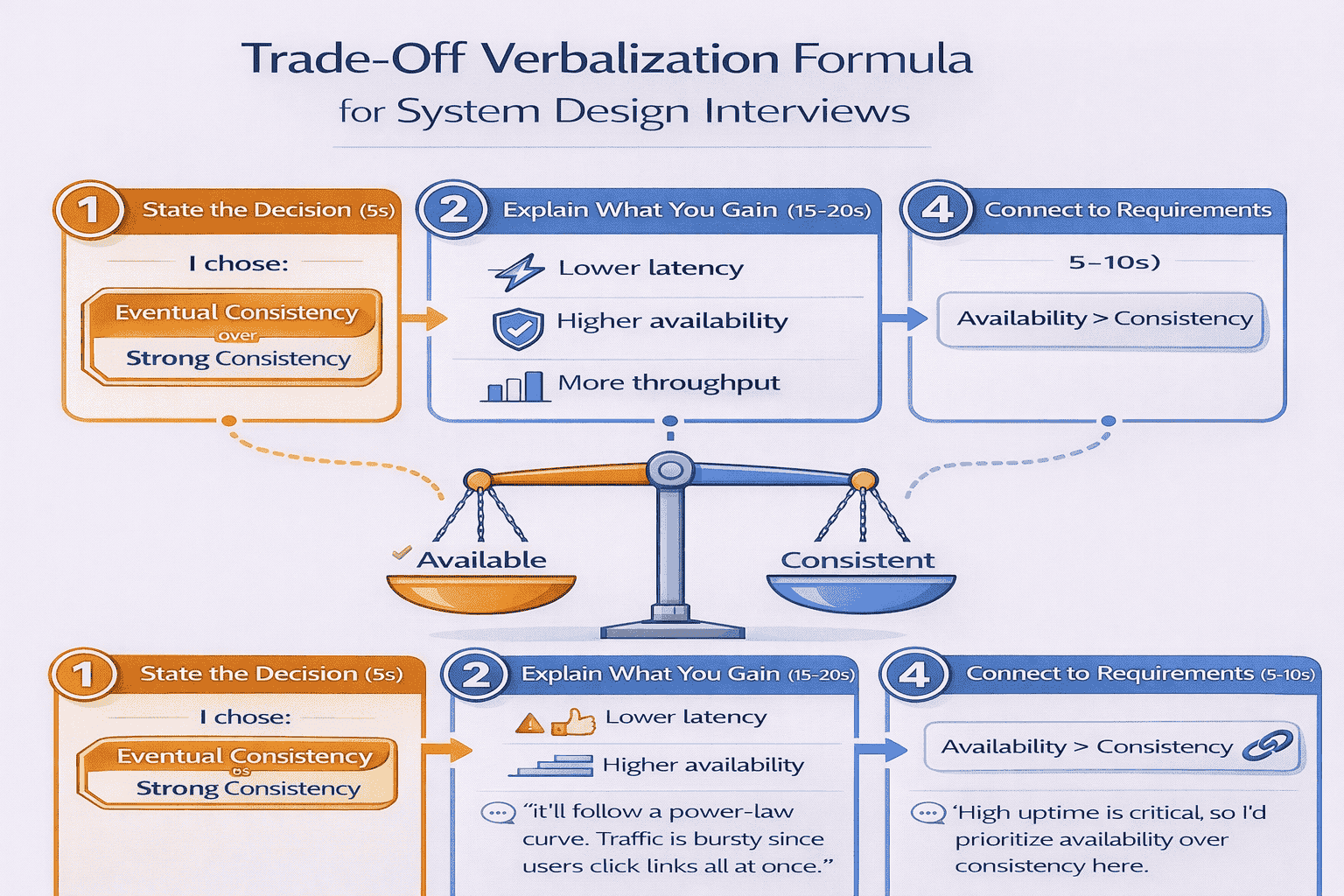
The Trade-Off Verbalization Formula
Use this exact structure every time you make a significant architectural choice It works for any decision any system any…
1. State the Decision Clearly (5 seconds)
Name the specific choice you’re making I’m choosing eventual consistency over strong consistency for the user feed Don’t be vague…
2. Explain What You’re Gaining (15-20 seconds)
Describe the benefits in concrete terms tied to the requirements you established earlier This choice gives us three advantages First…
3. Acknowledge What You’re Sacrificing (10-15 seconds)
This is the step most candidates skip Explicitly state the downside The trade-off is that users might see stale data…
4. Connect to Requirements (5-10 seconds)
Link your decision back to the constraints you established during context-setting Given our requirements prioritizing user experience and availability over…
Total time: 35-50 seconds. This sounds long, but it’s the most valuable 50 seconds of your interview.
Common Trade-Offs and How to Verbalize Them
Here are the most frequent architectural trade-offs you’ll encounter in system design interviews, with verbalization templates for each.
SQL vs NoSQL Database
I’m choosing a NoSQL document store like MongoDB over a relational database This gives us flexible schema evolution we can…
Synchronous vs Asynchronous Processing
I’m using asynchronous message queues for notification delivery instead of synchronous API calls This improves API response time the endpoint…
Vertical vs Horizontal Scaling
I’m designing for horizontal scaling by adding more application servers rather than vertical scaling by upgrading individual machines This gives…
Caching Layer
I’m adding Redis as a caching layer between the application and database This dramatically reduces database load and improves read…
Notice the pattern. Every verbalization follows the formula: decision ??? gains ??? sacrifices ??? justification based on requirements.
How to Handle Challenging Trade-Off Questions
Sometimes the interviewer will push back on your trade-off explanation They’ll ask What if we needed strong consistency or How…
This is not criticism This is the interviewer testing your ability to think through alternatives and constraints Handle these moments…
Acknowledge the Alternative Constraint (5 seconds)
“That’s a great question. If strong consistency were required, the design would change significantly.”
Explain the Alternative Architecture (20-30 seconds)
Instead of eventual consistency with async replication we’d need synchronous replication or distributed consensus like Raft Every write would need…
State the New Trade-Offs (15-20 seconds)
This would give us linearizability reads always reflect the latest write but write latency would increase from 10ms to potentially…
Circle Back to Original Requirements (5 seconds)
But if the requirements changed to prioritize consistency for example if this were a financial ledger instead of a social…
What just happened You demonstrated flexibility showed you understand multiple approaches and proved you make decisions based on requirements not…
The Power of Proactive Trade-Off Surfacing
Here’s an advanced technique that impresses interviewers: surface trade-offs before the interviewer asks about them.
When you introduce a component or make a decision, immediately acknowledge the obvious downside without being prompted.
I’m introducing a CDN for static asset delivery This gives us geographic distribution and reduces origin server load The obvious…
Why does this work Because it shows you think about failure modes and downsides naturally not just when challenged It…
Try to proactively surface at least one downside for every major architectural decision. The interviewer will notice.
???? Table: System Design Trade-Off Quick Reference
This reference table catalogs common architectural trade-offs you’ll encounter in interviews organized by what you optimize for and what you…
| Decision | What You Gain | What You Sacrifice | Best For |
|---|---|---|---|
| NoSQL over SQL | Schema flexibility horizontal scaling high write… | ACID transactions, complex joins, referential integrity | Flexible schemas, massive scale, document storage |
| Eventual consistency | Lower latency, higher availability, partition tolerance | Temporary stale reads, reconciliation complexity | Social feeds, product catalogs, non-critical data |
| Message queue | Async processing, decoupling, fault tolerance | Immediate feedback, ordering complexity, operational overhead | Background jobs, email/notifications, event-driven systems |
| Microservices | Independent deployment, team autonomy, tech diversity | Distributed complexity, network overhead, data consistency | Large teams, polyglot needs, independent scaling |
| Caching layer | Read latency reduction, database offloading | Cache invalidation complexity memory costs stale… | Read-heavy workloads, expensive queries, hot data |
| Denormalization | Read performance, simpler queries, fewer joins | Storage costs, update complexity, data duplication | Analytics, reporting, read-optimized systems |
| Horizontal scaling | Fault tolerance incremental growth no single… | Load balancing complexity stateless requirements higher… | Unpredictable traffic, high availability needs |
Step 6: Handle Scalability and Bottlenecks Out Loud
After establishing your core design and explaining trade-offs the interviewer will inevitably ask How does this scale or What are…
This is not a trick question The interviewer wants to see if you can identify failure points proactively and reason…
Strong candidates approach scalability as structured reasoning, not a technology checklist.
The Scalability Communication Framework
When discussing scale, follow this three-part structure. It demonstrates methodical thinking rather than pattern matching.
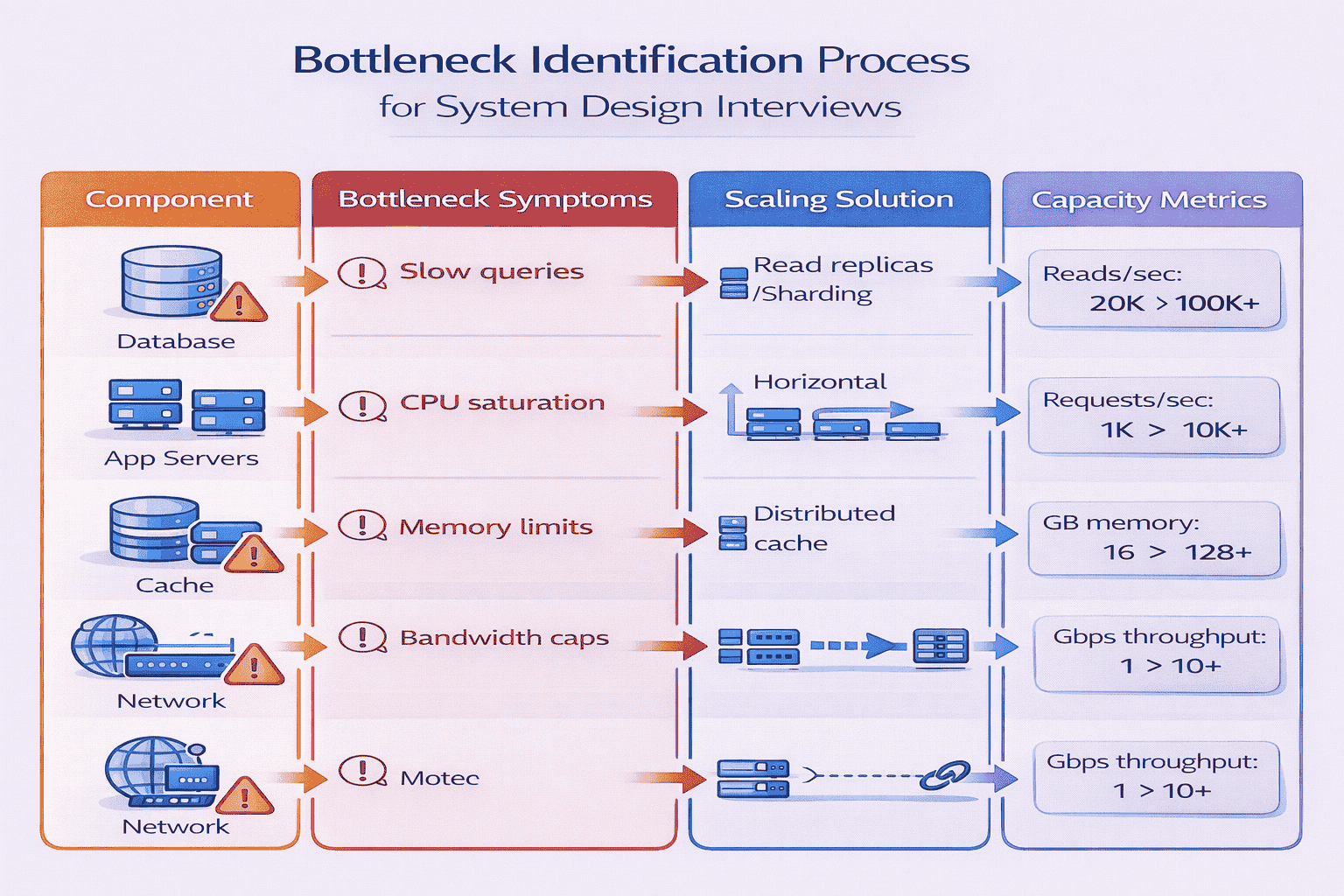
Part 1: Identify Bottlenecks by Component (20-30 seconds)
Walk through your architecture component by component, calling out where bottlenecks will appear first as load increases.
As traffic scales we’ll hit bottlenecks in this order First the database becomes overwhelmed at 4 000 reads per second…
Notice you’re identifying bottlenecks in priority order based on the system’s characteristics. This shows you understand where pressure points emerge.
Part 2: Propose Solutions with Scaling Metrics (30-45 seconds)
For each bottleneck, explain how you’d scale and what limits you’d hit.
To scale the database I’d implement read replicas We can distribute read traffic across multiple replicas scaling read capacity linearly…
For API server scaling horizontal scaling with a load balancer handles this naturally Each server can process maybe 1 000…
Cache scaling is similar we can use consistent hashing to distribute the cache across multiple Redis instances sharding by short…
You’re not just naming solutions. You’re explaining capacity numbers and scaling characteristics.
Part 3: Acknowledge Remaining Hard Problems (15-20 seconds)
After explaining how to scale each component, call out what doesn’t scale easily.
The remaining hard problem is globally distributed deployments If we need sub-100ms redirects worldwide we’ll need regional deployments with eventually…
This shows you distinguish between tractable scaling challenges and genuinely difficult distributed systems problems.
Scalability Discussion Example
Here’s how this sounds in a real interview.
Interviewer: “How would you scale this system to handle 10x the traffic?”
Candidate: Let me walk through the bottlenecks we’d hit and how to address them At 10x traffic we’re looking at…
Candidate: The database hits capacity first With our current single-instance setup we can’t handle 40 000 reads per second even…
Candidate: API servers scale horizontally behind the load balancer At 40 000 total requests per second and assuming 1 000…
Candidate: The cache layer needs to scale too If our working set is 1 million hot URLs and each mapping…
Candidate: The one challenge that doesn’t scale trivially is global distribution If we need low-latency redirects worldwide we’d deploy regional…
Interviewer: “How would you handle the cross-region replication?”
Candidate: For new URL creation we’d write to the local region’s database and asynchronously replicate to other regions Redirects would…
This entire discussion took about 90 seconds and demonstrated systematic scalability thinking, not random pattern application.
Common Scalability Questions and How to Answer Them
Interviewers often ask specific scalability questions to probe your understanding. Here’s how to handle the most common ones.
“What happens if the database goes down?”
This tests fault tolerance, not just performance scaling. Answer with both immediate impact and recovery strategy.
If the primary database fails writes immediately stop working users can’t create new short URLs Reads continue working for cached…
“How do you prevent duplicate short codes across distributed servers?”
This tests your understanding of distributed coordination.
There are two approaches First we could use a centralized ID generation service like Twitter’s Snowflake which generates guaranteed unique…
“What’s your database schema and how does it scale?”
This tests whether you think about data modeling, not just architecture boxes.
The core table is simple short_code as primary key long_url as the value created_at timestamp and optional user_id if we’re…
Step 7: Respond to Follow-Up Questions Without Losing Structure
System design interviews rarely proceed linearly Just when you’ve finished explaining your caching strategy the interviewer interrupts What if we…
These interruptions aren’t disruptions They’re the most important part of the interview They test whether you can think on your…
Most candidates handle interruptions poorly They either freeze restart their entire explanation or defensively cling to their original design Strong candidates treat follow-ups…
Why Follow-Up Handling Reveals Leadership Potential
In production engineering requirements change constantly A feature gets deprioritized mid-sprint A stakeholder adds a critical constraint two weeks before…
Senior engineers navigate these changes smoothly They acknowledge new information update their mental models and adjust plans without panic They…
Interviewers use follow-up questions to simulate this exact dynamic When they interrupt your explanation with a constraint change they’re watching…
The Follow-Up Response Framework
Use this four-step structure every time the interviewer adds a constraint or questions your design It keeps you structured even…
Step 1: Acknowledge the Question (3-5 seconds)
Pause. Don’t immediately start answering. Take a breath and verbally acknowledge what the interviewer asked.
That’s a great question You’re asking how the design changes if we need to support multi-tenancy where each customer’s data…
This accomplishes three things First it gives you a few seconds to think Second it confirms you understood the question…
Step 2: Anchor Back to Existing Design (10-15 seconds)
Before explaining what changes, briefly reference what you’ve already designed that’s still relevant.
In our current design we have a single shared database with all URL mappings The caching layer and API servers…
Why does this matter Because it creates continuity The interviewer doesn’t have to remember your entire design from 10 minutes…
Step 3: Explain the Incremental Change (30-45 seconds)
Now describe what you’d modify to accommodate the new constraint. Be specific about what changes and why.
To support multi-tenancy with strict isolation I’d make three key changes First add a tenant_id column to the database and…
Notice the structure: number the changes, explain each one clearly, and connect them to the new requirement (strict isolation).
Step 4: Call Out New Trade-Offs (15-20 seconds)
After explaining the changes, acknowledge what this new constraint costs you.
This multi-tenant approach adds complexity We now need tenant-aware authentication more complex database queries with tenant filtering and we risk…
You just demonstrated that even under pressure, you think about trade-offs systematically.
???? Download: Follow-Up Question Response Template
This simple one-page template provides the exact 4-step framework for handling interruptions and constraint changes Keep it next to you…
Download PDFExample Follow-Up Dialogue
Here’s how this framework sounds when the interviewer throws you a curveball mid-interview.
Interviewer: “What if 50% of our URLs needed to expire after 24 hours, like for temporary marketing campaigns?”
Candidate: “Good question. You’re asking how we’d handle automatic URL expiration for time-limited campaigns.”
Candidate: In our current design URLs live forever once created The database just stores the short-to-long mapping with no expiration…
Candidate: To support expiration I’d add an expires_at timestamp column to the database When creating a URL clients could optionally…
Candidate: The trade-off here is added complexity in the redirect logic every lookup now needs a timestamp comparison and we…
Interviewer: “How would you handle the cleanup job at scale?”
Candidate: At scale a single cleanup job scanning the entire database becomes slow I’d partition the cleanup by sharding run…
Total exchange about 90 seconds Notice how the candidate stayed calm connected the new requirement to the existing design explained…
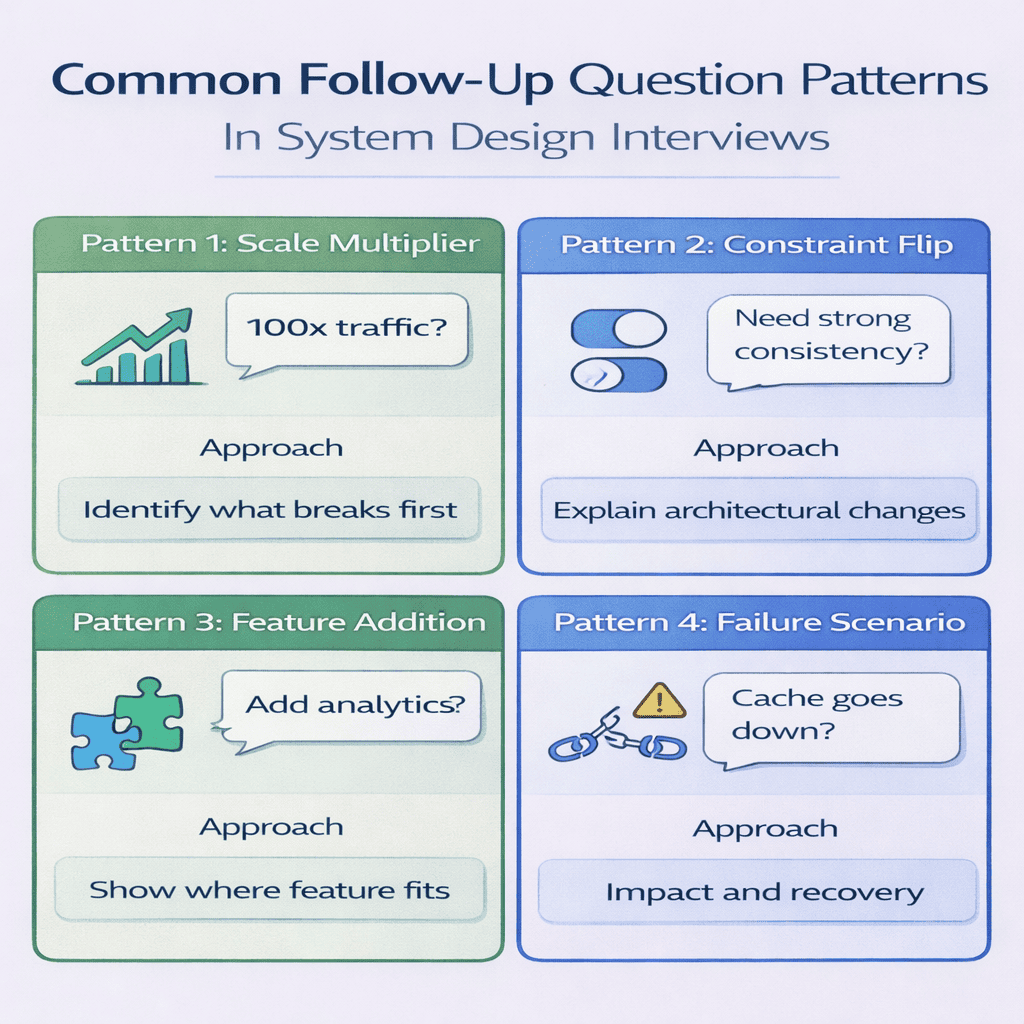
Common Follow-Up Patterns and How to Handle Them
Interviewers tend to use specific follow-up patterns repeatedly. Recognizing these patterns helps you respond more confidently.
Pattern 1: Scale Multiplier (“What if traffic is 100x higher?”)
This tests whether you understand scaling limits Don’t just list more components explain what breaks first and how you’d address…
At 100x traffic we’re looking at 4 000 writes per second and 400 000 reads per second The database definitely…
Pattern 2: Constraint Flip (“What if consistency was critical?”)
This tests your understanding of trade-offs. Explain what would change and what problems emerge.
If we needed strong consistency instead of eventual consistency the architecture would change significantly We couldn’t use async replication we’d…
Pattern 3: Feature Addition (“How would you add analytics?”)
This tests whether you can extend your design without breaking it Describe where the new feature fits and what components…
To add click analytics I’d introduce an event stream When a redirect happens the API server publishes a click event…
Pattern 4: Failure Scenario (“What if the cache goes down?”)
This tests your understanding of fault tolerance and degradation. Explain both immediate impact and recovery strategy.
If the cache fails completely all redirect requests hit the database At our read volume this would overwhelm the database…
What Not to Do When Interrupted
Certain responses to follow-up questions signal junior-level thinking. Avoid these patterns.
Don’t Restart Your Entire Explanation
When the interviewer asks a follow-up don’t say Let me start over or re-explain your whole design Acknowledge what’s already…
Don’t Get Defensive
If the interviewer challenges your design Wouldn’t that approach have high latency don’t defend dogmatically Acknowledge the concern explain your…
Don’t Ignore the Existing Design
When adding a new feature or constraint explicitly connect it to what you’ve already designed Don’t treat it as a…
Don’t Rush
It’s okay to pause for 3-5 seconds before answering a follow-up question Say Let me think through that for a…
Turning Follow-Ups Into Collaboration
The best candidates treat follow-up questions as collaborative design sessions not interrogations They use phrases that invite the interviewer into…
Instead of: “I would handle that by…”
Try There are two approaches we could take here Option A would be simpler but has this downside Option B…
This does two things First it shows you can generate multiple solutions Second it treats the interviewer as a collaborator…
Use this technique sparingly maybe once or twice per interview when the trade-offs are genuinely ambiguous and you want to…
Step 8: Close the Design with a Clear Summary
You’ve spent 35-40 minutes designing explaining and handling follow-ups The interviewer says We have about 5 minutes left any final…
This is not a throwaway question This is your last chance to leave a strong impression Most candidates waste this…
Strong candidates use these final minutes strategically They provide a crisp summary that reinforces their key decisions demonstrates they can…
Why the Closing Summary Matters
The closing summary serves three purposes First it creates recency bias the interviewer will remember your clear confident close more…
Second it demonstrates communication range You’ve been explaining technical details for 40 minutes Now you show you can zoom out…
Third, it gives you a chance to tie loose ends and address anything you intentionally deferred earlier.
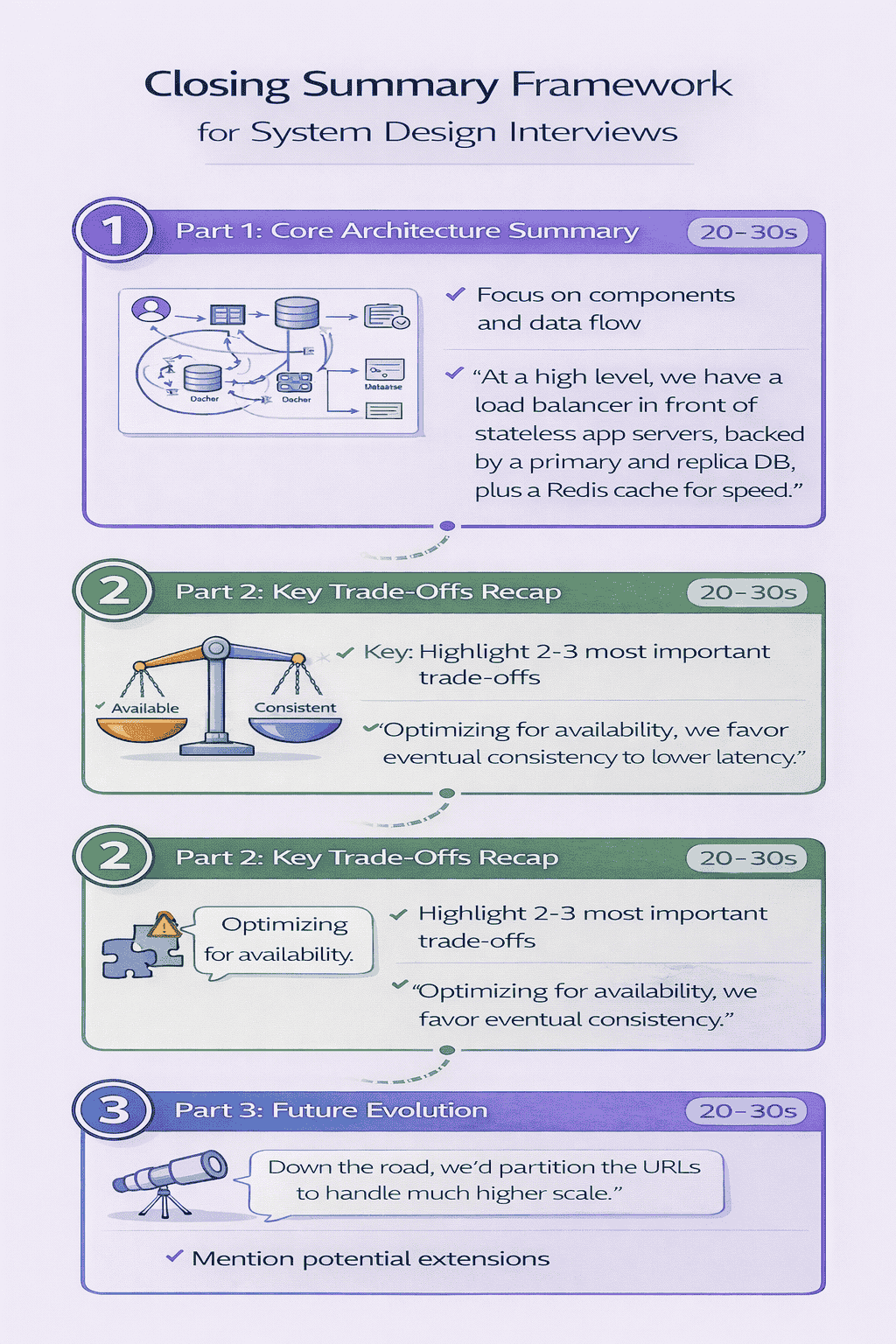
The Closing Summary Framework
Use this three-part structure. It takes 60-90 seconds and leaves a strong final impression.
Part 1: Core Architecture Summary (20-30 seconds)
Provide a one-paragraph overview of your design. Focus on the key components and data flow, not every detail.
To summarize the architecture clients send URL creation and redirect requests to a load-balanced API tier The API tier handles…
Notice this is concise, clear, and focuses on the major decisions that enable the system to meet requirements.
Part 2: Key Trade-Offs Recap (20-30 seconds)
Remind the interviewer of your most important trade-offs. Pick 2-3 of the most significant ones.
The key trade-offs we made we chose eventual consistency over strong consistency to prioritize availability and low latency We accepted…
This shows you think in trade-offs systematically, not just as one-off decisions.
Part 3: Future Evolution (20-30 seconds)
Briefly mention how the system could evolve with more time or changing requirements This demonstrates you think beyond the immediate…
If we had more time or if requirements evolved there are a few areas I’d explore We could add analytics…
You just showed you can prioritize???you know what matters now versus what could come later.
Example Closing Summary Dialogue
Here’s how a strong closing summary sounds in a real interview.
Interviewer: “We’re running low on time. Do you have any final thoughts on the design?”
Candidate: Let me summarize the key points We designed a distributed URL shortening service with a load-balanced API tier distributed…
Candidate: The critical trade-offs were choosing eventual consistency for better availability and lower latency accepting operational complexity of distributed caching…
Candidate: If requirements evolved we’d add an event stream for analytics support custom domains through DNS configuration and deploy regional…
Interviewer: “Great. That’s a good summary. Any questions for me?”
Total time 75 seconds The candidate reinforced their design clearly reminded the interviewer of thoughtful trade-offs and showed they think…
What to Include vs What to Skip
The closing summary is not a chance to brain-dump everything you forgot to mention. Be selective.
Include:
- Core architectural components and their relationships
- How the design meets the original requirements
- The 2-3 most important trade-offs
- 1-2 natural next evolution steps
Skip:
- Implementation details you didn’t cover earlier
- Random optimizations that aren’t critical
- Apologies for things you missed
- Completely new architectural alternatives
Keep it tight. 60-90 seconds maximum. If you find yourself talking for 3 minutes during the close, you’re rambling.
Addressing Gaps You Noticed
Sometimes during the interview you realize you didn’t cover something important The closing summary is a good time to briefly…
One area we didn’t dive deep on was security in production we’d need rate limiting per IP to prevent abuse…
This shows awareness without derailing the close. You acknowledge the gap, briefly explain how you’d address it, and move on.
Don’t apologize excessively. One brief acknowledgment is professional. Multiple apologies signal lack of confidence.
The Confidence Signal
How you deliver the closing summary matters as much as what you say. Use confident body language and tone.
Weak: “So… yeah, I think that’s basically it. Unless you want me to go over anything else?”
Strong To summarize we built a distributed URL shortener optimized for read-heavy traffic with sub-100ms redirects The key architectural choices…
The strong version is declarative clear and confident You’re not asking for permission or validation You’re presenting your design summary…
Putting Your Communication Framework Into Practice
You now have a complete communication framework for system design interviews Eight steps that transform ambiguous problems into clear structured…
The framework only works if you practice it deliberately Most engineers read interview guides nod along then freeze when they sit down for…
The Complete Communication Playbook
Here’s the entire framework in one place, ready to apply to any system design problem.
Step 1: Clarify the Problem (5-7 minutes)
- Restate the problem in simple terms
- Separate must-have from nice-to-have features
- Extract scale and performance constraints with specific numbers
- Confirm understanding before proceeding
Step 2: Set the Context (1-2 minutes)
- Restate scale parameters as design inputs
- Identify usage patterns and access characteristics
- Surface critical constraints and hard problems
- Preview architectural tensions
Step 3: Explain High-Level Design (2-3 minutes)
- Draw the minimum viable architecture (3-6 boxes)
- Narrate the core flow as a story
- Explicitly state what’s missing
- Get buy-in before adding complexity
Step 4: Introduce APIs and Data Flow (3-4 minutes)
- Define specific endpoints with HTTP methods
- Describe request and response payloads
- Explain core processing logic
- Trace a single request through the entire system
Step 5: Communicate Trade-Offs (ongoing, 30-50s per decision)
- State the decision clearly
- Explain what you’re gaining (benefits)
- Acknowledge what you’re sacrificing (costs)
- Connect back to requirements
Step 6: Handle Scalability (3-5 minutes)
- Identify bottlenecks by component in priority order
- Propose solutions with scaling metrics
- Acknowledge remaining hard problems
- Answer specific failure and scale questions
Step 7: Respond to Follow-Ups (ongoing, 60-90s per question)
- Acknowledge the question verbally
- Anchor back to existing design
- Explain the incremental change
- Call out new trade-offs introduced
Step 8: Close with Summary (1-2 minutes)
- Summarize core architecture in one paragraph
- Recap 2-3 key trade-offs
- Mention future evolution possibilities
- Deliver with confidence
Download: Complete Communication Checklist
This comprehensive 2-page checklist combines all eight steps into a single reference you can use during mock interviews Print it…
Download PDFHow to Practice This Framework
Reading the framework is step one. Making it automatic requires deliberate practice. Follow this three-phase practice plan.
Phase 1: Scripted Practice (Week 1-2)
Pick a simple system design problem like URL shortener or pastebin Walk through all eight steps out loud alone with…
Record yourself or write out your explanation Review it Did you follow the framework Did you use the trade-off formula…
Repeat with 3-4 different simple problems until the framework feels natural.
Phase 2: Timed Solo Practice (Week 3-4)
Set a 45-minute timer Pick a medium-complexity problem like designing Instagram or a chat system Execute the framework under time…
Record yourself Watch the recording Count how many times you verbalized trade-offs Did you establish context before drawing Did you…
Do this 5-6 times with different problems. Focus on pacing???making sure you leave time for scalability and closing summary.
Phase 3: Mock Interviews with Feedback (Week 5+)
Find a practice partner or use a mock interview service Have them ask follow-up questions and interrupt you Practice adapting…
After each mock interview ask for specific feedback Did I clarify requirements before designing Did my trade-off explanations make sense…
Do at least 8-10 mock interviews before your real interviews The first few will feel awkward By the eighth the…
Common Mistakes Even After Learning the Framework
Even candidates who understand the framework make execution errors. Watch for these patterns.
Mistake 1: Skipping Steps Under Pressure
When nervous candidates skip clarification or context-setting to save time This backfires They waste 20 minutes designing the wrong scope…
Solution: Force yourself to complete Steps 1 and 2 even when nervous. They’re not optional. They’re foundational.
Mistake 2: Forgetting to Verbalize Trade-Offs
Candidates make good decisions but forget to explain why They choose Redis add a message queue implement sharding all sound…
Solution: After introducing any significant component, pause and ask yourself: “What’s the trade-off here?” Then say it out loud.
Mistake 3: Over-Explaining Simple Parts
Some candidates spend 5 minutes explaining what a load balancer does The interviewer already knows This wastes time better spent…
Solution Assume the interviewer has senior-level knowledge Define components briefly Spend time on why you chose them and how they…
Mistake 4: Not Closing Deliberately
The interviewer says “We’re out of time.” Candidate says “Okay, cool.” Interview ends. No summary, no reinforcement of key points.
Solution When you hear 5 minutes left or we’re wrapping up immediately transition to your closing summary Even 60 seconds…
Beyond the Interview: How This Framework Applies to Real Work
This communication framework isn’t just for interviews. It’s how senior engineers communicate architecture in production.
When you write a design doc you clarify requirements establish context present a high-level design first then dive into details…
The interview is a compressed high-pressure version of conversations you’ll have throughout your career Mastering interview communication makes you better…
If you can explain a system design clearly in 45 minutes to a skeptical interviewer who keeps interrupting you you…
Your Next Steps
You now have everything you need to communicate system designs clearly under pressure. Here’s how to move forward.
Immediate Actions (This Week):
- Download the complete communication checklist and print it
- Pick one simple system (URL shortener, pastebin, or key-value store)
- Walk through all eight steps out loud, alone, with no timer
- Record yourself and review the recording for framework adherence
Short-Term Practice (Next 4 Weeks):
- Complete 4-6 timed solo practice sessions with different problems
- Schedule 3-4 mock interviews with peers or mock interview platforms
- After each practice, identify which step needs the most work
- Focus one practice session exclusively on that weak step
Long-Term Development (Ongoing):
- Apply this framework to real design docs and architecture discussions at work
- Watch yourself for trade-off verbalization in production conversations
- When reviewing code or designs, notice how others communicate decisions
- Mentor others using this framework???teaching reinforces mastery
System design communication is a skill, not a talent. You can improve it through deliberate practice. Start today.
Ready to Master System Design Interviews?
This guide gives you the communication framework But communication is only one part of interview success You also need deep… practice with real system design problems
At geekmerit.com we’ve helped 2 400 engineers prepare for senior-level system design interviews Our courses combine comprehensive technical content with deliberate…
Every module includes:
- Step-by-step problem walkthroughs demonstrating this exact communication framework
- 200+ practice problems with detailed solutions
- Live mock interviews with personalized feedback on your communication
- Architecture trade-off libraries covering every common decision point
Choose the plan that fits your learning style:
Self-Paced ($197): All course content practice problems and recorded mock interviews Perfect for disciplined learners who want complete access at…
Guided ($397): Everything in Self-Paced plus 3 live coaching sessions and personalized feedback on your designs Ideal for engineers who…
Bootcamp ($697): Maximum support with 8 coaching sessions 3 full live mock interviews and a personalized study plan The fastest…
All plans include lifetime access and a 30-day money-back guarantee. View detailed pricing and curriculum .
Start practicing this framework today with our free resources, or accelerate your preparation with structured coaching and feedback.
Frequently Asked Questions
How long does it take to master this communication framework?
Most engineers need 4-6 weeks of deliberate practice to make the framework automatic The first week focuses on understanding each…
What if the interviewer doesn’t follow this structure?
You control the structure not the interviewer Even if they ask questions in random order or interrupt frequently you can…
Should I memorize specific system designs or learn communication patterns?
Learn communication patterns not memorized designs Interviewers can tell when you’re reciting a memorized solution versus reasoning through a problem…
How do I handle questions about technologies I’ve never used?
Admit unfamiliarity honestly then reason from first principles If asked about Kafka but you’ve only used RabbitMQ say I haven’t…
What’s the biggest mistake senior engineers make in system design interviews?
Jumping to solutions without clarifying requirements Experienced engineers often skip the clarification phase because they’ve solved similar problems before They…
How much coding or pseudocode should I write during a system design interview?
Very little System design interviews test architectural thinking not implementation You might write pseudocode for a specific algorithm like consistent…
Citations
Content Integrity Note
This guide was written with AI assistance and then edited, fact-checked, and aligned to expert-approved teaching standards by Andrew Williams . Andrew has over 10 years of experience coaching software developers through technical interviews at top-tier companies including FAANG and leading enterprise organizations. His background includes conducting 500+ mock system design interviews and helping engineers successfully transition into senior, staff, and principal roles. Technical content regarding distributed systems, architecture patterns, and interview evaluation criteria is sourced from industry-standard references including engineering blogs from Netflix, Uber, and Slack, cloud provider architecture documentation from AWS, Google Cloud, and Microsoft Azure, and authoritative texts on distributed systems design.

