
System Design Interview Anxiety: Why Experienced Engineers Freeze Under Pressure

You walk into a system design interview knowing you’ve built scalable systems in production. Yet when the interviewer asks you to design a URL shortener, your mind goes blank. The system design interview anxiety that grips experienced engineers isn’t about lacking knowledge—it’s about how this unique interview format hijacks your cognitive abilities at the worst possible moment.
After coaching over 150 senior developers through mock system design interviews, I’ve seen the same pattern: brilliant engineers who confidently architect complex systems at work suddenly freeze, rush, or lose their train of thought in interviews.
This isn’t a competence problem. It’s a predictable response to how system design interviews are structured.
If you’re freezing mainly because you haven’t done formal architecture work before, start here: How to Crack System Design Interviews Without Prior Design Experience.
Last updated: Feb. 2026
Table of Contents
- 1. Understanding the Phenomenon: When Preparation Doesn’t Prevent Panic
- 2. The Hidden Myth: “If I’m Good at System Design, I Should Be Calm”
- 3. What System Design Interviews Actually Test (And Why That Triggers Anxiety)
- 4. What Anxiety Looks Like in System Design Interviews
- 5. Why Experienced Engineers Are Hit the Hardest
- 6. The Crucial Reframe: Structure vs. Anxiety
- 7. Moving Forward: From Understanding to Action
- 8. FAQs
Contents








Understanding the Phenomenon: When Preparation Doesn’t Prevent Panic
The email I received last month was heartbreaking in its familiarity.
“I’ve designed distributed caching systems serving millions of requests per second. I’ve led architecture reviews for three different microservices migrations. But in my Meta interview, I couldn’t even explain my caching strategy coherently. What’s wrong with me?”
Nothing is wrong with this engineer. And nothing is wrong with you if this resonates.
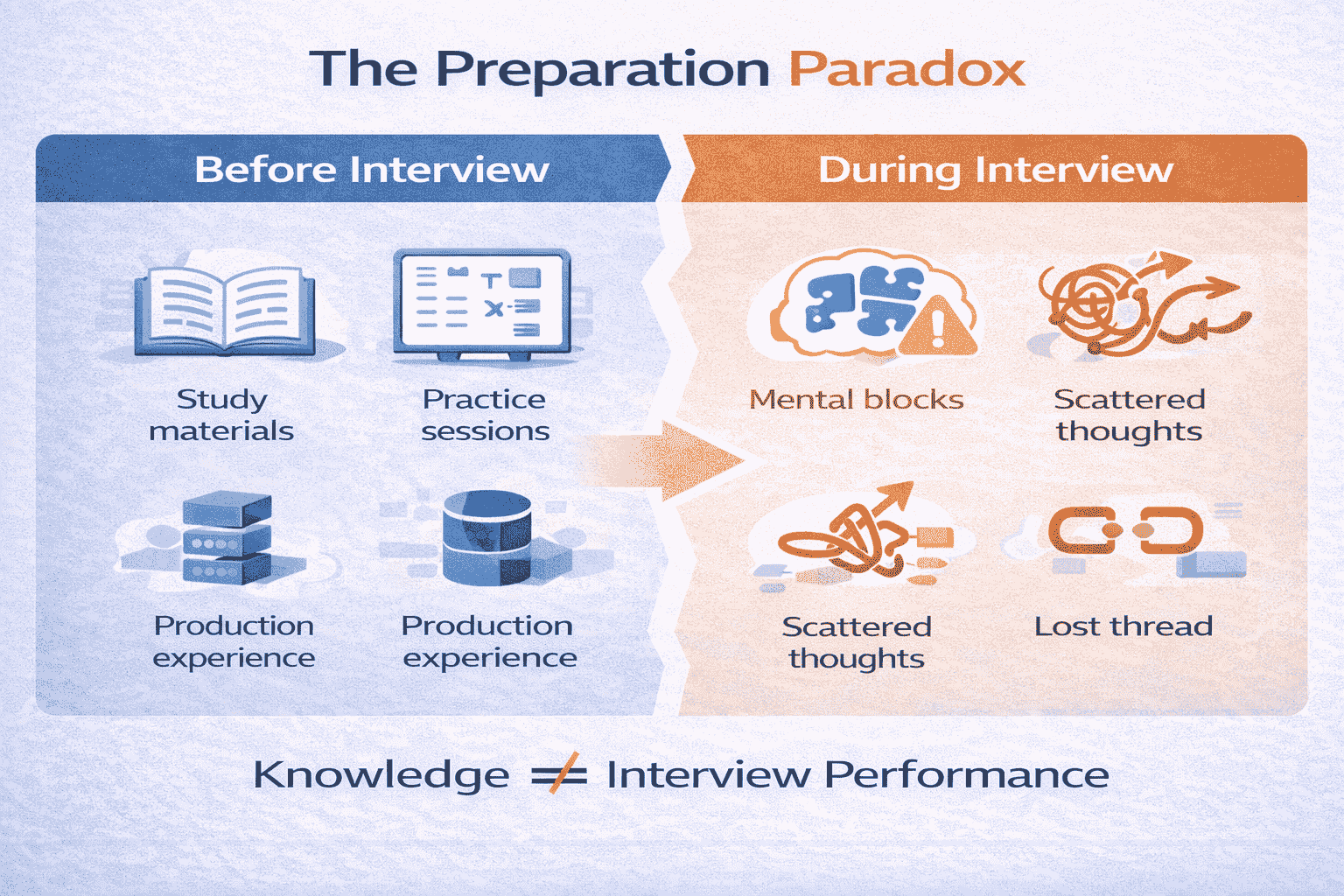
The Preparation Paradox
You study system design patterns. You practice on mock interviews . You review architectural decisions from your own production systems.
Then the interview starts, and despite all that preparation, your brain betrays you.
You know the concepts. You’ve applied them successfully at work. But in the interview, that knowledge feels unreachable—like trying to remember a word that’s on the tip of your tongue.
The Symptoms You’re Actually Experiencing
System design interview anxiety doesn’t announce itself with dramatic panic attacks. It shows up as subtle cognitive disruptions that you might dismiss as “just nerves.”
Your thoughts scatter. You start explaining load balancing, then suddenly realize you’ve jumped to database sharding without finishing your point.
Your pacing accelerates. You talk faster, trying to cover ground before the fear catches up. The interviewer’s silence feels like judgment, so you fill it with more words.
Your sequencing breaks down. You know you should clarify requirements first, but you’re already sketching database schemas because doing something—anything—feels safer than pausing to think.
Why This Matters More Than You Think
When you don’t understand what’s happening to you, anxiety becomes recursive. You’re anxious about the interview, then anxious about being anxious, then anxious that your anxiety proves you’re not senior enough.
That shame spiral is what keeps talented engineers from ever reaching their potential in interviews.
Understanding that anxiety is a predictable response to specific interview conditions—not a character flaw or competence gap—is the first step toward breaking that cycle.
What System Design Interviews Actually Test (And Why That Triggers Anxiety)
System design interviews are fundamentally unlike any real engineering environment you’ve experienced.
That’s not hyperbole. The format combines multiple stressors simultaneously in a way that has no parallel in actual work.
The Unique Cognitive Demands
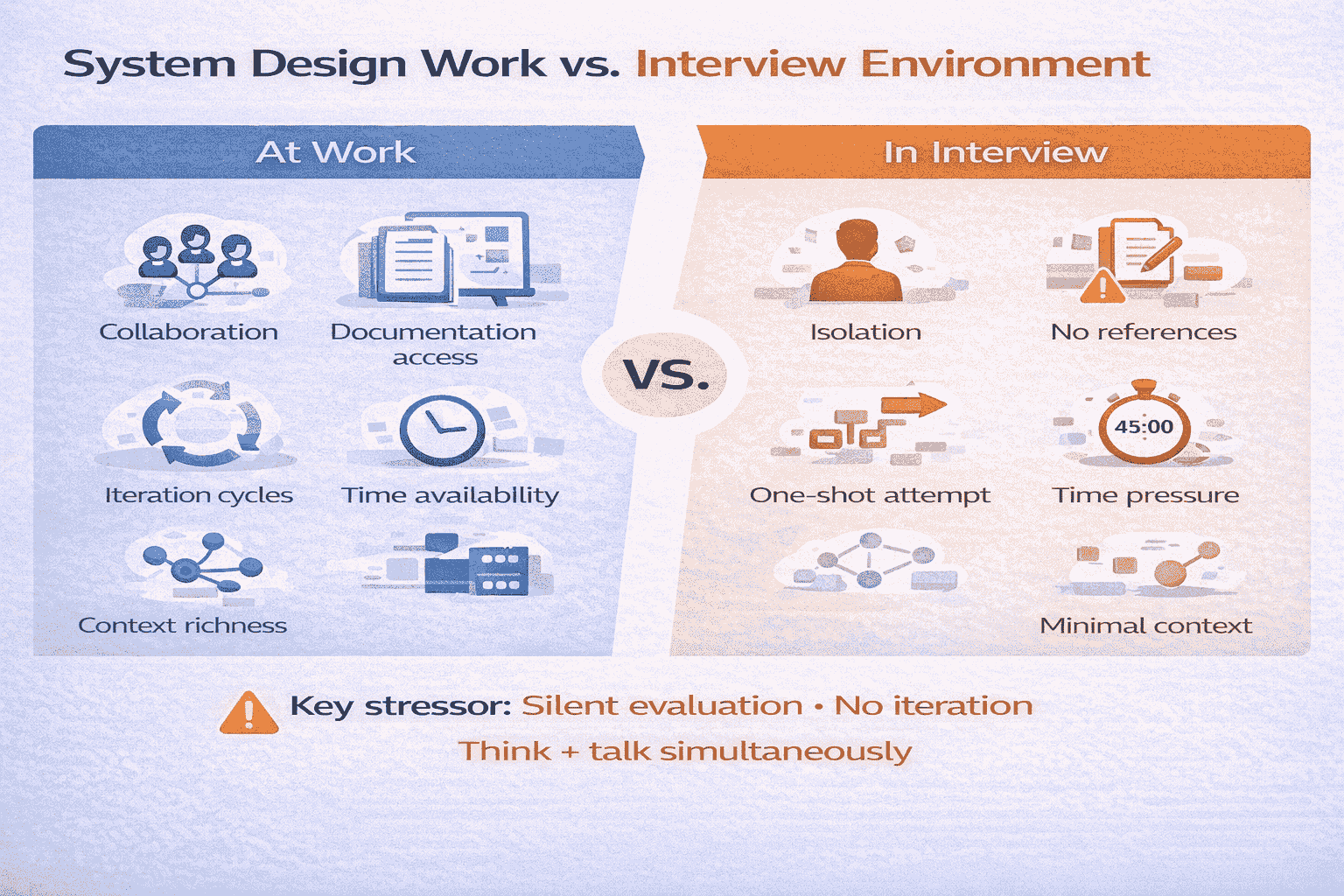
At work, you design systems with context, collaboration, and iteration. You have access to documentation. You can ask clarifying questions without worrying they reveal incompetence. You have time to think.
In interviews, all of that disappears.
No clear starting point. The problem is deliberately ambiguous. “Design Instagram” could mean anything from photo storage to recommendation algorithms to real-time messaging.
No single correct answer. Every architectural decision involves tradeoffs. Choose consistency over availability? Depends on requirements. Normalize your database? Depends on query patterns.
Continuous pressure to verbalize while thinking. Silence is interpreted negatively, so you must articulate your thought process in real-time—something you never do at work.
The Evaluation Ambiguity
Perhaps the most anxiety-inducing aspect is that you’re being continuously evaluated on criteria that are never fully explicit.
Yes, you know they’re assessing your technical knowledge. But they’re also evaluating your communication style, your ability to handle ambiguity, your question-asking approach, your awareness of tradeoffs, and your “senior engineering judgment.”
What does “senior engineering judgment” look like in a 45-minute conversation with a stranger? Nobody really knows, which is precisely the problem.
This ambiguity creates a constant background fear: “Am I already going in the wrong direction?”
The Working Memory Overload
Here’s what your brain is trying to hold simultaneously during a system design interview:
The technical content: requirements, constraints, architectural components, data flows, API contracts, scaling bottlenecks, failure modes.
The meta-cognitive layer: “Am I talking too much? Should I ask more questions? Did I address their concern? Am I being too detailed or too high-level?”
The emotional regulation: managing anxiety, maintaining confidence, reading social cues, responding to silence.
Cognitive psychology research shows that working memory can hold roughly 4-7 items simultaneously. You’re trying to juggle 15-20.
When working memory overloads, the first thing that fails is executive function—your ability to organize, sequence, and prioritize information.
This explains why you might know exactly what to do but can’t seem to do it coherently in the moment. The cognitive load is simply too high.
Why Every Pause Feels Risky
At work, pausing to think is normal. Healthy, even. You take time to consider approaches, sketch diagrams, consult with teammates.
In interviews, every pause feels like the clock ticking toward failure.
You know intellectually that interviewers expect some silence. But anxiety doesn’t care about logic. The silence feels like judgment, so you fill it—often with half-formed thoughts that make things worse.
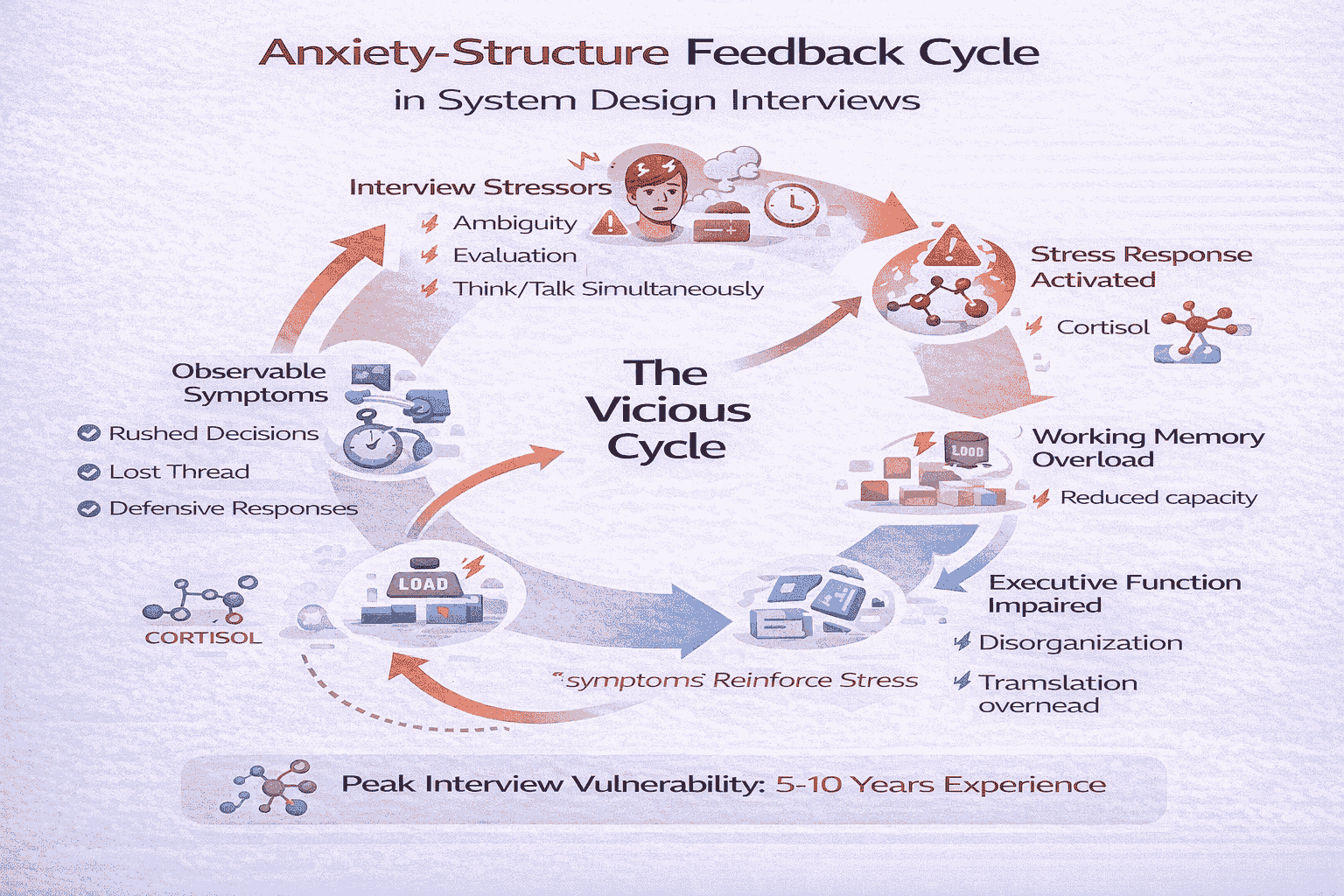
This creates a vicious cycle. Anxiety makes you talk faster. Talking faster reduces thinking quality. Poor thinking increases anxiety.
What Anxiety Looks Like in System Design Interviews
Anxiety rarely announces itself with obvious panic. Instead, it masquerades as behaviors that interviewers misinterpret as weak system design skills.
Understanding these behaviors helps you recognize anxiety when it’s happening—which is the first step toward managing it.
Rushing Into Architecture
The classic anxiety-driven mistake : jumping straight into database schemas or API endpoints before clarifying requirements.
This isn’t because you don’t know better. You’ve probably told junior engineers a hundred times to “clarify requirements first.”
But anxiety creates urgency. Drawing boxes and arrows feels productive. It fills the awkward space. It proves you know things.
The problem is that rushing into solutions is exactly what interviewers flag as a red flag—it signals poor problem-solving process, even though the real cause is anxiety seeking relief.
📊 Table: Anxiety Behaviors vs. How They’re Interpreted
These common anxiety-driven behaviors are systematically misread as technical weaknesses. Recognizing this pattern helps you understand that the feedback you receive often reflects symptom management, not your actual capabilities.
| Anxiety Behavior | What’s Actually Happening | How Interviewer Reads It | Impact on Evaluation |
|---|---|---|---|
| Rushing into architecture without clarifying requirements | Anxiety creates urgency; taking action reduces discomfort | “Doesn’t understand problem-solving methodology” | Marked as lacking senior judgment |
| Over-explaining every component in excessive detail | Trying to prove competence; filling silence feels safer | “Can’t identify what matters; poor prioritization” | Scored as missing the bigger picture |
| Losing track of requirements mid-discussion | Working memory overloaded by anxiety and multi-tasking | “Not keeping user needs in focus” | Flagged as poor requirements management |
| Freezing when assumptions are challenged | Unexpected challenge triggers fight-or-flight response | “Defensive; can’t handle feedback gracefully” | Noted as collaboration concern |
| Jumping between topics without finishing thoughts | Anxiety disrupts executive function and sequencing | “Scattered thinking; lacks structured approach” | Assessed as weak communication skills |
Over-Explaining Components
Another anxiety tell: launching into exhaustive explanations of components that don’t warrant that level of detail.
“So the load balancer will use a round-robin algorithm, or we could use least connections, or maybe consistent hashing if we need session affinity, and we should consider health checks…”
You know you’re doing it even as the words come out. But stopping feels dangerous. What if the interviewer thinks you don’t understand load balancers? Better to keep talking.
From the interviewer’s perspective, this looks like poor prioritization—inability to distinguish what matters from what doesn’t.
But the real issue is that anxiety hijacks your filtering mechanism. Everything feels equally important because you’re operating from fear rather than strategic thinking.
Losing the Thread
You start explaining your caching strategy, then suddenly realize you’ve veered into discussing API versioning, and you can’t quite remember how you got there.
This happens because anxiety fragments attention. Part of your mind is tracking the technical content. Part is monitoring the interviewer’s reactions. Part is managing your own stress response.
When attention is divided like this, you lose the narrative thread that holds your explanation together.
Interviewers interpret this as unclear thinking or poor communication. They don’t see the cognitive juggling act happening beneath the surface.
Defensive Responses to Questions
The interviewer asks, “What happens if that database becomes the bottleneck?”
A calm response might be: “Good question. We could introduce read replicas or implement caching. Let me think through the tradeoffs…”
An anxiety-driven response: “Well, I was planning to get to that. The database wouldn’t actually be a bottleneck because of the caching layer I mentioned, and also we could partition the data…”
The defensiveness isn’t intentional. When you’re already stressed, questions feel like attacks. Your nervous system responds accordingly—even though intellectually you know the interviewer is just probing your thinking.
This defensive posture gets noted as “doesn’t handle feedback well” or “not collaborative,” even though collaboration requires psychological safety that doesn’t exist in high-stakes interviews.
Why Experienced Engineers Are Hit the Hardest
There’s a cruel irony in system design interview anxiety: seniority often makes it worse, not better.
Junior engineers sometimes breeze through these interviews with unjustified confidence. Meanwhile, architects with a decade of production experience freeze.
This isn’t random. It’s a predictable consequence of how expertise develops.
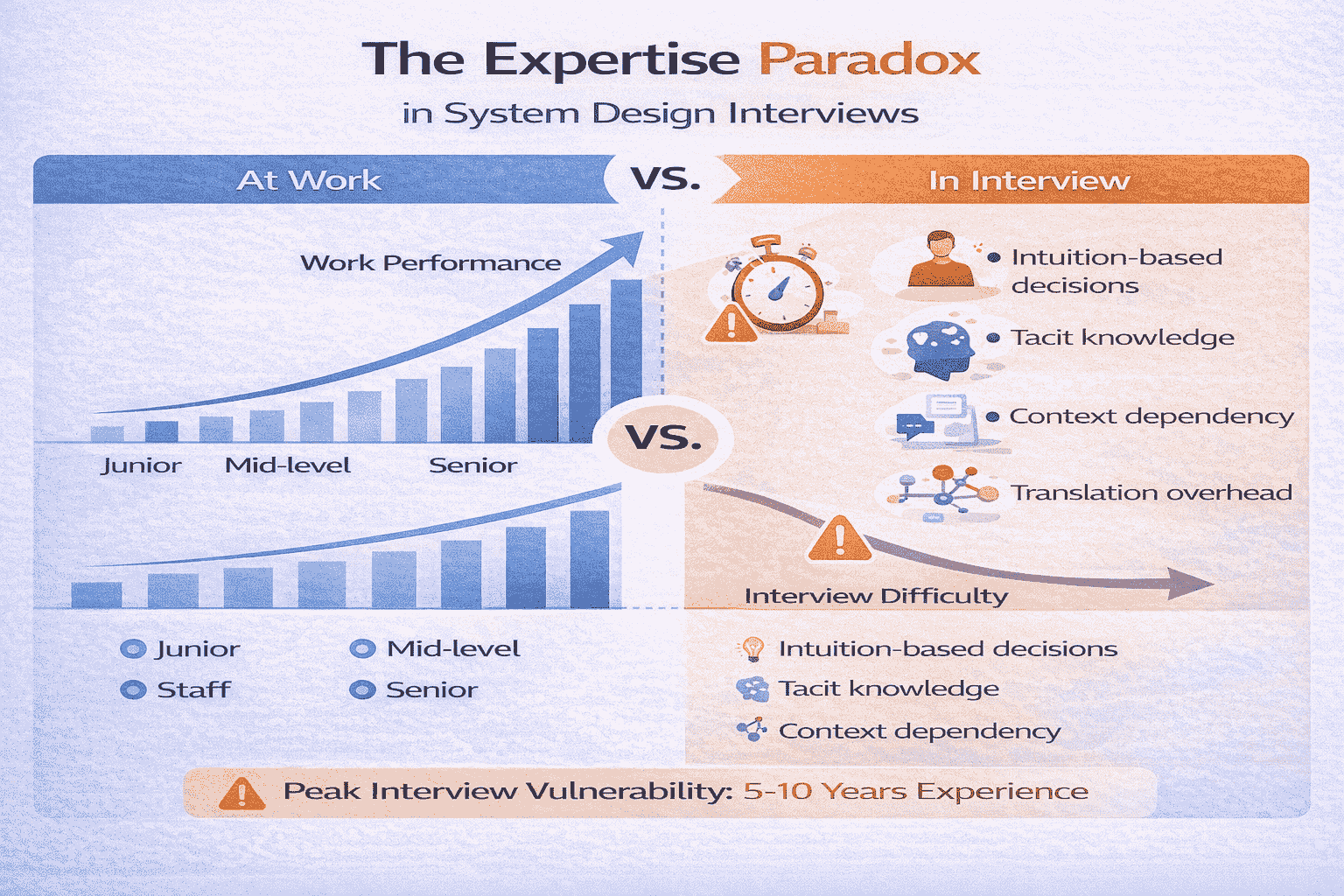
The Expertise Paradox
As you gain experience, your system design skills become increasingly intuitive. You don’t consciously think through every decision anymore—you just “know” what will work.
At work, this intuition is your superpower. You can quickly identify architectural issues. You see patterns others miss . You make good decisions efficiently.
But interviews require you to explain that intuition step-by-step to someone who doesn’t share your context.
That translation from intuition to explicit reasoning is cognitively expensive. Under stress, it often fails completely.
Tacit Knowledge vs. Explicit Performance
Much of what makes you effective as a senior engineer is tacit knowledge—things you know but can’t easily articulate.
You know that microservices introduce operational complexity. How do you know? From dozens of incidents, architecture reviews, migration projects. That knowledge lives in your gut, not in tidy explanations.
When anxiety narrows your thinking, you lose access to that rich experiential base. You’re left trying to reconstruct reasoning that you normally access automatically.
Junior engineers often fare better because their knowledge is still explicitly structured. They can recite textbook approaches because they recently memorized them.
Your knowledge is deeper but harder to verbalize under pressure—especially when that pressure triggers the exact cognitive constraints that make verbalization difficult.
The Stakes Feel Higher
When you’re interviewing for senior or staff positions, the evaluation criteria are inherently more subjective.
Junior interviews test if you can implement algorithms. Senior interviews test if you “think like a senior engineer”—whatever that means.
That ambiguity raises the stakes. You’re not just being tested on knowledge. You’re being tested on judgment, maturity, architectural taste—qualities that feel inseparable from your professional identity.
Failure doesn’t just mean “I didn’t get the job.” It means “Maybe I’m not actually as senior as I thought.”
That identity threat amplifies anxiety beyond what any junior candidate experiences.
The Context Compression Problem
At work, your architectural decisions make sense within layers of context: team capabilities, existing infrastructure, business constraints, timeline realities, political considerations.
In interviews, all of that context vanishes. You’re expected to make “good” architectural decisions in a vacuum, based on deliberately minimal requirements.
For senior engineers, this is disorienting. Your decision-making process fundamentally depends on context. Without it, you feel unmoored.
You compensate by asking clarifying questions—which is good. But anxiety makes you second-guess whether you’re asking too many questions or the “right” questions.
Meanwhile, junior engineers are more comfortable operating from first principles because that’s how they’ve always worked. They haven’t yet developed the context-sensitivity that makes senior judgment valuable but interview performance difficult.
The Crucial Reframe: Anxiety Causes Loss of Structure (Not the Other Way Around)
This is the insight that changes everything for candidates who understand it.
Most engineers believe they become anxious because they’re struggling with system design interviews. They think anxiety is a symptom of poor performance.
The reality is the reverse.
The Actual Causal Chain
You don’t lose structure because you’re anxious about system design. You become anxious because the interview format disrupts your ability to stay structured .
Here’s the sequence that actually occurs:
Step 1: The interview begins with inherent stressors—ambiguous problem, silent evaluation, requirement to think and speak simultaneously.
Step 2: These stressors activate your stress response, consuming cognitive bandwidth and working memory.
Step 3: Reduced cognitive capacity impairs executive function—your ability to organize, sequence, and prioritize information.
Step 4: Impaired executive function manifests as the exact behaviors interviewers penalize: losing track of requirements, jumping between topics, over-explaining details, rushing into solutions.
Step 5: Recognizing these behaviors creates secondary anxiety (“Why am I struggling with this?”), which further reduces cognitive capacity.
Why This Reframe Matters
When you understand anxiety as a cause rather than a symptom, three important things happen.
First, shame dissipates. You’re not fundamentally broken or unprepared. You’re experiencing a predictable physiological response to a challenging cognitive environment.
Second, the problem becomes addressable. If anxiety were proof of incompetence, there would be no solution except “become more competent.” But if anxiety is a response to specific conditions, you can learn to manage those conditions.
Third, feedback becomes interpretable. When an interviewer says you “lacked structure,” you can now understand this as “anxiety impaired your executive function” rather than “you don’t understand how to structure system design discussions.”
The Neuroscience Brief
Understanding what’s happening in your brain during anxiety helps demystify the experience and reduces its power.
When you perceive threat—even social/professional threat—your amygdala triggers a cascade of stress hormones including cortisol and adrenaline.
These hormones are excellent for physical emergencies. They sharpen reflexes and boost energy. But they’re terrible for complex cognitive tasks.
Specifically, elevated cortisol impairs the prefrontal cortex—the brain region responsible for executive function, working memory, and strategic planning. These are precisely the capabilities system design interviews demand.
Meanwhile, the amygdala becomes hyperactive, making you more reactive to perceived threats (like interviewer silence or challenging questions) and less capable of nuanced reasoning.
This isn’t weakness. It’s neurochemistry. And once you understand it, you can stop fighting yourself and start working with your nervous system.
Recognizing the Spiral in Real-Time
The most practical application of this reframe is developing awareness of when the anxiety-structure cycle is beginning.
Early warning signs include:
Physical sensations: Elevated heart rate, shallow breathing, tension in shoulders or jaw, feeling warm.
Cognitive changes: Thoughts speeding up, difficulty finishing sentences, awareness that you’re talking too fast.
Behavioral shifts: Suddenly drawing components without explanation, asking questions you don’t actually need answers to, defending choices before they’re challenged.
When you notice these signs, you’re not “doing it wrong.” You’re observing the cycle beginning. That awareness itself creates a small gap—a moment where intervention becomes possible.
We’ll explore specific interventions in related resources. For now, recognition is the goal. You can’t manage what you can’t see.
📋 Download: Anxiety Recognition Checklist
A printable single-page checklist to help you identify when the anxiety-structure cycle is activating during practice sessions or actual interviews. Use this to build self-awareness without self-judgment.
Download PDFBreaking the Identity Fusion
Perhaps the most liberating aspect of this reframe is separating anxiety from identity.
When you believe “I’m anxious because I’m not good enough,” anxiety becomes evidence of who you are. It feels fixed, permanent, defining.
When you understand “I’m experiencing anxiety because of how this interview format interacts with my nervous system,” anxiety becomes a state—temporary, situational, manageable.
You are not your anxiety. You are an experienced engineer whose cognitive performance is being temporarily impaired by a predictable physiological response.
That distinction is everything.
Moving Forward: From Understanding to Action
Understanding why anxiety happens doesn’t automatically eliminate it. But understanding is the essential foundation for everything that follows.
You now know that system design interview anxiety is:
Predictable — not a personal failing, but a systematic response to specific interview conditions.
Common — affecting even highly experienced engineers, particularly those with deep expertise.
Mechanical — following a clear causal chain from stressors to cognitive impairment to observable symptoms.
Addressable — because it operates through identifiable mechanisms rather than representing fundamental incompetence.
What Comes Next
With this foundation in place, you’re ready to move from diagnosis to intervention.
The next phase involves learning specific techniques for managing anxiety before it hijacks your performance. This includes:
Pre-interview preparation protocols that build psychological safety and reduce anticipatory anxiety.
In-interview grounding techniques that interrupt the anxiety spiral when you notice it beginning.
Structured communication frameworks that provide cognitive scaffolding when executive function becomes impaired.
Post-interview debrief processes that prevent negative experiences from reinforcing anxiety for future interviews.
If you’re preparing for upcoming system design interviews, consider exploring our comprehensive preparation programs at geekmerit.com , where we integrate anxiety management with technical skill-building.
The Immediate Priority: Self-Compassion
Before learning techniques, establish one critical practice: treating yourself with the same compassion you’d offer a colleague experiencing interview anxiety.
You wouldn’t tell a talented engineer they’re incompetent because they froze in an interview. You’d recognize the interview as a stressful, artificial situation that doesn’t reflect their actual capabilities.
Extend that same understanding to yourself.
Every time you catch yourself thinking “What’s wrong with me?” or “Why can’t I just perform under pressure?”, pause. Recognize that as the anxiety talking, not accurate self-assessment.
Replace it with: “I’m experiencing a normal stress response to an abnormally challenging cognitive task. This doesn’t define my abilities.”
Practice as Exposure, Not Just Preparation
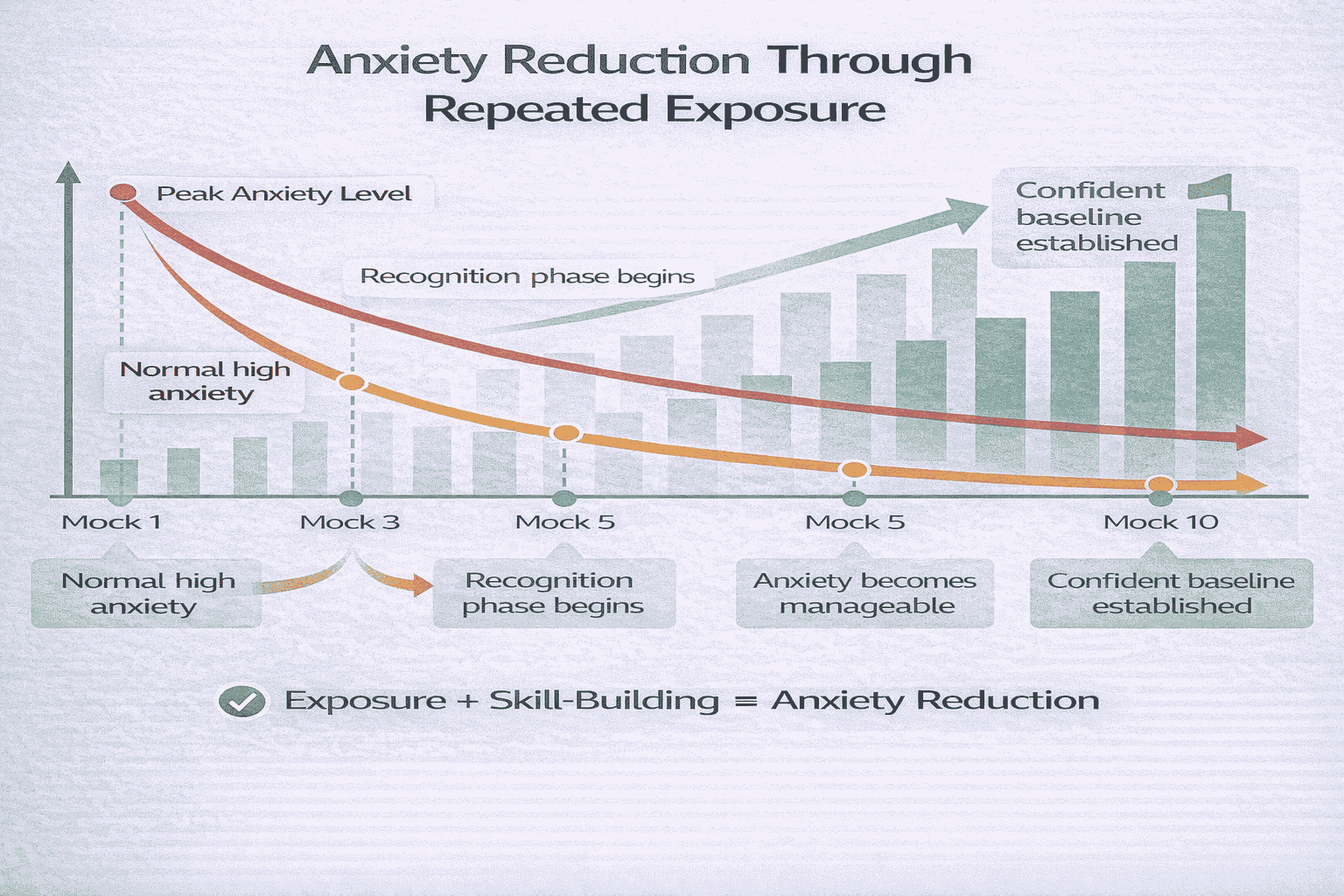
When you understand anxiety’s role, mock interviews serve a dual purpose.
Yes, they help you practice technical content. But more importantly, they provide controlled exposure to interview conditions, helping your nervous system learn that these situations aren’t actually dangerous.
This is why repeated practice in interview-like conditions matters more than you might think. You’re not just building skills—you’re desensitizing your threat response.
Our mock interview program is specifically designed to provide this therapeutic exposure alongside technical feedback, helping you build both competence and confidence.
Building Your Support System
Interview preparation shouldn’t be isolating. One of anxiety’s favorite tactics is making you feel alone in your struggle.
Connect with other engineers preparing for system design interviews. Share experiences. Normalize the difficulty. Recognize that everyone battles some version of this challenge.
When you hear others describe the same thought patterns and behaviors, anxiety loses some of its power. It’s harder to believe “I’m uniquely broken” when you realize the experience is nearly universal.
Consider working with a coach who understands both the technical and psychological dimensions of system design interviews. At geekmerit.com , our coaching approach explicitly addresses anxiety alongside architectural thinking.
Not sure whether paying for coaching is worth it in your situation? Read Is System Design Interview Coaching Worth It?.
Measuring Progress Differently
Finally, redefine what progress looks like during your preparation.
Progress isn’t just “I explained the architecture more clearly this time.” It’s also:
“I noticed my anxiety beginning and didn’t panic about it.”
“I took a breath before answering instead of rushing into a response.”
“I asked a clarifying question even though it felt uncomfortable.”
“I recognized I was over-explaining and course-corrected mid-answer.”
These small victories in managing anxiety are as important as technical improvements—perhaps more so, because they address the root cause of performance impairment.
Celebrate them accordingly.
You’re Not Broken—The Format Is Broken
If there’s one message to carry forward from this article, it’s this: your anxiety doesn’t prove you lack system design skills .
It proves you’re a human being with a functioning nervous system responding predictably to an inherently stressful situation.
System design interviews combine multiple cognitive and social stressors in a format that has no parallel in actual engineering work. Of course that triggers anxiety. Of course that impairs performance.
What You’ve Learned
You now understand that:
Interview anxiety follows predictable patterns rooted in cognitive science and neurochemistry, not personal inadequacy.
The behaviors interviewers flag as “weak system design” are often anxiety symptoms being misread as technical deficits.
Senior engineers are particularly vulnerable because expertise becomes intuitive and context-dependent, making verbalization under stress especially difficult.
Anxiety causes loss of structure, not the other way around—a reframe that transforms shame into understanding.
Your Path Forward
Armed with this understanding, you can approach interview preparation differently.
Instead of just studying system design patterns, you can also develop anxiety management skills. Instead of beating yourself up after a difficult interview, you can analyze what triggered the anxiety response.
Most importantly, you can separate your anxiety from your identity. You are a capable engineer who experiences a normal stress response to abnormal conditions.
That clarity is the foundation for everything else.
Ready to Transform Your Interview Performance?
Understanding anxiety is the first step. The next step is building the skills to manage it while demonstrating your technical expertise.
At geekmerit.com, we offer comprehensive programs that integrate anxiety management with system design mastery:
Self-Paced Course ($197): Learn at your own speed with video lessons, practice problems, and frameworks designed to work even under stress. View pricing details .
Guided Program ($397): Add weekly live sessions and direct feedback on your practice interviews. Get personalized coaching that addresses both technical gaps and anxiety patterns. Explore the curriculum .
Bootcamp ($697): Intensive preparation with daily mock interviews, anxiety coaching, and accountability. Designed for engineers with upcoming interviews who need rapid improvement. Learn about our approach .
Every program explicitly addresses the psychological dimension of system design interviews, because we know that managing anxiety is as critical as understanding distributed systems.
Compare programs and choose your path forward .
The Final Truth
You know more about system design than you’re able to demonstrate under interview pressure. That’s not speculation—it’s the inevitable result of how anxiety impairs cognitive function.
The solution isn’t to know more. It’s to create conditions where you can access what you already know.
That journey starts with understanding. And now you do.
Frequently Asked Questions
Is it normal to feel more anxious in system design interviews than coding interviews?
Yes, this is extremely common and has a clear explanation. Coding interviews have more structure—specific problems with verifiable solutions. System design interviews are deliberately ambiguous with no single correct answer, which creates more uncertainty. Additionally, system design interviews evaluate subjective qualities like “senior judgment” and communication style, making the stakes feel higher. The open-ended nature and continuous verbal performance requirement trigger more anxiety for most engineers, regardless of their actual system design competence.
Why do I perform well in architecture discussions at work but freeze in interviews?
Work discussions and interviews operate under fundamentally different conditions. At work, you have shared context with colleagues, ability to iterate on ideas, access to documentation, and psychological safety. Interviews remove all of these supports while adding evaluation pressure and time constraints. Your expertise at work relies heavily on tacit knowledge and intuition that’s difficult to verbalize under stress. This isn’t a performance gap—it’s a context mismatch. Your interview performance doesn’t accurately reflect your architectural abilities; it reflects how well you can translate context-dependent expertise into explicit explanations under artificial conditions.
Does anxiety during system design interviews mean I’m not senior enough for the role?
No. Anxiety has no correlation with technical competence or seniority level. In fact, senior engineers often experience more interview anxiety because their knowledge has become intuitive and context-dependent, making it harder to verbalize under pressure. Junior engineers sometimes perform better in interviews because their knowledge is still explicitly structured from recent study. Your anxiety is a physiological response to evaluation pressure and cognitive load—not evidence that you lack the skills for senior roles. Many highly successful senior engineers and architects experience significant interview anxiety.
Can practicing more system design problems reduce my anxiety?
Yes, but only if practice includes interview-like conditions. Simply studying system design patterns helps with knowledge but doesn’t address anxiety. Effective practice requires simulating actual interview pressure—timed sessions, thinking aloud while solving problems, working with unfamiliar interviewers, and receiving real-time feedback. This controlled exposure helps your nervous system learn that interview conditions aren’t genuinely threatening, gradually reducing the anxiety response. Mock interviews with experienced coaches are particularly valuable because they provide both technical feedback and anxiety management strategies. Our mock interview program is specifically designed for this dual benefit.
What should I do when I notice anxiety starting during an interview?
First, recognize that noticing anxiety is actually a positive sign—awareness creates the opportunity for intervention. Take one slow, deep breath to activate your parasympathetic nervous system. Then verbalize what you’re doing: “Let me take a moment to organize my thoughts” or “I want to make sure I’m addressing your question properly.” This pause gives your prefrontal cortex a chance to re-engage. If you’ve lost your thread, it’s okay to say “Let me step back and recap where we are.” Interviewers generally respect intentional pauses more than rushed, disorganized answers. The key is catching anxiety early before it fully hijacks your executive function.
How long does it typically take to manage system design interview anxiety?
Most engineers see meaningful improvement within 5-10 structured practice sessions that explicitly address anxiety alongside technical content. The timeline varies based on baseline anxiety levels and quality of practice. Simply doing more interviews without understanding anxiety mechanisms tends to reinforce anxiety patterns rather than resolve them. Working with a coach who addresses both technical and psychological dimensions typically accelerates progress significantly. Our guided program is structured around this integrated approach, helping engineers build both confidence and competence over 8-12 weeks of focused preparation.
Citations
Content Integrity Note
This guide was written with AI assistance and then edited, fact-checked, and aligned to expert-approved teaching standards by Andrew Williams . Andrew has over 10 years of experience coaching software developers through technical interviews at top-tier companies including FAANG and leading enterprise organizations. His background includes conducting 500+ mock system design interviews and helping engineers successfully transition into senior, staff, and principal roles. Technical content regarding distributed systems, architecture patterns, and interview evaluation criteria is sourced from industry-standard references including engineering blogs from Netflix, Uber, and Slack, cloud provider architecture documentation from AWS, Google Cloud, and Microsoft Azure, and authoritative texts on distributed systems design.

