
System Design Interviews vs Real-World Experience: Why Senior Developers Struggle

You walk out of another system design interview feeling confused and frustrated. You’ve built production systems. You’ve scaled services that handle millions of requests. Yet somehow, why senior developers fail system design interviews remains a personal mystery.
If you feel stuck because you haven’t done formal system design/architecture work before, start here: How to Crack System Design Interviews Without Prior Design Experience.
The interviewer said you “jumped to solutions” and “lacked structure.” But in your actual job, speed and intuition are assets, not liabilities.
This disconnect isn’t because you’re bad at system design. It’s because interviews measure something entirely different than what you do every day.
Last updated: Feb. 2026
Table of Contents
- 1. Understanding the Disconnect Between Work and Interviews
- 2. The Dangerous Myth That Experience Equals Interview Success
- 3. What System Design Interviews Actually Test
- 4. Why Senior Developers Struggle More Than Mid-Level Candidates
- 5. Common Interview Mistakes That Quietly Kill Senior Candidates
- 6. What Interviewers Expect Instead
- 7. The Reframe That Changes Everything
- 8. What Comes Next
- 9. Moving From Self-Doubt to Clarity
- 10. Frequently Asked Questions
Contents










Understanding the Disconnect Between Work and Interviews
“I’ve designed real systems. So why do I keep failing these interviews?”
This question haunts senior developers who walk out of system design interviews confused and quietly doubting themselves.
You’ve built production systems. You’ve handled incidents at 2 a.m. You’ve scaled services, optimized performance, and made trade-offs that actually mattered.
When Experience Feels Like It Should Be Enough
And yet, in a 45-minute interview, you’re told things like:
“You didn’t show enough structure.”
“You jumped to solutions too quickly.”
“Your fundamentals seem weak.”
This disconnect hurts. It feels unfair. Worse, it feels personal.
The Truth About What’s Being Measured
Let’s say this clearly upfront: this is not because you’re bad at system design.
It’s because system design interviews are not measuring real-world system design the way you practice it daily.
Real-world experience builds intuition. Interviews demand explicit reasoning.
Interviewers can’t see what’s in your head. They don’t infer competence from confidence. They evaluate what you say, when you say it, and how you structure it under pressure.
Experience helps. But only if you know how to translate it into interview signals.
The Dangerous Myth That Experience Equals Interview Success
One of the biggest traps senior developers fall into is a silent assumption.
“If I’ve done this at work, I should naturally pass this interview.”
Unfortunately, this belief is exactly what causes many experienced engineers to fail.
Why This Assumption Breaks Down
At work, you have context. You know the constraints. You understand the team’s capabilities and the existing infrastructure.
You make decisions quickly because you’ve accumulated pattern recognition over years. Your judgment is usually right.
In interviews, none of that context exists. The interviewer is testing whether you can build that context from scratch, out loud, in real-time.
The Hidden Cost of Assumptions
When you assume requirements are “obvious,” you skip clarification questions.
When you rely on intuition, you fail to verbalize your reasoning process.
When you move quickly to solutions, interviewers see recklessness rather than expertise.
The problem isn’t your technical ability. The problem is that interviews require you to externalize your thinking in ways your daily work doesn’t.
???? Table: Experience vs. Interview Requirements
This table shows the specific mismatches between what real-world experience teaches you and what interviews actually evaluate.
| What Experience Teaches | What Interviews Evaluate | The Gap |
|---|---|---|
| Move fast with incomplete information | Clarify requirements systematically first | Speed looks like carelessness |
| Rely on established patterns | Explain reasoning from first principles | Intuition is invisible to interviewers |
| Iterate and improve post-launch | Design correctly in one pass | No second chances in 45 minutes |
| Use company-specific tools and jargon | Communicate in universal abstractions | Internal language doesn’t translate |
| Focus on shipping quickly | Demonstrate comprehensive thinking | Completeness beats speed |
| Make decisions collaboratively | Drive design solo with confidence | Independence is required, not optional |
The Performance Skill Realization
Here’s the shift that changes everything: system design interviews are a performance skill, not a knowledge test.
You’re not proving you can design systems. You already can.
You’re demonstrating that you can communicate your design thinking clearly to strangers under time pressure.
That’s a completely different skill. One that requires specific preparation.
What System Design Interviews Actually Test
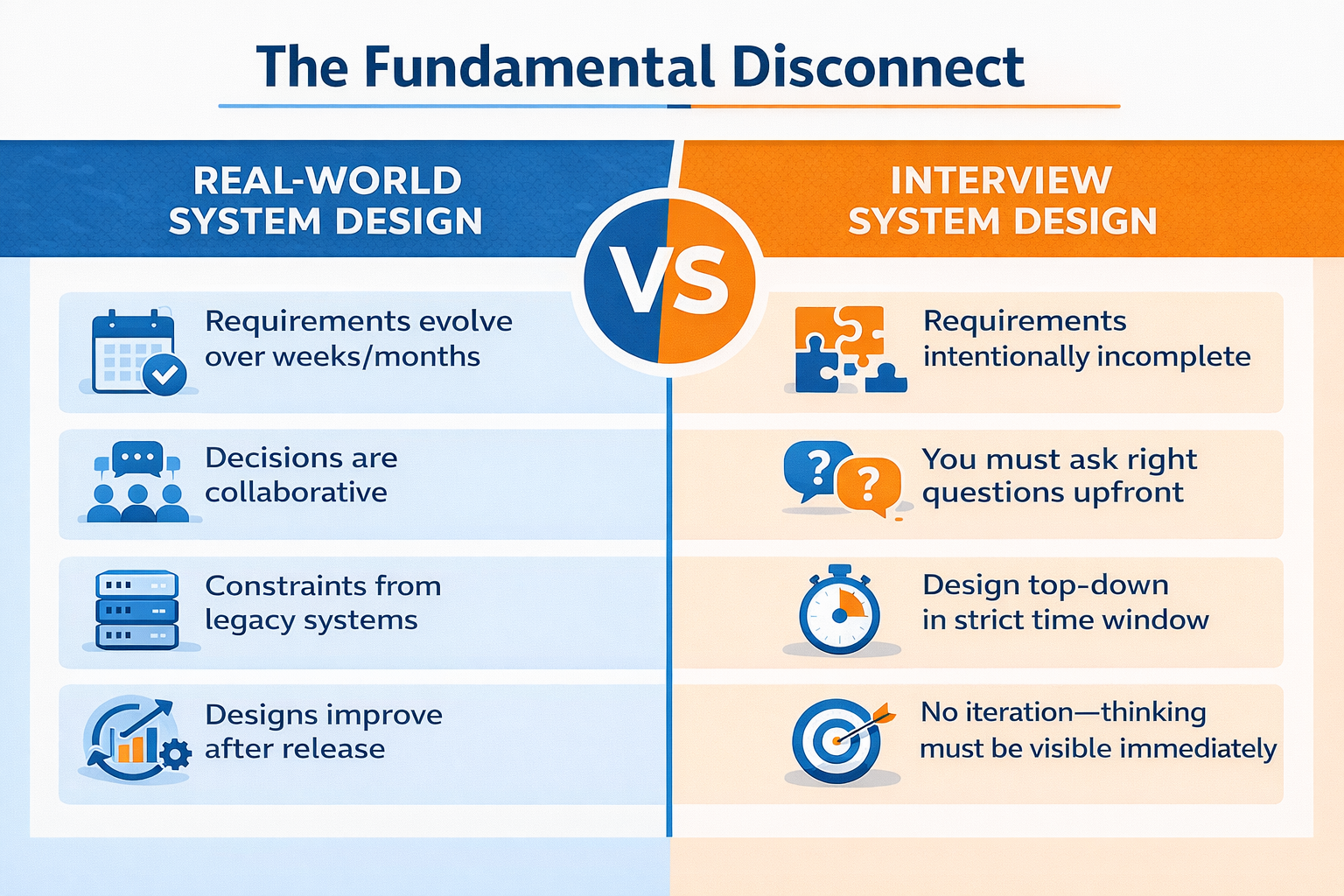
In your job, system design looks like this:
Requirements evolve over weeks or months. Decisions are collaborative and revisited. Constraints come from legacy systems, teams, and deadlines. You improve designs incrementally after release.
The Interview Version of System Design
In interviews, system design looks nothing like that:
Requirements are intentionally incomplete. You are expected to ask the right questions upfront. You must design top-down in a strict time window. There is no iteration???your thinking must be visible immediately.
The interview is not about building the “best” system. It’s about demonstrating structured thinking under uncertainty.
What “Structured Thinking” Actually Means
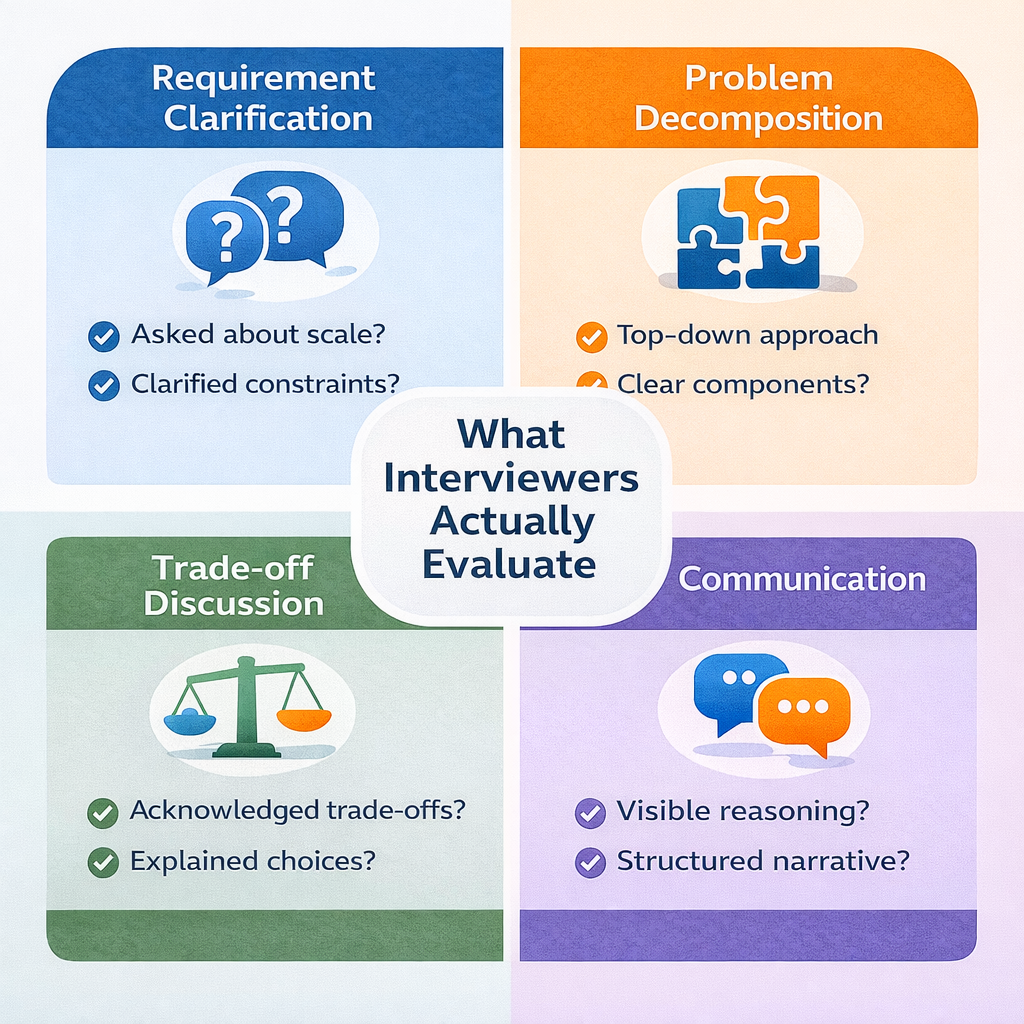
When interviewers say they want to see “structure,” they mean specific behaviors:
Starting with clarifying questions before any technical decisions. Breaking down the problem into clear components before diving into details. Discussing trade-offs explicitly rather than presenting perfect solutions. Showing your reasoning process step-by-step.
These behaviors prove you can handle ambiguity. That’s what senior engineers do.
Why This Feels Wrong to Experienced Developers
At work, these behaviors often slow you down unnecessarily. You’re paid to ship, not to explain every decision in excruciating detail.
But interviews aren’t work. They’re calibrated to evaluate your thinking process, not your delivery speed.
That’s why strong senior engineers often feel blindsided. The skills that make you valuable at work???speed, intuition, decisiveness???can actually work against you in interviews if not communicated properly.
Why Senior Developers Struggle More Than Mid-Level Candidates
Here’s an uncomfortable truth: experience can work against you in system design interviews.
This sounds counterintuitive. More experience should mean better performance, right?
Not necessarily. Not in this context.
The Experience Paradox
Senior developers tend to make specific mistakes that mid-level candidates avoid simply because they lack the same intuition.
You jump to familiar architectures too quickly. You’ve seen this problem before, so you skip to the solution without showing your work.
You assume constraints instead of clarifying them. The requirements seem “obvious” based on your experience, so you don’t ask questions that interviewers expect.
You over-optimize early because you’ve seen failures before. You know what breaks at scale, so you design for problems that may not exist in the interview scenario.
When Expertise Becomes Invisible
The phrase “I’ve built this exact thing” running through your head is actually a warning sign.
When something feels obvious, you’re more likely to skip the clarification questions. You’re more likely to assume scale requirements. You’re more likely to jump to implementation details.
All of these behaviors signal poor judgment to interviewers, even though they’re signs of expertise in the real world.
???? Table: How Experience Creates Interview Blind Spots
Understanding these patterns helps you recognize when your experience is helping versus hurting your interview performance.
| Senior Developer Behavior | Why It Happens | What Interviewer Sees | Mid-Level Advantage |
|---|---|---|---|
| Skips requirement clarification | Problem seems familiar and “obvious” | Arrogance or carelessness | Asks questions because genuinely uncertain |
| Jumps to specific technologies | Knows what works from past projects | Technology-driven, not requirements-driven | Starts with abstractions, adds tech later |
| Over-optimizes prematurely | Has battle scars from production failures | Solving wrong problem first | Addresses stated requirements only |
| Uses internal jargon | Comfortable with company-specific terms | Poor communication or limited exposure | Uses textbook terminology naturally |
| Moves too fast | Pattern recognition from experience | Skipping critical thinking steps | Methodical because learning as they go |
The Communication Gap
Interviewers don’t reward speed. They reward clarity, structure, and trade-off awareness.
If you don’t verbalize your reasoning, it doesn’t count. Your mental model doesn’t matter if it stays in your head.
Mid-level candidates often perform better because they naturally talk through their thinking. They’re still building confidence, so they explain more.
Senior developers often think faster than they speak. You make intuitive leaps that seem obvious to you but look like logical gaps to interviewers.
Breaking the Pattern
The fix isn’t to become less experienced. It’s to recognize when your expertise is invisible to the interviewer.
Every assumption you make silently is a missed opportunity to demonstrate judgment. Every shortcut you take mentally needs to be shown explicitly.
Your experience is your strength. But only when you learn to make it visible.
Common Interview Mistakes That Quietly Kill Senior Candidates
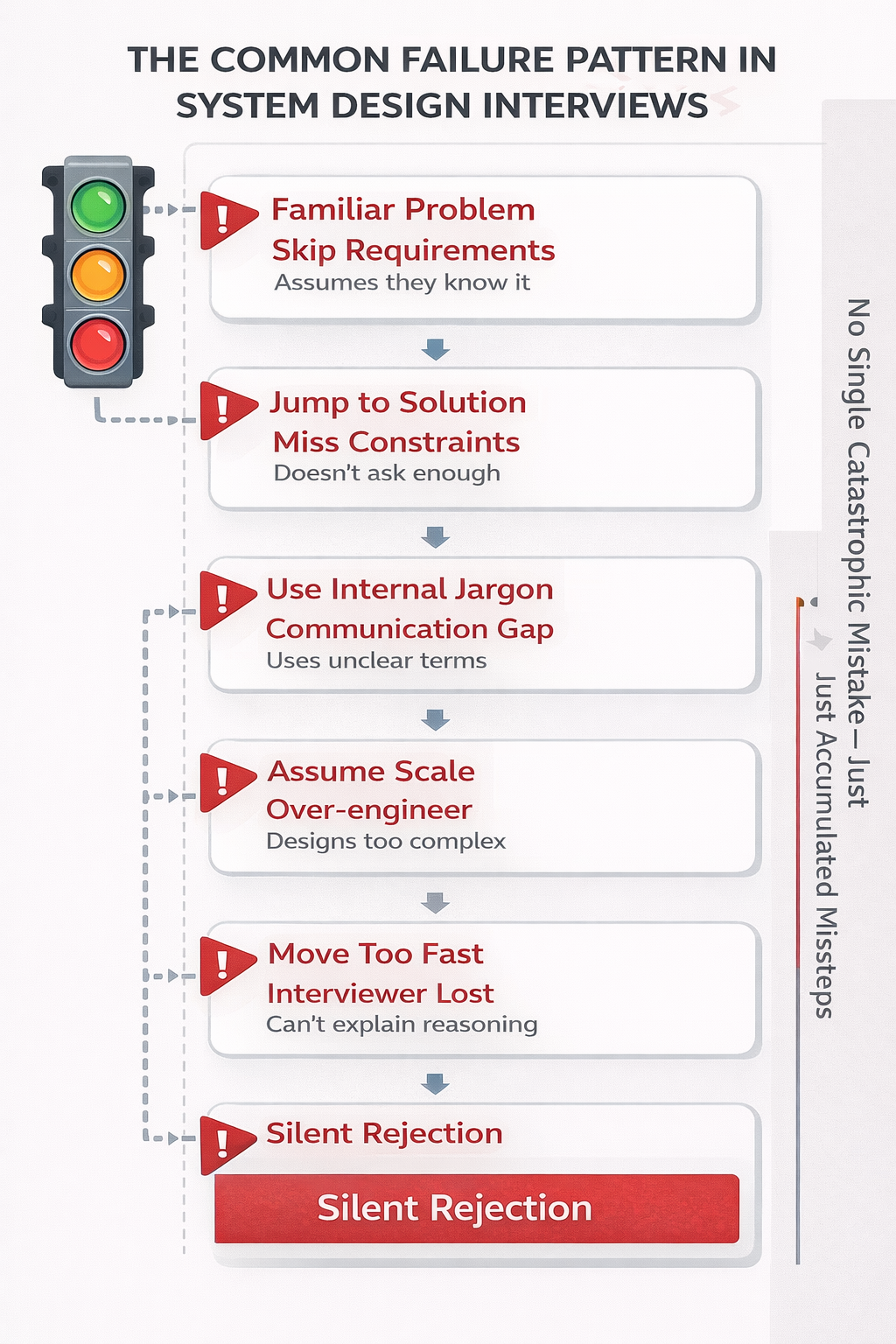
Most senior candidates don’t fail dramatically. They fail subtly.
There’s no single catastrophic mistake. Instead, there’s a pattern of small missteps that accumulate.
The interviewer doesn’t say “you’re terrible.” They say “you’re not quite what we’re looking for” or “we’re moving forward with other candidates.”
The Silent Failure Patterns
Starting with databases, caches, or cloud services before defining the problem. This signals solution-first thinking rather than requirements-driven design.
Designing for massive scale without validating traffic assumptions. You jump to “millions of users” when the interviewer never specified scale requirements.
Skipping requirement clarification because the use case “seems clear.” What seems obvious to you might be intentionally ambiguous to test your judgment.
Describing systems as they exist at work instead of explaining why they exist. You say “we use Kafka” without explaining the trade-offs that led to that choice.
Why These Mistakes Hurt More for Senior Candidates
When a mid-level engineer jumps to solutions, interviewers attribute it to inexperience. They course-correct gently.
When a senior engineer does the same thing, interviewers question judgment. They wonder if you’ll listen to feedback on the job.
The bar is higher because the expectations are higher. Fair or not, that’s the reality.
The “Obvious” Trap
Thoughts like “this is obvious” are your enemy in interviews.
When something seems obvious to you, that’s exactly when you need to slow down and verbalize your assumptions.
Ask yourself: “Have I explicitly stated what I’m assuming about scale, consistency requirements, latency budgets, or failure modes?”
If the answer is no, you’re probably making the same mistake that’s costing other senior developers their offers.
None of These Mean You Lack Skill
Every single one of these mistakes comes from competence, not incompetence.
You skip requirements because you’ve seen similar problems. You jump to solutions because you know what works. You move fast because you’re confident in your judgment.
These behaviors make you valuable at work. They just don’t translate to interview success without deliberate adjustment.
Download: Senior Developer Interview Mistake Checklist
Use this checklist during practice sessions to catch the specific mistakes that hurt senior candidates. Print it and review before each mock interview.
Download PDFWhat Interviewers Expect Instead
When interviewers evaluate senior candidates, they’re looking for signals that rarely get discussed explicitly.
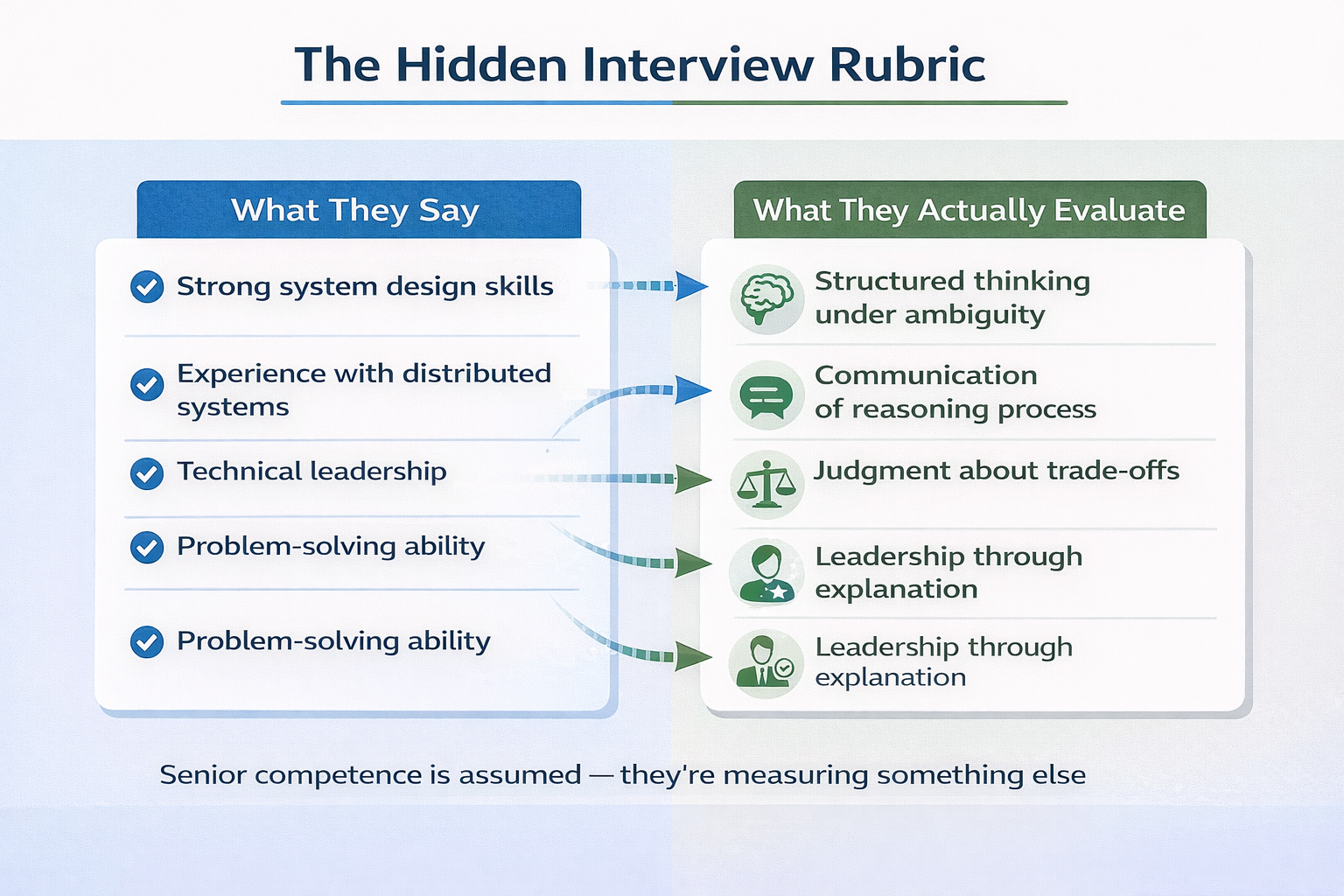
The job description says “strong system design skills.” But what does that actually mean in the interview context?
The Real Evaluation Criteria
Calm, methodical clarification of requirements. Not rushing to show technical knowledge, but taking time to understand the problem completely.
Top-down decomposition before technical depth. Starting with high-level components and relationships before diving into database schemas or API designs.
Explicit discussion of trade-offs, not perfect solutions. Showing that you understand every design choice has costs and benefits.
Clear communication that shows leadership thinking. Explaining your reasoning in ways that would help junior engineers understand your decisions.
The Question Behind the Question
Interviewers are really asking: “Can this person reason clearly when nothing is given to them?”
They’re not asking: “Can this person build production systems?”
That distinction changes everything about how you should approach the interview.
What “Good” Looks Like in Practice
A senior candidate who performs well typically starts by asking questions about scale, consistency, and latency before proposing any architecture.
They sketch high-level components first. They label the boxes clearly. They explain relationships between services before discussing implementation.
When they make a design choice, they state the trade-off explicitly. “We’re choosing eventual consistency here to gain availability, which means we need to handle conflicts in the application layer.”
They pause to check in with the interviewer. “Does this align with the constraints we discussed? Should I go deeper on the data model or move to the API design?”
The Senior-Level Signal
What separates senior candidates from mid-level isn’t more complex architectures. It’s showing wisdom about what matters most.
Senior candidates acknowledge uncertainty. “I’d want to validate these latency assumptions with load testing before committing to this approach.”
They consider operational concerns early. “This adds complexity to deployments, so we’d need to evaluate whether the performance gain justifies the operational overhead.”
They think about team and organizational constraints. “This design assumes we have strong SRE support. If that’s not the case, I’d simplify the caching layer.”
These statements demonstrate leadership thinking. That’s what distinguishes senior performance from technically correct but junior-sounding answers.
If you’re preparing for senior system design interviews, understanding structured frameworks that emphasize communication patterns can help you translate your experience into interview-appropriate signals.
The Reframe That Changes Everything
System design interviews are a performance skill, not a reflection of your real-world competence.
Read that sentence again. Let it sink in.
This single reframe changes how you prepare, how you practice, and how you interpret feedback.
What This Reframe Actually Means
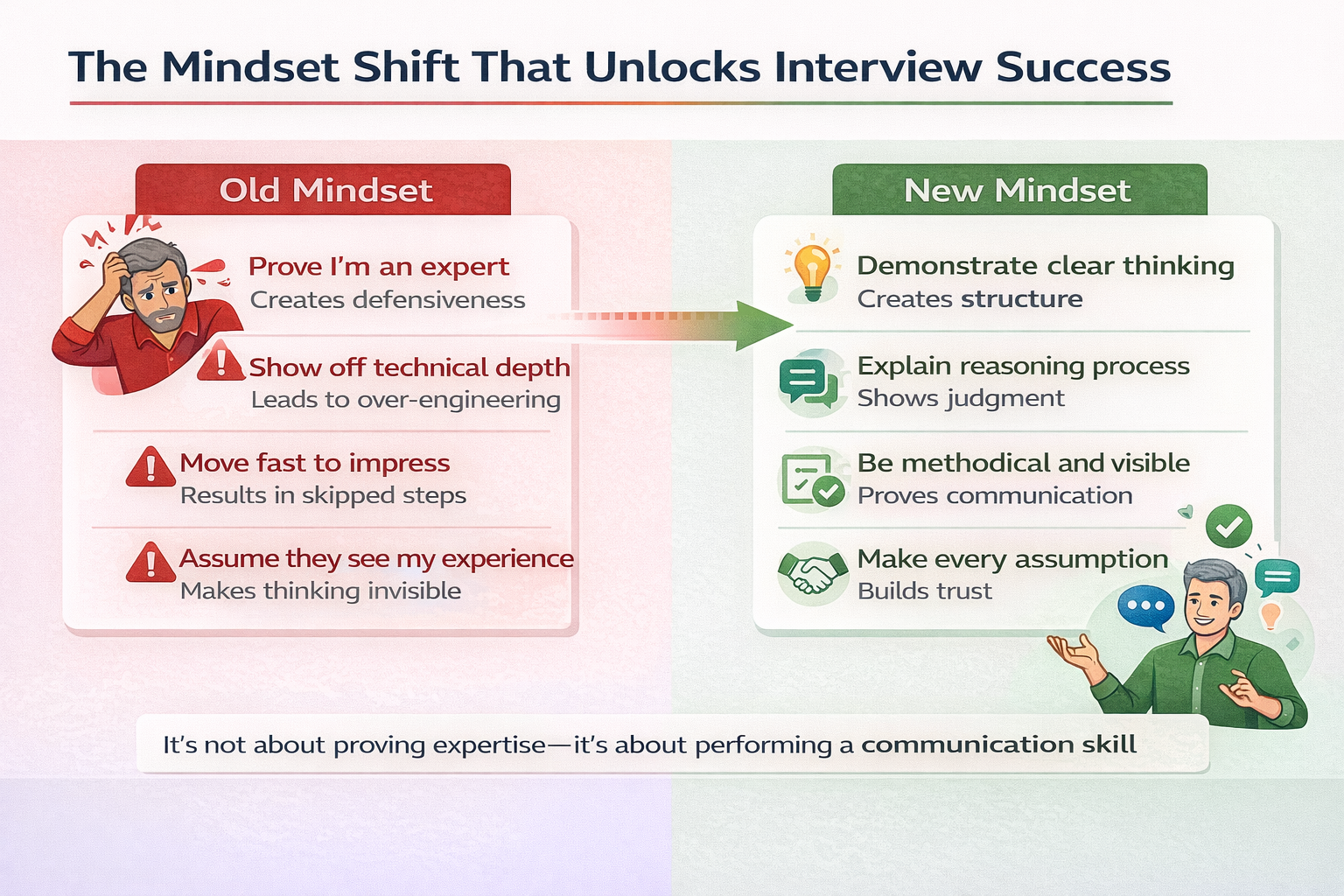
You’re not defending your expertise. You’re demonstrating a specific communication pattern that interviewers are trained to recognize.
The interview isn’t testing whether you can build systems. You’ve already proven that through years of work.
It’s testing whether you can explain your thinking clearly to strangers under artificial time constraints.
That’s a completely different skill. One that requires different preparation.
How This Changes Your Preparation
Once you accept that interviews are performance skills, preparation becomes targeted instead of overwhelming.
You stop trying to memorize every possible architecture pattern. Instead, you practice the communication framework that works across all problems.
You stop reviewing your past projects for “interview stories.” Instead, you practice verbalizing your reasoning process in real-time.
You stop second-guessing your technical judgment. Instead, you focus on making that judgment visible to interviewers.
Practice Becomes Deliberate Instead of Random
With the wrong mindset, you practice by reading articles about distributed systems or watching videos about microservices.
With the right mindset, you practice by recording yourself solving problems out loud and watching the playback.
You notice when you make assumptions silently. You catch yourself skipping clarification questions. You see the moments when your reasoning becomes invisible.
That’s deliberate practice. That’s what actually improves interview performance.
Feedback Finally Makes Sense
Remember that confusing feedback? “You didn’t show enough structure” or “You jumped to solutions too quickly”?
With the performance skill mindset, this feedback becomes actionable.
It’s not saying your design was wrong. It’s saying your communication pattern didn’t match what interviewers were trained to look for.
Fix the performance, not the underlying knowledge.
You Stop Trying to “Prove Experience”
The most liberating part of this reframe is simple: you can stop defending your competence.
Your resume already proved your experience. The interview isn’t questioning whether you can design systems.
It’s measuring whether you can teach someone else your design thinking in 45 minutes.
Can you show your work? Can you explain trade-offs? Can you help an interviewer follow your reasoning?
That’s the skill. Nothing more, nothing less.
Many senior developers find that structured mock interview practice with feedback helps them internalize this reframe faster than studying alone.
What Comes Next
If this article felt like it was describing you, that’s not accidental.
Thousands of senior developers experience this exact pattern. The confusion. The frustration. The quiet self-doubt.
The good news: once you understand what’s actually being measured, the problem becomes solvable.
The Three Critical Realizations
First, you need to identify which assumptions consistently fail you in interviews. Is it scale? Consistency requirements? Communication patterns?
Second, you need to learn how to structure answers so your experience becomes visible instead of invisible. This means specific communication frameworks.
Third, you need to understand how senior candidates are actually evaluated differently from mid-level candidates. The rubric isn’t the same.
The Learning Path Forward
Start by recording yourself solving a system design problem out loud. Watch the playback with the mistakes from this article in mind.
Notice when you skip clarification. Mark every assumption you make silently. Count how many times you explain trade-offs versus just stating decisions.
This self-awareness is the foundation. You can’t fix patterns you can’t see.
Common Questions at This Stage
“How long does it take to fix these patterns?” Most senior developers see improvement within 3-5 focused practice sessions once they know what to focus on.
“Do I need to re-learn system design?” No. You need to re-learn how to communicate system design in interview contexts.
“What if I’ve already failed multiple interviews?” Past failures actually help because you have specific feedback to work with. Use it.
Resources That Actually Help
Generic system design courses often make the problem worse for senior developers. They teach patterns you already know without addressing the communication gap.
What helps: structured practice with feedback on your communication patterns. Mock interviews where someone evaluates how visible your thinking is, not whether your design would work.
Understanding common assumptions that fail system design interviews helps you anticipate pitfalls before they occur.
Learning why strong coders still fail system design interviews reveals the specific performance skills that matter most.
The right preparation approach focuses on communication frameworks and performance skills rather than accumulating more technical knowledge.
Moving From Self-Doubt to Clarity
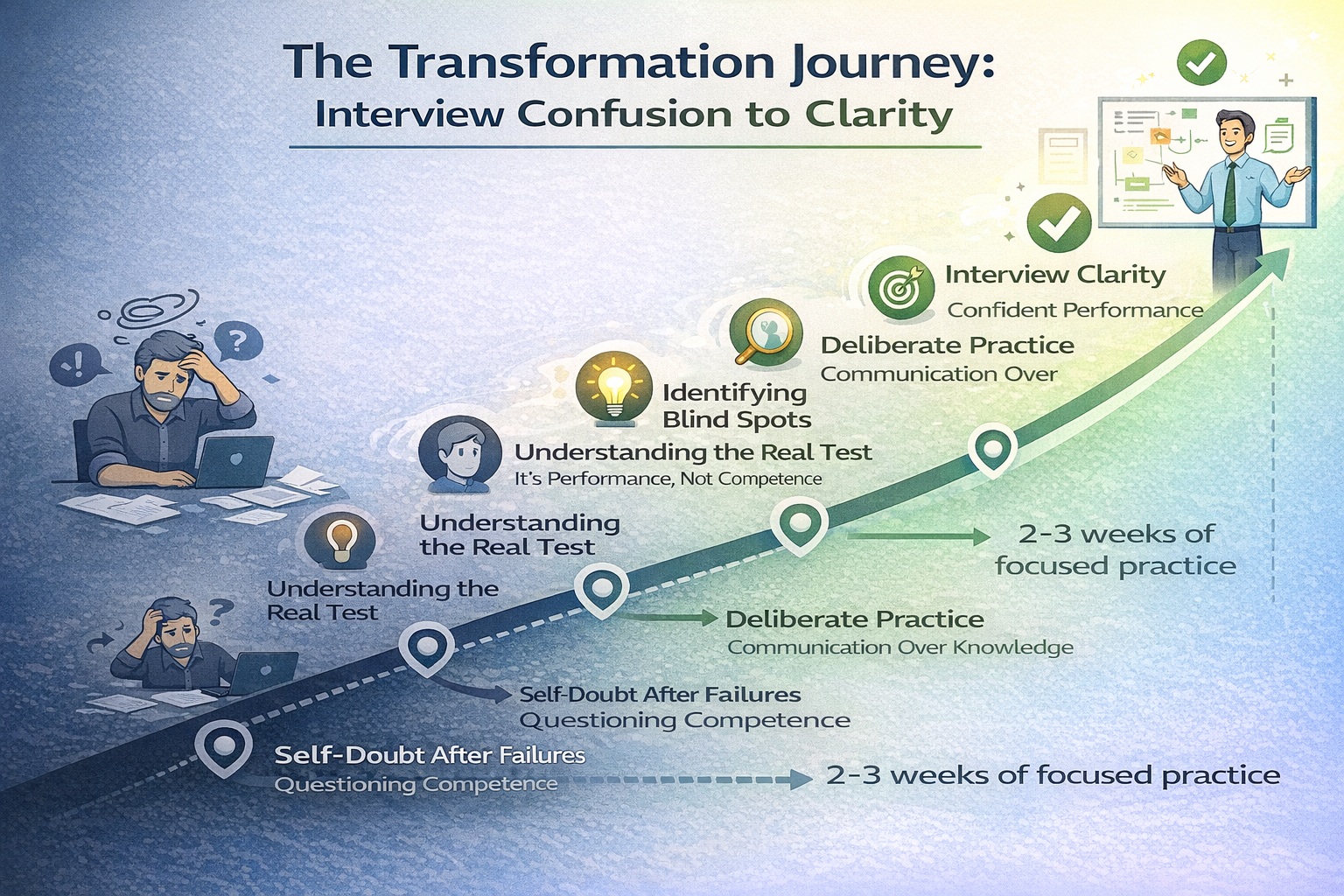
This page was designed to do one thing well: replace self-doubt with clarity.
If you walked away from system design interviews questioning your abilities, you now have a different framework for understanding what happened.
The problem wasn’t your technical competence. It was the mismatch between how you naturally work and how interviews measure thinking.
What You Now Understand
System design interviews test communication performance, not design ability. Your experience is an asset only when you make it visible through specific communication patterns.
Senior developers struggle with unique challenges that mid-level candidates avoid. Your expertise creates blind spots when intuition replaces explicit reasoning.
Interview failure is usually subtle accumulation of small missteps, not catastrophic mistakes. Each silent assumption, each unexplained leap, each missed clarification adds up.
The Path Forward Is Clear
You don’t need to become a better system designer. You need to become better at performing system design thinking in interview contexts.
That means deliberate practice focused on communication patterns. Recording yourself. Getting feedback on visibility, not correctness.
It means recognizing when your experience is helping versus hurting. Learning to slow down and verbalize the thinking that currently happens silently in your head.
This Is Not About Working Harder
You don’t need more study time. You need different practice.
You don’t need more technical knowledge. You need better communication frameworks.
You don’t need to prove yourself. You need to perform a specific skill that you haven’t practiced yet.
Once that clicks, fixing the problem becomes straightforward.
The Next Step
Knowledge without action just breeds more confusion. You now understand why senior developers fail system design interviews despite real-world success.
The question is: what will you do with this understanding?
Start with one practice session. Record yourself. Watch for the patterns discussed in this article. Notice when your thinking becomes invisible.
That single session will teach you more than reading ten more articles.
For developers ready to systematically address these patterns, structured coaching programs provide the feedback loop that makes improvement measurable and consistent.
Not sure whether paying for coaching is worth it in your situation? Read Is System Design Interview Coaching Worth It?.
Frequently Asked Questions
Why do I fail system design interviews when I’ve built similar systems at work?
Work and interviews measure different skills. At work, you design with full context, team collaboration, and time to iterate. Interviews test whether you can communicate your design thinking clearly to strangers in 45 minutes without context. Your technical ability isn’t in question???your communication performance is what’s being evaluated.
How long does it take to improve interview performance for senior developers?
Most senior developers see measurable improvement within 3-5 focused practice sessions once they understand what to focus on. The key is deliberate practice on communication patterns, not reviewing more technical material. Expect 4-6 weeks of consistent practice to internalize the new communication framework.
Should I study more distributed systems concepts or practice communication?
As a senior developer, you already have the technical knowledge. Your gaps are almost certainly in communication patterns???verbalizing assumptions, explaining trade-offs explicitly, and structuring your thinking visibly. Focus 90% of preparation time on communication practice and only 10% on technical review.
What’s the biggest mistake senior developers make in system design interviews?
Skipping requirement clarification because the problem seems familiar. When something feels “obvious,” that’s exactly when you need to slow down and ask questions. Interviewers are testing whether you can handle ambiguity, not whether you recognize patterns quickly.
Do mock interviews actually help or are they just practice tests?
Mock interviews help only if they focus on communication feedback, not just whether your design is “correct.” You need someone evaluating how visible your thinking is, whether you’re explaining trade-offs, and how well you’re structuring the conversation. Generic technical feedback won’t address the performance skills gap.
Can I use examples from my current company during interviews?
Yes, but translate them into universal abstractions first. Don’t say “we use our internal UserProfileService.” Instead say “we maintain a centralized user service that handles authentication and profile data, which trades consistency for availability in our use case.” Explain the why and the trade-offs, not just the what.
Citations
Content Integrity Note
This guide was written with AI assistance and then edited, fact-checked, and aligned to expert-approved teaching standards by Andrew Williams . Andrew has over 10 years of experience coaching software developers through technical interviews at top-tier companies including FAANG and leading enterprise organizations. His background includes conducting 500+ mock system design interviews and helping engineers successfully transition into senior, staff, and principal roles. Technical content regarding distributed systems, architecture patterns, and interview evaluation criteria is sourced from industry-standard references including engineering blogs from Netflix, Uber, and Slack, cloud provider architecture documentation from AWS, Google Cloud, and Microsoft Azure, and authoritative texts on distributed systems design.

