
System Design Interviews Without Prior Experience: Why You’re Not Automatically Disqualified

The most common reason engineers fail system design interviews without prior experience has nothing to do with technical ability. It’s the quiet voice that whispers: “I’ve never designed a real system. I don’t belong here.”
That single thought eliminates more candidates than poor performance ever will. It stops qualified engineers from applying, postpones preparation indefinitely, and creates mental surrender before the interview even begins.
If that thought sounds familiar, you’re in the right place. This page exists to dismantle that fear and show you what system design interviews actually test.
Last updated: Feb. 2026
Table of Contents
- 1. Why Engineers Panic the Moment They Hear “System Design”
- 2. The Crippling Myth: “No Prior Experience = Automatic Failure”
- 3. What System Design Interviews Actually Test
- 4. Why Candidates Without Experience Often Fail (And It’s Not Skill)
- 5. Another Myth: “Experience Guarantees Success”
- 6. What Interviewers Actually Want From Candidates Without Experience
- 7. The Real Problem: Self-Disqualification Before the Interview Begins
- 8. Removing the Mental Block That Keeps You From Trying
- 9. Your Permission to Prepare Seriously
- 10. FAQs
Contents










“I’ve Never Designed a Big System… So Why Am I Even Here?”
This page is for engineers who quietly panic the moment they hear “system design interview.”
Not because they’re lazy or unprepared. But because a single thought keeps repeating in their head: “I’ve never designed a system end-to-end. I don’t belong in this interview.”
So they hesitate to apply. They postpone preparation. They mentally give up before the interview even starts.
If that thought sounds familiar, this page is for you.
The Invisible Barrier Most Engineers Face
Most engineers preparing for senior roles have solid coding skills. They’ve shipped features, fixed bugs, optimized APIs, and built internal tools.
But when they read job descriptions mentioning “designed scalable systems” or “architecture ownership,” a different narrative takes over.
They compare their experience to what they think the company wants. And the gap feels insurmountable.
📊 Table: Common Experience Gaps Engineers Worry About
This table shows the difference between typical mid-level developer experience and what job descriptions seem to demand. The gap feels wider than it actually is.
| What You’ve Actually Done | What Job Descriptions Say | How It Feels |
|---|---|---|
| Built features within existing services | “Designed distributed systems at scale” | Like you’re missing years of experience |
| Fixed performance bottlenecks | “Architected high-throughput systems” | Like optimization isn’t architecture |
| Integrated third-party APIs | “End-to-end system ownership” | Like integration work doesn’t count |
| Worked on microservices teams | “Led architectural decisions” | Like being on a team isn’t enough |
| Debugged production issues | “Designed for reliability and fault tolerance” | Like reactive work isn’t design thinking |
Why This Matters More Than You Think
This isn’t just imposter syndrome. It’s a specific, measurable problem.
When engineers believe they’re underqualified, they:
- Delay applying to roles they could land
- Prepare defensively instead of strategically
- Communicate uncertainty during interviews
- Accept lower offers because they feel lucky to be considered
The cost isn’t just emotional. It’s financial and career-limiting.
What This Page Will Do For You
This page has one goal: remove the mental block that stops you from preparing seriously.
By the end, you’ll understand:
- What system design interviews actually test (it’s not experience)
- Why insecurity sabotages candidates more than skill gaps
- What interviewers expect from candidates without prior exposure
- How to shift from “I don’t belong” to “I can prepare for this”
This isn’t a preparation guide. This is the conversation that needs to happen before preparation can begin.
The Crippling Myth: “No Prior Experience = Automatic Failure”
One belief eliminates more candidates than poor performance ever does.
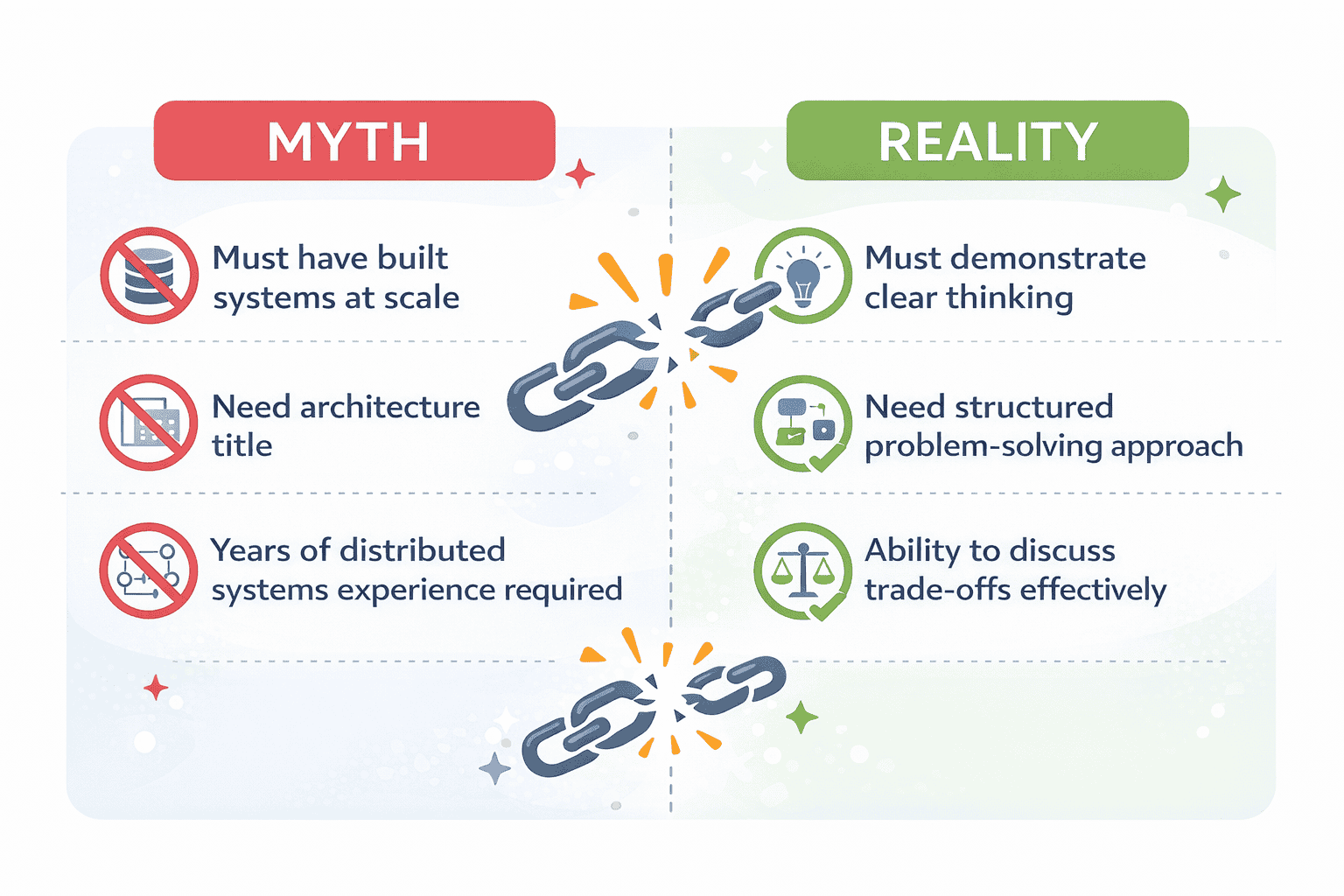
“System design interviews are only for architects or people who’ve already built large systems.”
This belief feels especially convincing when job descriptions mention “designed scalable systems,” “architecture ownership,” or “high-scale distributed systems.”
Why This Myth Feels True
If your experience is mostly feature development, API work, bug fixes, optimizations, or internal tools, it’s easy to conclude: “They’re not looking for someone like me.”
The myth gains strength from three sources:
Job descriptions use architectural language. Phrases like “designed systems handling millions of requests” sound like requirements, not aspirations.
Interview prep content assumes experience. Most guides start with “leverage your production experience” or “think about systems you’ve built.”
Successful candidates rarely admit they lacked experience. Once someone passes, they reframe their background to match the narrative. You only hear success stories that confirm the myth.
Where This Myth Actually Comes From
The myth didn’t emerge from nowhere. It comes from a misunderstanding of what hiring managers write versus what interviewers evaluate.
Hiring managers write job descriptions to attract experienced candidates. They use ambitious language to set expectations.
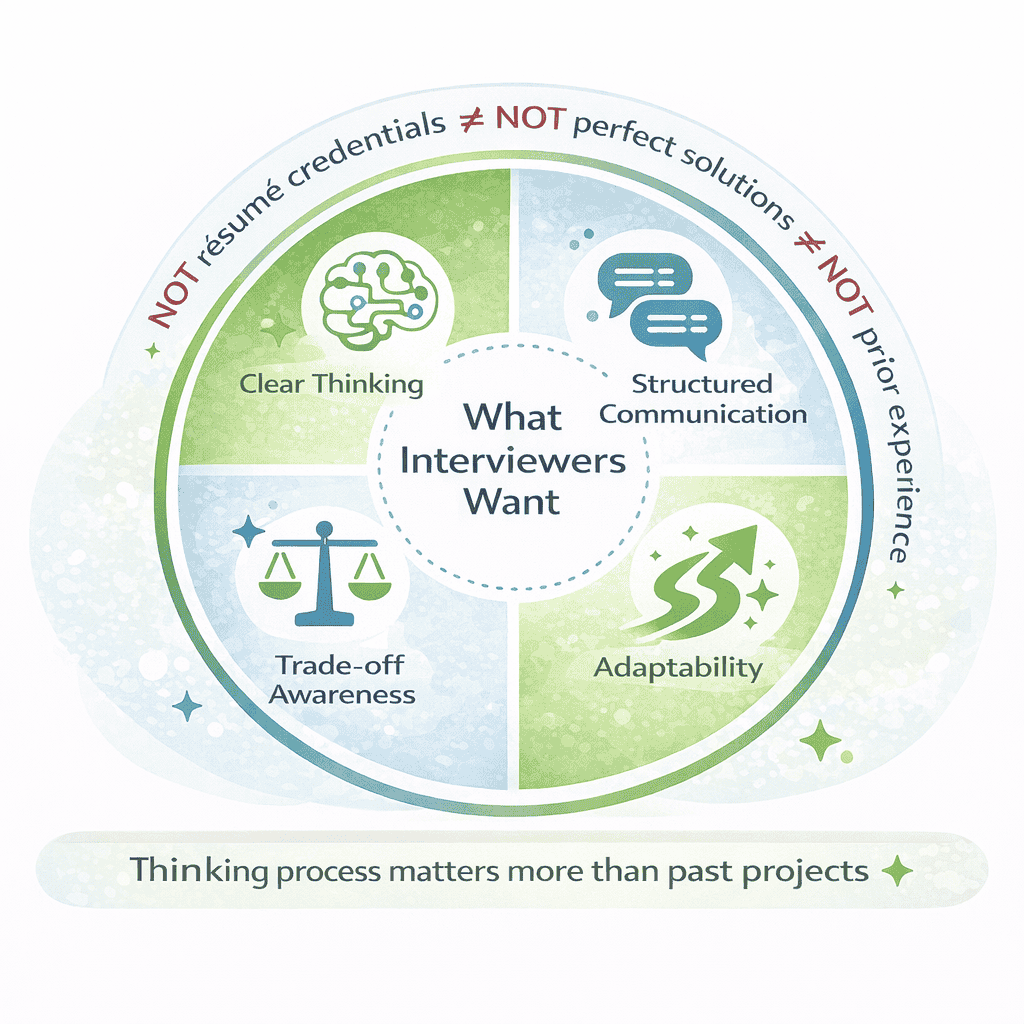
Interviewers, however, evaluate thinking process. They watch how candidates clarify ambiguity, decompose problems, and communicate trade-offs.
The gap between these two perspectives creates the myth.
The Truth: Interviews Test Thinking, Not Résumés
Here’s what actually happens in a system design interview.
An interviewer presents an ambiguous problem. “Design Instagram” or “Design a URL shortener” or “Design a notification system.”
They’re not checking whether you’ve built Instagram. They’re observing how you think when information is missing.
The evaluation focuses on:
- How you clarify vague requirements
- How you reason when data is incomplete
- How you break problems into logical components
- How you explain trade-offs under time pressure
- How you adapt when challenged or corrected
In other words, they’re testing how you think, not what you’ve already built.
Why This Distinction Changes Everything
Once you understand this, the interview stops looking like a résumé trap. It starts looking like a reasoning exercise.
You don’t need permission from past projects to demonstrate clear thinking. You need preparation that trains thinking skills.
That’s a fundamentally different challenge. And it’s one you can address regardless of your background.
What System Design Interviews Actually Test
System design interviews are not experience audits.
Interviewers are not checking whether you’ve already built the system they’re asking about. They’re running a thinking simulation.
Understanding this difference changes everything about how you prepare.
The Core Evaluation Framework
When an interviewer asks you to “design Twitter” or “design a ride-sharing system,” they’re observing specific thinking behaviors.
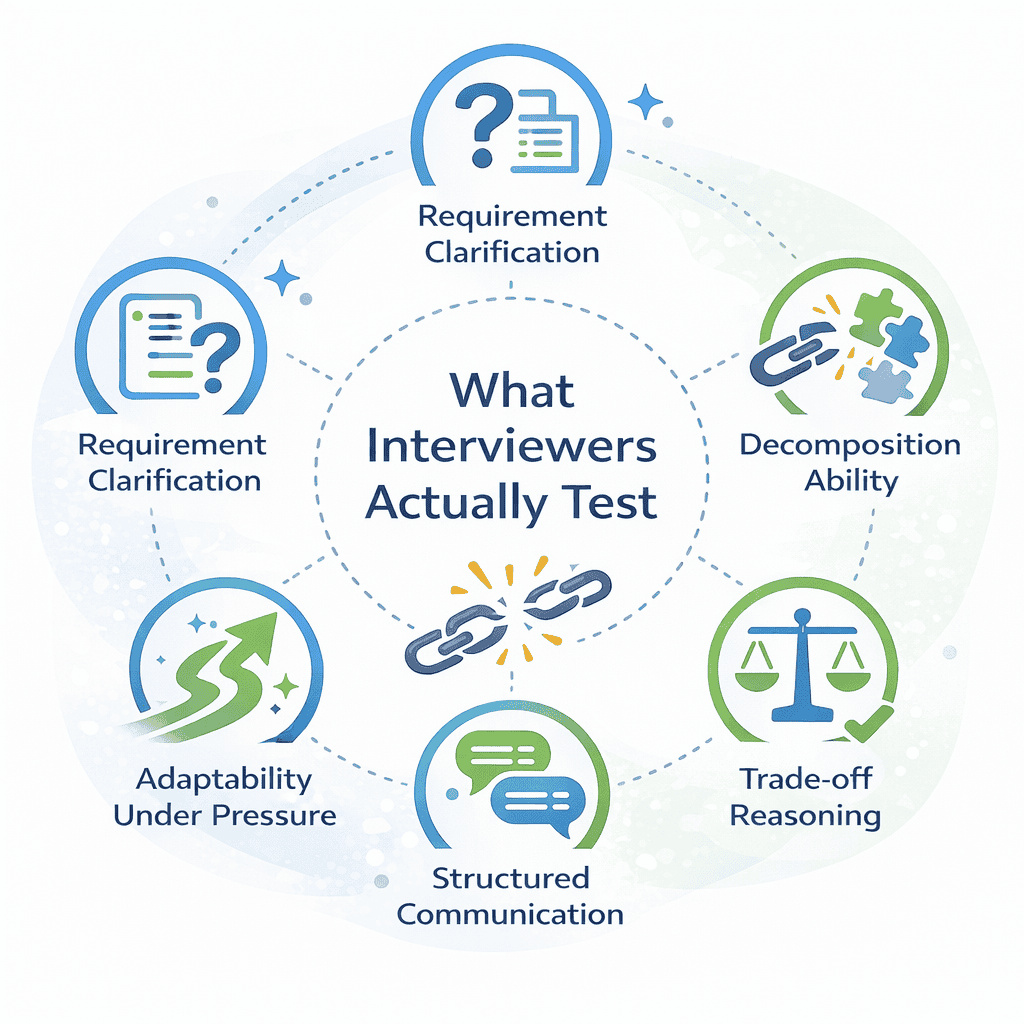
Here’s what they’re actually testing:
Requirement clarification. Can you identify what’s ambiguous and ask the right questions? When given “design a messaging system,” do you clarify scale expectations, latency requirements, and delivery guarantees?
Decomposition ability. Can you break a complex problem into logical components? Do you identify core services, data flows, and boundaries between system parts?
Trade-off reasoning. Can you articulate why you’d choose SQL over NoSQL, or vertical scaling before horizontal? Do you understand what you’re gaining and losing with each decision?
Structured communication. Can you explain your thinking process clearly? Do you walk through your design methodically, or jump around randomly?
Adaptability under pressure. When the interviewer challenges an assumption or introduces a constraint, can you adjust your design logically?
Why Past Experience Isn’t the Deciding Factor
Here’s the surprising truth: candidates with extensive production experience often struggle with these exact same areas.
They might have built real systems, but if they can’t articulate their reasoning or respond to constraints, they perform poorly.
Conversely, candidates without production experience who demonstrate clear thinking, structured communication, and trade-off awareness perform well.
The interview tests your ability to think through problems methodically. That’s a skill you can develop regardless of your résumé.
The Information Gap Strategy
System design interviews deliberately create information gaps.
When an interviewer says “design a URL shortener,” they’re intentionally leaving out critical details. Scale? Geographic distribution? Read-heavy or write-heavy? Custom URLs or random generation only?
The ambiguity is the point.
Strong candidates recognize the gaps and fill them through clarifying questions. Weak candidates make assumptions and build on shaky foundations.
This has nothing to do with whether you’ve built a URL shortener before. It’s about recognizing what’s missing and asking for it.
What “Good Enough” Actually Looks Like
You don’t need a perfect architecture. You need a defensible one.
Interviewers aren’t looking for the “correct” answer. They’re looking for logical reasoning that leads to a workable solution.
A candidate who says “I’d use Redis for caching because we need sub-millisecond reads, but I’m aware we’ll need cache invalidation strategies” demonstrates understanding.
A candidate who says “I’d use Redis” without explanation demonstrates nothing.
The quality of your reasoning matters more than the sophistication of your architecture.
Why Candidates Without Experience Often Fail (And It’s Not Skill)
Here’s the painful irony.
Candidates without prior experience often fail not because they lack ability, but because insecurity sabotages them.
The failure happens before they even start solving the problem.
The Self-Sabotage Patterns
When engineers believe they don’t belong in the interview, they exhibit specific behaviors that interviewers penalize heavily.
Excessive apologizing. “I haven’t done this before, so I’m not sure if this is right, but…” This signals lack of confidence, not honesty.
Staying vague to avoid being wrong. Using hand-wavy language like “we’d use some kind of queue” or “probably need a database” instead of making concrete proposals.
Freezing while searching for the “correct” answer. Spending minutes in silence because they’re afraid of proposing something imperfect.
Copying standard architectures without understanding. Regurgitating patterns from prep materials without being able to explain why they fit this specific problem.
These behaviors don’t signal honesty or humility. They signal lack of clarity and preparation.
And interviewers penalize that far more than inexperience.
📊 Table: Self-Sabotaging Behaviors vs. Strong Candidate Behaviors
This table contrasts how insecurity manifests in interviews versus how confidence in your reasoning process appears. Notice that the strong behaviors don’t require prior experience—just preparation and clarity.
| Self-Sabotaging Behavior | What It Signals | Strong Alternative |
|---|---|---|
| “I’ve never built this before, so…” | Lack of confidence; asking for lower standards | “Let me clarify requirements first: what scale are we targeting?” |
| Staying vague: “Some kind of cache layer” | Avoiding specifics to dodge being wrong | “I’d use Redis for caching because we need fast reads” |
| Long silences while searching for perfect answer | Inability to think out loud or structure thoughts | “Let me think through this step by step…” [explains reasoning] |
| Copying architectures without explanation | Memorization without understanding | “I’m choosing X over Y because of this specific trade-off” |
| “Is that what you’re looking for?” | Seeking validation instead of demonstrating reasoning | “Here’s my reasoning: [explains]. Does that align with the constraints?” |
| Defensive responses to challenges | Rigidity; unwillingness to adapt | “Good point—let me adjust for that constraint” |
The Confidence Paradox
The paradox is this: the less experience you have, the more critical it is to communicate with clarity and confidence.
Experienced candidates can sometimes get away with vague communication because their résumé provides credibility buffer.
Candidates without that buffer need to demonstrate clarity in real time.
But insecurity pushes them toward the exact opposite behaviors.
What Insecurity Actually Sounds Like
Let’s contrast two candidates responding to the same question: “How would you handle caching for this system?”
Insecure response: “Um, I haven’t really worked with caching at scale, so I’m not sure… Maybe Redis? Or Memcached? I’ve heard those are good. Is that what you’re looking for?”
Prepared response: “I’d use Redis for caching. We need sub-second read latency, and Redis gives us in-memory performance. The trade-off is we’ll need a cache invalidation strategy—probably TTL-based initially, with event-driven invalidation for critical updates.”
Notice what’s different. The second candidate doesn’t claim to have built Redis-backed systems at scale. They simply articulate clear reasoning.
That’s all the interviewer needs to hear.
The Real Problem Isn’t Missing Experience
The problem is trying to hide that fact instead of reasoning clearly.
When you apologize for not having experience, you’re asking the interviewer to lower their standards. They won’t.
When you stay vague to avoid being wrong, you prevent the interviewer from evaluating your thinking. That’s an automatic fail.
When you freeze looking for perfection, you demonstrate that you can’t work under ambiguity. That’s exactly what the role requires.
The solution isn’t to fake experience. It’s to prepare your thinking process so thoroughly that you can reason clearly even when you’re uncertain.
Why Preparation Beats Experience Here
Here’s the good news buried in this pattern.
The behaviors that sink inexperienced candidates—vagueness, apologizing, freezing, copying without understanding—are all fixable through preparation.
You can train yourself to:
- Ask clarifying questions confidently
- Make specific proposals with reasoning
- Think out loud in a structured way
- Explain trade-offs clearly
- Adapt when challenged without getting defensive
None of these require building production systems. They require practicing structured thinking and communication.
That’s a preparation problem, not an experience problem.
📥 Download: Self-Sabotage Recognition Checklist
Use this simple checklist during practice interviews to catch yourself falling into insecurity-driven patterns. Print it and keep it visible during your preparation sessions to build awareness of these behaviors before they become habits.
Another Myth That Needs to Die: “Experience Guarantees Success”
Here’s a reality that surprises most candidates.
Many engineers with real-world system design experience still fail interviews.
Not occasionally. Frequently.
Why Experience Doesn’t Automatically Translate to Interview Success
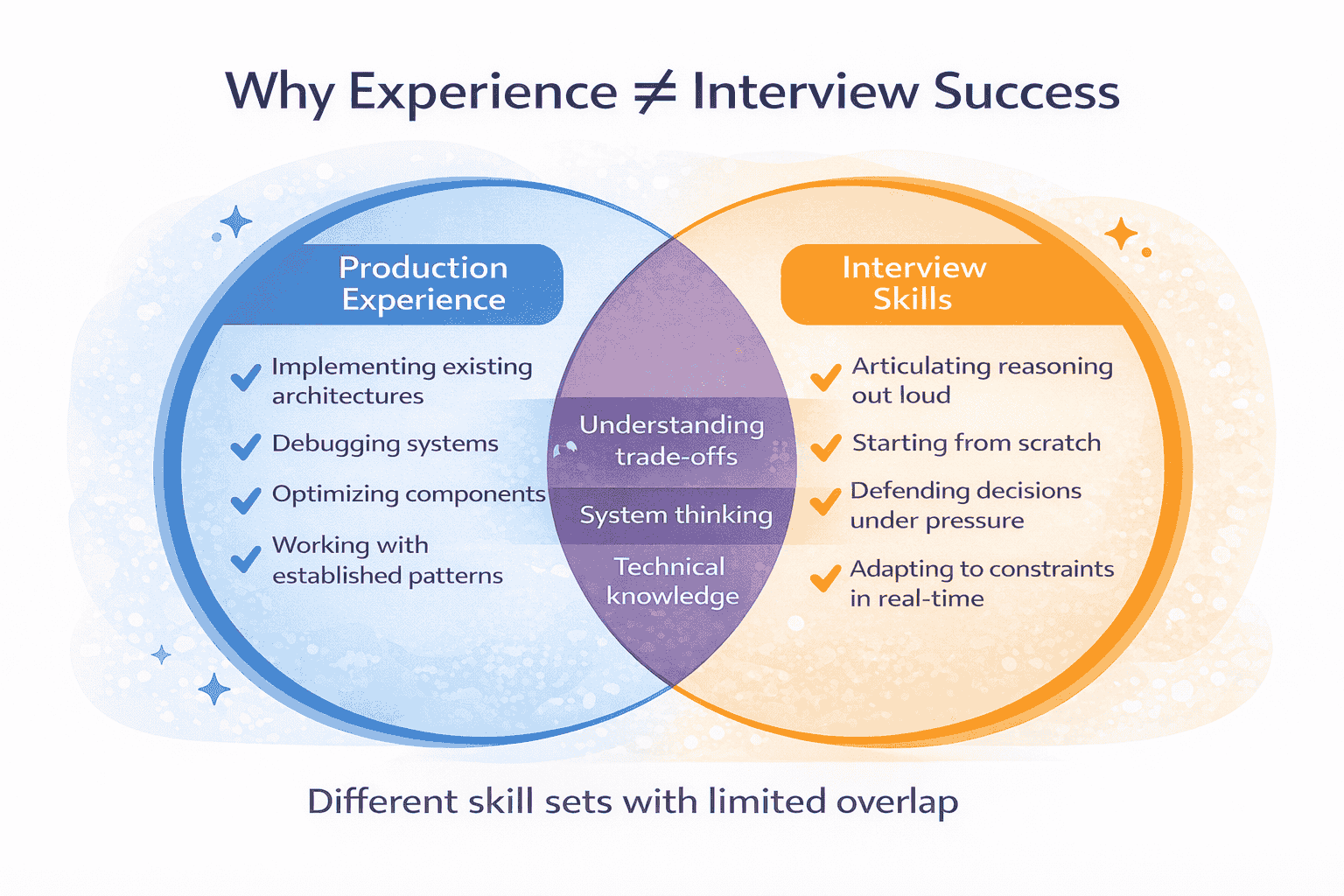
Production experience and interview performance are different skill sets.
In production, you inherit existing architectures. You optimize components. You debug issues. You implement solutions designed by others.
In interviews, you start from scratch. You articulate reasoning out loud. You defend decisions under time pressure. You adapt to changing constraints in real time.
These require overlapping but distinct capabilities.
Common Failure Patterns Among Experienced Engineers
Engineers with production experience often fail for the same reasons beginners do.
No clear structure. They jump into implementation details without establishing requirements or high-level architecture. Experience doesn’t automatically teach interview structure.
Poor communication. They assume the interviewer understands their reasoning without explaining it. In production, colleagues share context. In interviews, you start from zero.
Jumping to solutions. They propose their company’s architecture without considering whether it fits this problem’s constraints. Experience can create blind spots.
Weak trade-off discussion. They know what worked in production but can’t articulate why it was chosen over alternatives. Doing isn’t the same as explaining.
Experience alone doesn’t save candidates. Clear thinking does.
The Hidden Disadvantage of Experience
Experience can actually create specific disadvantages in interviews.
Pattern matching over first principles. Experienced engineers often pattern-match to solutions they’ve used before instead of reasoning from requirements. “We used microservices at my company” doesn’t answer whether microservices fit this problem.
Overconfidence in familiar technologies. Defaulting to what you know without considering alternatives. An engineer who only knows SQL might force relational patterns onto problems better suited for NoSQL.
Difficulty explaining the obvious. Things that feel intuitive from years of practice become hard to articulate. But interviewers need to hear your reasoning, not just your conclusions.
Anchoring to scale you’ve experienced. If you’ve only worked at small companies, you might underestimate scale challenges. If you’ve only worked at massive companies, you might over-engineer simple problems.
These aren’t insurmountable. But they’re real, and they require conscious correction.
What This Means for Candidates Without Experience
This levels the playing field more than most people realize.
If experienced engineers struggle with structure, communication, and trade-off articulation—and those are exactly what interviews test—then the gap isn’t as wide as it appears.
You don’t need to close a decade-long experience gap. You need to develop specific interview competencies that even experienced engineers often lack.
That’s achievable through focused preparation.
The Common Ground: What Actually Matters
Both experienced and inexperienced candidates succeed when they demonstrate the same core behaviors.
Structured thinking. Clear communication. Trade-off awareness. Adaptability under constraints.
None of these require years of production experience. They require deliberate practice with interview-specific scenarios.
An engineer with two years of experience who has practiced 50 system design problems will outperform an architect with fifteen years who has practiced zero.
The interview rewards preparation, not tenure.
What Interviewers Actually Want From Candidates Without Experience
Interviewers don’t expect perfection from candidates without prior exposure.
But they do have specific expectations. Understanding these changes how you prepare and how you communicate during the interview.
The Core Expectations
When interviewers know a candidate lacks production system design experience, they adjust what they’re evaluating. But not in the way you might think.
They’re not lowering technical standards. They’re focusing more intensely on thinking process.
Honest assumption-setting. They want to see you acknowledge uncertainty and set clear assumptions. “I’m assuming we’re targeting 100K daily active users—let me know if that’s off” is stronger than pretending you know the requirements.
Logical decomposition. Can you break the problem into reasonable components even if you don’t know the “optimal” architecture? Clear structure matters more than perfect choices.
Curiosity-driven clarification. Asking thoughtful questions signals that you understand what matters. “Should we optimize for read latency or write consistency?” shows better judgment than jumping to solutions.
Step-by-step reasoning instead of solution-dumping. Walking through your thought process—”First I’d clarify requirements, then identify core entities, then map data flows”—demonstrates organized thinking.
Willingness to adapt when challenged. When the interviewer introduces a constraint, saying “Good point—that changes my caching strategy” shows flexibility and learning ability.
These signals demonstrate learnability, judgment, and thinking discipline. Those qualities are far more valuable than résumé keywords.
📊 Table: What Interviewers Actually Evaluate (Inexperienced vs. Experienced Candidates)
This table shows how evaluation focus shifts based on candidate background. Notice that inexperienced candidates are held to high standards on thinking process, not résumé credentials.
| Evaluation Area | For Inexperienced Candidates | For Experienced Candidates |
|---|---|---|
| Requirements Clarification | High importance: Must demonstrate ability to identify ambiguity | Expected but can rely on “similar to systems I’ve built” |
| Reasoning Process | Primary focus: Must articulate every step clearly | Can sometimes skip explaining “obvious” steps |
| Trade-off Discussion | Critical: Must explain why choosing X over Y | Critical: Same expectation |
| Technology Choices | Reasonable choices with clear reasoning accepted | Expected to know nuances and edge cases |
| Scale Considerations | Must acknowledge scale implications, approximations OK | Expected to provide specific numbers and calculations |
| Communication Clarity | Very high importance: Compensates for lack of experience | Important but résumé provides some buffer |
| Adaptability | High importance: Signals learning ability | High importance: Same expectation |
What You’re NOT Being Judged For
Understanding what doesn’t matter is as important as understanding what does.
You’re not being judged for what you haven’t built. No interviewer expects you to have designed Netflix’s recommendation engine. They expect you to reason through how you might approach it.
You’re not being judged for knowing every technology. Not knowing the difference between Kafka and RabbitMQ is fine if you can reason about message queue requirements and ask clarifying questions.
You’re not being judged for having the “optimal” solution. There’s rarely one correct answer. A defensible solution with clear reasoning beats a “perfect” solution you can’t explain.
You’re not being judged for speed. Taking time to think through requirements carefully is better than rushing to a poorly-considered solution.
You are being judged for how you think right now, in this conversation.
The Permission Structure You Need
Here’s what candidates without experience often miss.
You have permission to:
- Ask clarifying questions before proposing solutions
- State assumptions explicitly (“I’m assuming X—correct me if that’s wrong”)
- Think out loud and show your reasoning process
- Propose a simple solution first, then iterate based on constraints
- Say “I don’t know” when genuinely uncertain, then reason about how you’d find out
- Adapt your design when the interviewer introduces new information
These aren’t signs of weakness. They’re signs of clear thinking and professional maturity.
Interviewers value engineers who can navigate ambiguity, acknowledge what they don’t know, and reason through problems systematically.
That’s what senior engineers do in production every day.
How to Signal “I’m Prepared to Learn”
Since you can’t signal experience through your résumé, you signal preparedness through your process.
Start with structure. “Let me make sure I understand the requirements first, then I’ll propose a high-level architecture before diving into details.”
Make assumptions explicit. “I’m assuming we need to support 1M requests per day with 99.9% availability—does that match your expectations?”
Explain your reasoning. “I’m choosing a relational database here because we need strong consistency for financial transactions, even though it limits horizontal scaling.”
Show adaptability. “That’s a good point about read-heavy workload—let me add a caching layer to handle that.”
These patterns demonstrate that you approach problems systematically. That’s exactly what interviewers want to see.
The Real Problem: Self-Disqualification Before the Interview Begins
Most candidates without experience don’t actually fail interviews.
They fail before the interview.
The failure happens in the weeks and months before they ever speak to an interviewer.
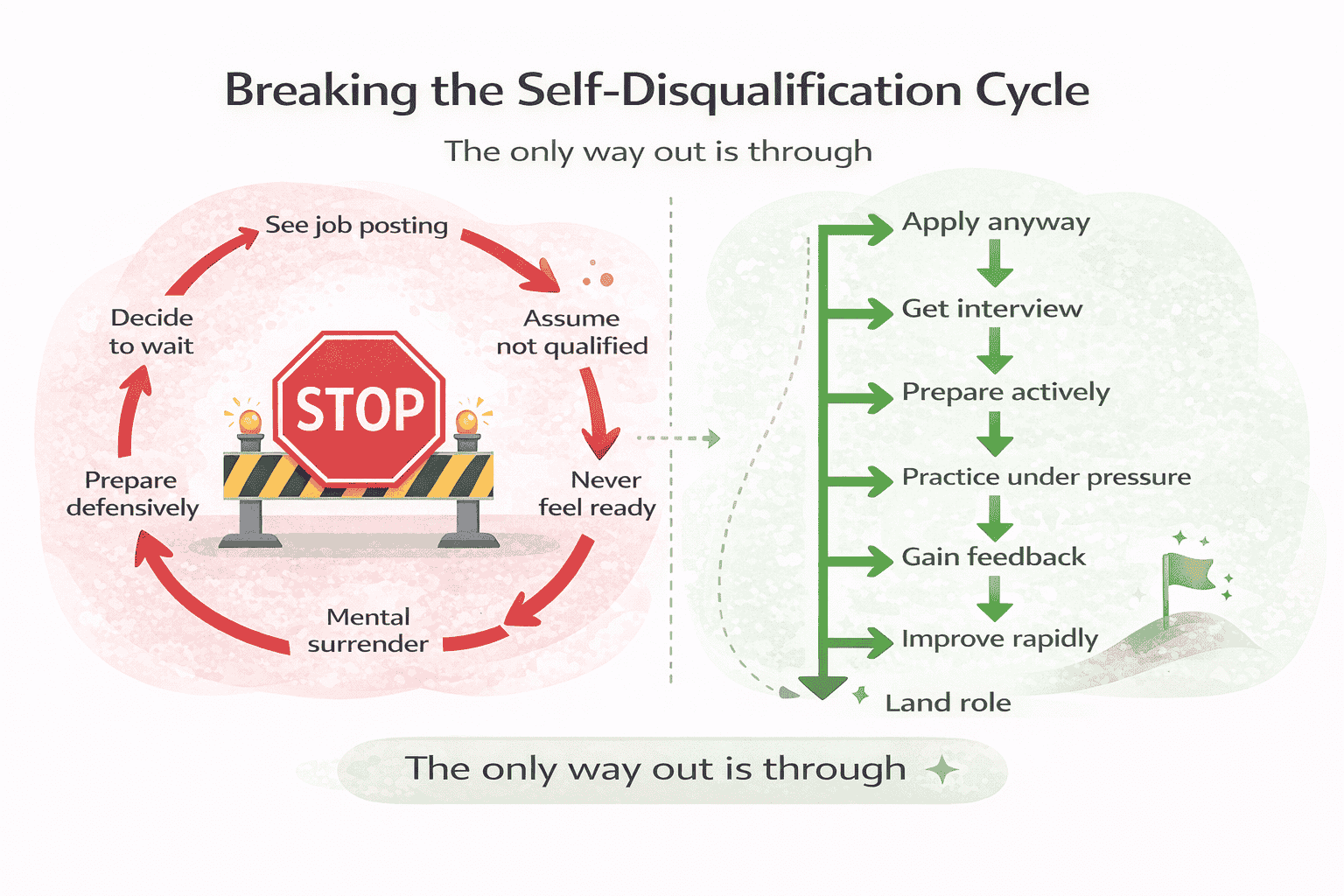
The Three Stages of Self-Disqualification
Self-disqualification follows a predictable pattern.
Stage 1: The Decision Not to Apply. You see a job posting for a senior or staff role. The description mentions “designed distributed systems” or “architecture experience.” You convince yourself you’re not qualified. You don’t apply.
The opportunity never existed because you eliminated yourself.
Stage 2: The Decision to Wait. You tell yourself you’ll prepare “when you’re ready.” But since you don’t know what “ready” looks like, you postpone indefinitely. Months pass. The roles you could have landed go to candidates who started preparing immediately.
Stage 3: The Defensive Preparation. If you do prepare, you do it half-heartedly. You consume content passively instead of practicing actively. You avoid mock interviews because you’re “not ready yet.” You study theory but never test yourself under pressure.
By the time you reach an actual interview, you’ve already decided you don’t belong there.
Why This Pattern Is So Destructive
Self-disqualification isn’t just about missed opportunities. It compounds over time.
Every month you delay is a month someone else is gaining interview experience. Every role you don’t apply for is practice you’re not getting. Every interview you avoid is feedback you’re missing.
The gap between you and candidates who started preparing immediately grows wider.
And the longer you wait, the more the delay feels justified. “See? I was right to wait. I’m still not ready.”
But the real issue isn’t readiness. It’s the belief that you need permission to start.
The Hidden Cost You’re Not Calculating
When you delay applying or preparing, you’re making an implicit calculation.
You’re deciding that waiting costs less than the risk of trying and failing.
But that calculation is wrong. Here’s what waiting actually costs:
Opportunity cost. Six months of salary at a senior level role is $75,000-$100,000+. That’s the cost of waiting six months to start preparing seriously.
Compounding career trajectory. Senior roles lead to staff roles faster than mid-level roles do. Delaying your transition delays everything that comes after.
Lost interview practice. Every interview you avoid is valuable feedback you’re not getting. Candidates who interview regularly get better faster.
Confidence erosion. The longer you wait, the more evidence you accumulate that you “can’t” do this. Your belief becomes self-fulfilling.
Waiting feels safe. But it’s the most expensive choice you can make.
Why “Waiting Until You’re Ready” Is a Trap
Here’s the brutal truth about readiness.
You will never feel ready.
Not because you lack ability. Because readiness is a feeling that comes from doing the thing, not preparing for it.
Candidates who succeed aren’t more confident before their first interview. They gain confidence by going through interviews and learning from them.
The preparation-before-action model is backwards. Action creates readiness, not the other way around.
What Breaking the Cycle Actually Looks Like
Breaking self-disqualification requires conscious decision-making at each stage.
When you see a job posting: Apply anyway. The worst outcome is rejection, which costs nothing. The best outcome is an interview that teaches you exactly what to prepare for.
When you feel unprepared: Start preparing immediately, not “when you’re ready.” Set a specific start date (today or tomorrow) and a concrete first action (solve one system design problem).
When you want to avoid mock interviews: Do them anyway. Discomfort during practice is the entire point. It’s how you build tolerance for ambiguity under pressure.
Each decision to move forward despite uncertainty weakens the self-disqualification pattern.
The Permission You’ve Been Waiting For
If you’re reading this section hoping for permission to start preparing seriously, here it is:
You don’t need more experience to begin. You don’t need to feel confident first. You don’t need to wait until you’ve “earned” the right to try.
The engineers who land senior roles aren’t more qualified when they start. They’re more willing to feel uncertain while they prepare.
That willingness is the only prerequisite that actually matters.
Removing the Mental Block That Keeps You From Trying
This entire page has been building toward one goal.
Not to teach you system design. Not to give you interview frameworks. But to remove the belief that stops you from preparing seriously.
Let’s consolidate what you now understand.
What You Now Know That Changes Everything
System design interviews test thinking, not résumés. The evaluation focuses on how you clarify requirements, decompose problems, explain trade-offs, and adapt to constraints. None of these require prior production experience.
Experienced engineers fail for the same reasons inexperienced ones do. Poor structure, weak communication, inability to articulate trade-offs—these sink candidates regardless of background. Experience doesn’t automatically solve interview-specific challenges.
Insecurity sabotages more candidates than skill gaps. Apologizing, staying vague, freezing, and copying without understanding are all behaviors driven by the belief that you don’t belong. These are fixable through preparation.
Interviewers evaluate your thinking process, not your credentials. They want to see clear reasoning, structured communication, and adaptability. Those are learnable skills, not résumé requirements.
Self-disqualification is the real barrier. Most candidates eliminate themselves before they ever test their abilities. The belief “I’m not qualified” prevents the preparation that would make you qualified.
The Shift You Need to Make
The shift isn’t about gaining confidence. It’s about changing what you’re optimizing for.
Stop optimizing for feeling ready. Readiness is a feeling that comes from doing, not from waiting. You’ll never feel ready before you start.
Start optimizing for learning speed. The fastest way to improve is to interview, fail, learn, and iterate. Candidates who interview monthly improve faster than those who wait years.
Stop optimizing for avoiding failure. Every failure in a practice interview or real interview is free data about what to improve. Avoiding interviews protects your ego but stalls your growth.
Start optimizing for increasing attempts. More applications, more interviews, more practice problems. Volume creates skill faster than perfect preparation ever will.
📊 Table: Mental Model Shift – From Self-Disqualification to Preparation
This table shows the cognitive reframing required to move from self-disqualification to effective preparation. Notice how each shift changes what you do, not just how you feel.
| Self-Disqualifying Belief | What It Causes You to Do | Productive Reframe | What It Enables You to Do |
|---|---|---|---|
| “I need experience first” | Wait indefinitely, never apply | “Interviews test thinking skills I can develop” | Start preparing immediately with practice problems |
| “I’ll prepare when I’m ready” | Procrastinate, consume content passively | “Readiness comes from doing, not waiting” | Schedule mock interviews this week |
| “Experienced candidates have an advantage” | Assume you can’t compete | “Experience doesn’t guarantee interview success” | Focus on learnable interview skills |
| “I’ll fail because I haven’t built systems” | Avoid interviews, stay in comfort zone | “Insecurity sabotages more than skill gaps” | Practice clear communication and reasoning |
| “I need to feel confident first” | Wait for confidence that never comes | “Confidence comes from repeated attempts” | Apply to 5 roles this month despite uncertainty |
| “Failure means I’m not qualified” | Avoid situations where you might fail | “Every failure is data for improvement” | Interview monthly, track patterns, iterate |
Your First Three Actions
Knowledge without action changes nothing. Here are the three concrete steps to take immediately after reading this page.
Action 1: Apply to three roles this week. Don’t wait until you feel ready. Apply now. The applications themselves commit you to preparation and might generate interviews that teach you exactly what to study.
Action 2: Solve one system design problem today. Not tomorrow. Today. Pick any common problem (URL shortener, notification system, rate limiter) and work through it following a structured approach. Time yourself. Record your reasoning.
Action 3: Schedule a mock interview within 7 days. Find a peer, use a mock interview platform, or record yourself. The discomfort you feel during the mock is the exact discomfort you need to build tolerance for.
These three actions break the self-disqualification cycle. Each one proves you’re capable of moving forward despite uncertainty.
What Success Actually Looks Like
Success isn’t landing the first role you interview for.
Success is developing a repeatable preparation system that makes you better with each attempt.
Success is going from “I don’t belong in these interviews” to “I know exactly what they’re testing and how to prepare.”
Success is replacing fear with process.
The goal isn’t to eliminate uncertainty. It’s to act effectively despite it.
That’s what separates engineers who advance from those who stay stuck.
The Real Preparation Starts Now
This page has done its job if you now understand:
- System design interviews test learnable skills, not résumé credentials
- Self-disqualification is the real barrier, not skill gaps
- Preparation requires action, not perfect readiness
- Every interview—successful or not—accelerates your learning
The mental block that kept you from trying seriously has been removed.
What you do next determines whether this was just interesting content or the turning point in your career preparation.
If you’re ready to move from mindset correction to structured preparation, our complete system design interview preparation guide provides the frameworks, practice problems, and step-by-step approach that candidates without prior experience need to succeed.
Your Permission to Prepare Seriously
If you’ve read this far, you now understand something most engineers never grasp.
The barrier to system design interview success isn’t your résumé. It’s the belief that your résumé disqualifies you.
That belief is false. And expensive. And completely fixable.
What’s Different Now
Before reading this page, you might have thought:
- “I need to build real systems before I can interview”
- “Experienced engineers have an insurmountable advantage”
- “I should wait until I feel ready”
- “My lack of experience means automatic failure”
Now you know:
- Interviews test thinking process, not production experience
- Experienced engineers fail for the same reasons beginners do
- Readiness comes from action, not waiting
- Clear communication beats impressive credentials
This isn’t motivational fluff. It’s how system design interviews actually work.
The Only Question That Matters Now
You have two options.
Option 1: Continue waiting. Tell yourself you’ll start preparing “soon.” Consume more content passively. Avoid applying to roles because you don’t feel ready yet. Check back in six months and wonder why nothing has changed.
Option 2: Start today. Apply to three roles this week. Solve one system design problem today. Schedule a mock interview within seven days. Accept that discomfort is part of the process, not a sign you’re doing it wrong.
Neither option is wrong. But only one leads to the career outcome you actually want.
Where to Go From Here
If you’re deciding between a structured program and DIY learning, see:
System Design Course vs Self-Study – What Works for Senior Developers?.
This page removed the mental block. The next step is structured preparation.
If you’re ready to move from understanding to action, here’s what systematic preparation looks like:
Learn the interview framework. System design interviews follow predictable patterns. Master the structure: requirements clarification, high-level design, deep dives, trade-off discussion, and scaling considerations.
Practice core problems systematically. Start with fundamental problems like URL shorteners and rate limiters. Build to complex systems like video streaming and distributed messaging. Focus on reasoning process, not memorizing solutions.
Get real feedback early. Mock interviews with peers or professionals reveal gaps you can’t see yourself. One mock interview teaches more than ten hours of passive study.
Interview regularly. Apply monthly, not annually. Each interview—pass or fail—gives you data about what to improve. Candidates who interview frequently improve exponentially faster.
For candidates who want structured guidance through this process, geekmerit.com provides the complete preparation system: frameworks, practice problems, mock interviews, and personalized feedback designed specifically for engineers without prior system design experience.
📥 Download: Your First Week Action Plan
This simple one-page plan gives you the exact steps to take in your first week of preparation. No theory, no fluff—just concrete actions that break the self-disqualification cycle and build momentum immediately.
The Final Truth
You’re not disqualified by default.
You never were.
The engineers landing senior roles right now aren’t more talented, more experienced, or more deserving. They’re more willing to start before they feel ready.
That willingness is available to you right now. Today. This moment.
The question is whether you’ll use it.
Frequently Asked Questions
Can I really succeed in system design interviews without having built large-scale systems?
Yes. System design interviews test your ability to think through problems clearly, not your résumé. The evaluation focuses on how you clarify requirements, decompose problems, explain trade-offs, and adapt to constraints. These are learnable skills that don’t require prior production experience. Many candidates without system design experience pass interviews by demonstrating clear reasoning and structured communication.
Don’t experienced engineers have a huge advantage in these interviews?
Not as much as you’d think. Experienced engineers often fail system design interviews for the same reasons inexperienced candidates do: poor structure, weak communication, and inability to articulate trade-offs. Production experience and interview performance are different skill sets. An engineer with two years of experience who has practiced 50 system design problems will outperform an architect with fifteen years who has practiced zero.
How long does it take to prepare for system design interviews without prior experience?
With focused preparation, most candidates need 4-8 weeks to develop interview-ready skills. This assumes practicing 3-5 system design problems per week, doing at least 2-3 mock interviews, and studying fundamental concepts like scalability, databases, caching, and load balancing. The key is active practice (solving problems and getting feedback) rather than passive study (just reading or watching videos).
What if the interviewer asks about technologies I’ve never used?
Acknowledge what you don’t know, then reason through the requirements. For example: “I haven’t worked with Kafka specifically, but I understand we need a message queue that handles high throughput and guarantees ordering. Let me reason through what characteristics that system would need…” This demonstrates thinking ability, which is what interviewers actually want to see. Not knowing specific technologies is acceptable; not being able to reason about system requirements is not.
Should I wait to apply until I feel more confident about system design?
No. Confidence comes from doing interviews, not from waiting. The preparation-before-action model is backwards—you’ll never feel “ready” until you’ve gone through real interviews and learned from them. Start applying now. Even if you don’t pass your first few interviews, you’ll gain invaluable feedback about exactly what to study. Candidates who interview monthly improve much faster than those who wait years.
How do I practice system design without access to large-scale production systems?
Practice through structured problem-solving, not production work. Pick common system design problems (URL shortener, notification system, rate limiter, chat application), work through them using a framework, and record your reasoning. Focus on requirement clarification, component decomposition, and trade-off articulation. Mock interviews with peers or platforms like Pramp give you the pressure-testing you need. The goal isn’t to build these systems—it’s to develop clear thinking about how you would approach building them.
Citations
Content Integrity Note
This guide was written with AI assistance and then edited, fact-checked, and aligned to expert-approved coaching standards by Ram Arun. Ram has 10 years of experience coaching system design candidates into senior engineering roles at top tech companies. Interview evaluation criteria, preparation frameworks, and behavioral patterns are sourced from extensive mock interview experience and established system design interview resources, and are cited throughout.

