
System Design Interview Coaching: Is It Worth It? A Complete Decision Guide for Senior Engineers

You’ve prepared for weeks. You understand distributed systems. You’ve built production architecture. Yet you keep failing
system design interview coaching worth it
evaluations at companies you know you’re qualified for.
The question isn’t whether you’re capable. It’s whether
investing in coaching
will actually change your interview outcomes, or if you’re better off continuing alone.
This guide provides an honest, comparison-driven analysis to help you make that decision confidently.
Last updated: Feb. 2026
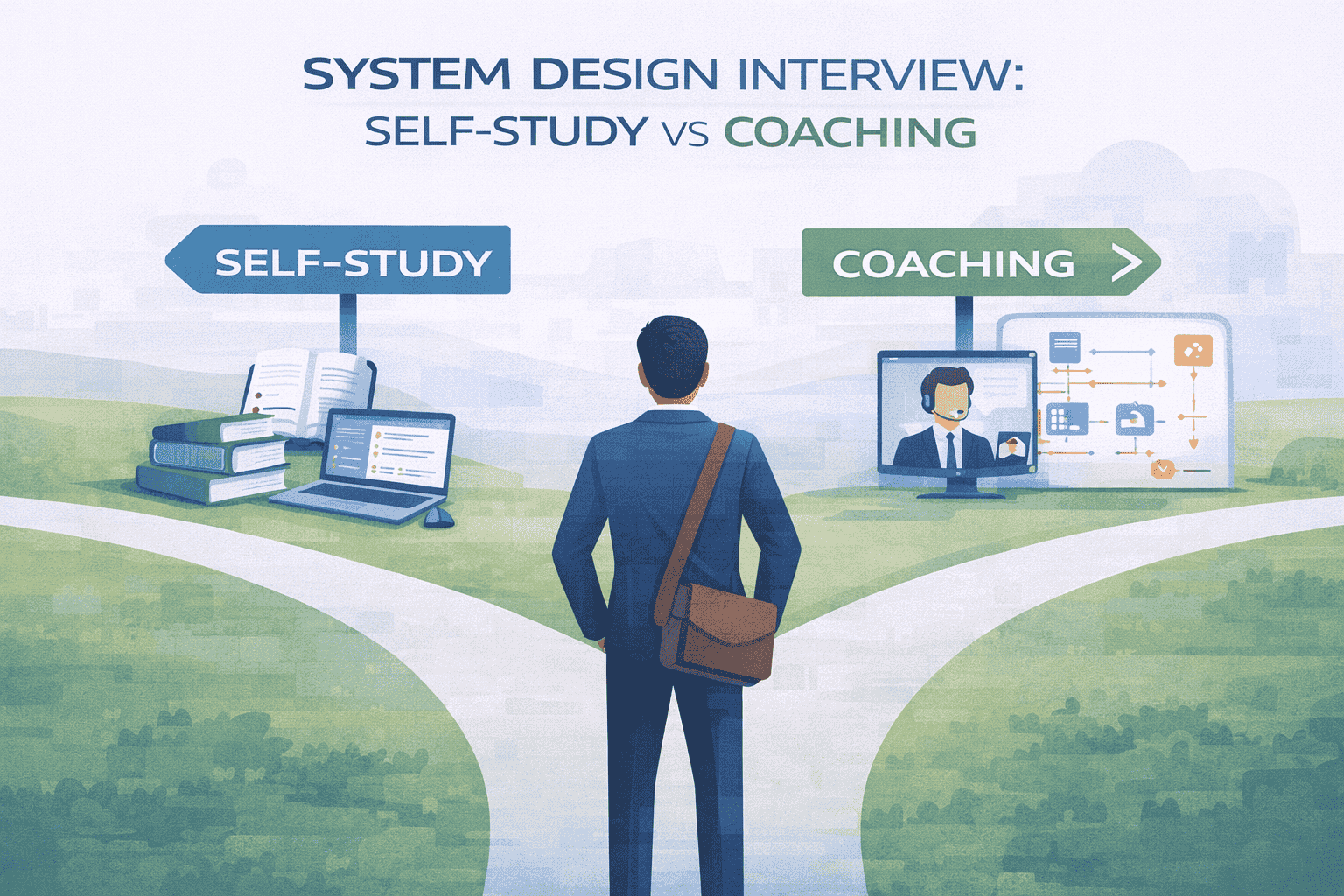
Table of Contents
-
1. The Real Decision Senior Engineers Face
-
2. Preparation Options Compared at a High Level
-
3. Self-Study: When It Works (and When It Breaks)
-
4. Coaching: What Actually Changes (and What Doesn’t)
-
5. Side-by-Side: Self-Study vs Coaching in Real Scenarios
-
6. Who Should Choose Coaching (Clear Answer)
-
7. Who Should Not Choose Coaching (Equally Clear)
-
8. ROI Framed as Time vs Risk (Not Money Alone)
-
9. Decision Checklist (Final Filter)
-
10. Next Steps (No Pressure, Clear Direction)
-
11. FAQs
Contents











The Real Decision Senior Engineers Face
Most engineers don’t ask “What is system design?”
They ask: “Should I keep preparing on my own, or is coaching actually worth the money?”
This question matters because you’re not a beginner. You have years of experience building production systems. You understand distributed architectures, database scaling, and API design.
The Problem Isn’t Knowledge
System design interviews
don’t test what you know. They test how you communicate technical decisions under time pressure.
You might design excellent systems at work. But interviews require a different skill: structured thinking that matches interviewer expectations within 45 minutes.
That’s why experienced engineers often struggle more than they expect.
What This Decision Actually Tests
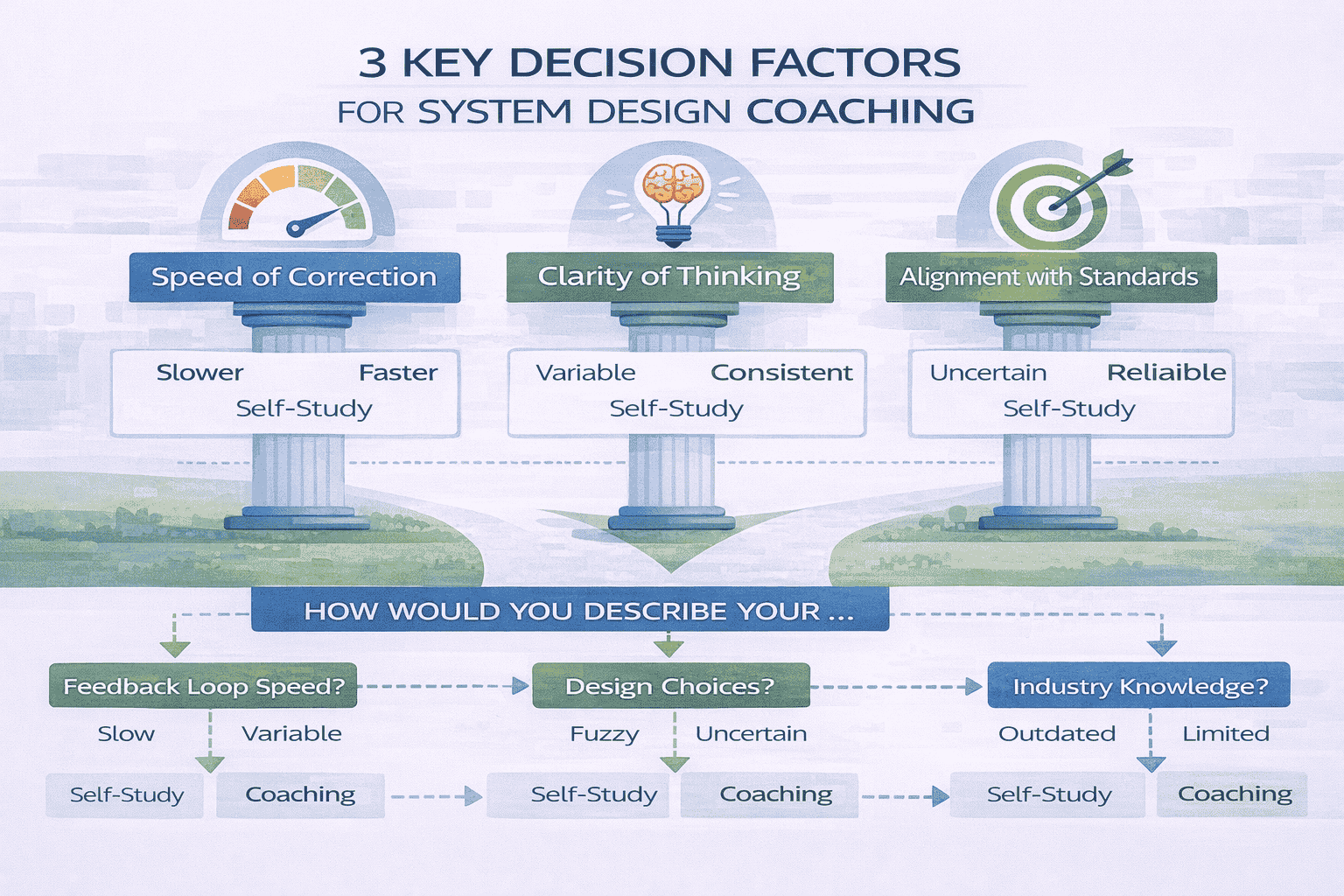
Choosing between self-study and coaching isn’t about your intelligence or commitment. It’s about three factors:
Speed of correction.
How quickly can you identify and fix your communication gaps?
Clarity of thinking.
Can you structure problems the way interviewers expect?
Alignment with standards.
Do you know what “good enough” looks like in 45 minutes?
Self-study can address all three. But it takes significantly longer without feedback.
Why Most Engineers Hesitate
The hesitation around coaching usually comes from valid concerns. You’ve already invested time learning system design concepts.
Adding coaching feels like admitting your preparation wasn’t enough. Or that you’re paying for something you should figure out yourself.
Both thoughts are understandable. Neither is accurate.
Coaching doesn’t replace your knowledge. It accelerates the specific skill of interviewing, which is distinct from building systems.
What Makes This Guide Different
This isn’t a sales pitch disguised as advice. You’ll see honest comparisons showing when self-study works and when it doesn’t.
You’ll understand exactly what coaching changes and what it leaves the same. You’ll get scenario-based analysis showing which path makes sense for your situation.
The goal is a confident decision, not a pressured one.
How to Use This Guide
Read the comparison sections to understand both paths clearly. Then use the decision checklist to evaluate your specific situation.
Don’t skip the “who should NOT choose coaching” section. It’s as important as the “who should” section.
Your goal is clarity, not commitment to either option.
Preparation Options Compared at a High Level
Before diving into specific scenarios, you need a neutral comparison. This table establishes baseline differences without declaring a winner.
If you’re also evaluating a structured curriculum versus DIY (beyond 1:1 coaching), see:
System Design Course vs Self-Study – What Works for Senior Developers?.
Both paths work. They work differently.
???? Table: Self-Study vs Coaching Comparison
This comparison focuses on practical differences that affect your preparation efficiency and interview outcomes. Use it to identify which factors matter most for your situation.
| Aspect | Self-Study | System Design Coaching |
|---|---|---|
| Learning materials | Blogs, videos, books | Structured curriculum + live guidance |
| Feedback mechanism | None or significantly delayed | Immediate, personalized |
| Error correction | Trial-and-error discovery | Directed and accelerated |
| Interview realism | Low (simulated practice) |
High (
mock interviews ) |
| Time to clarity | Slow, iterative | Accelerated, focused |
| Financial cost | Low money investment | Higher money investment |
| Time cost | High (longer path) | Lower (compressed timeline) |
| Risk level | Higher (blind spots) | Lower (identified gaps) |
Understanding the Trade-Offs
Notice the table shows complementary trade-offs, not absolute advantages. Self-study trades money for time. Coaching trades money for speed and reduced risk.
Neither path guarantees success. Both require substantial effort.
The difference lies in efficiency and feedback loops.
What “Immediate Feedback” Actually Means
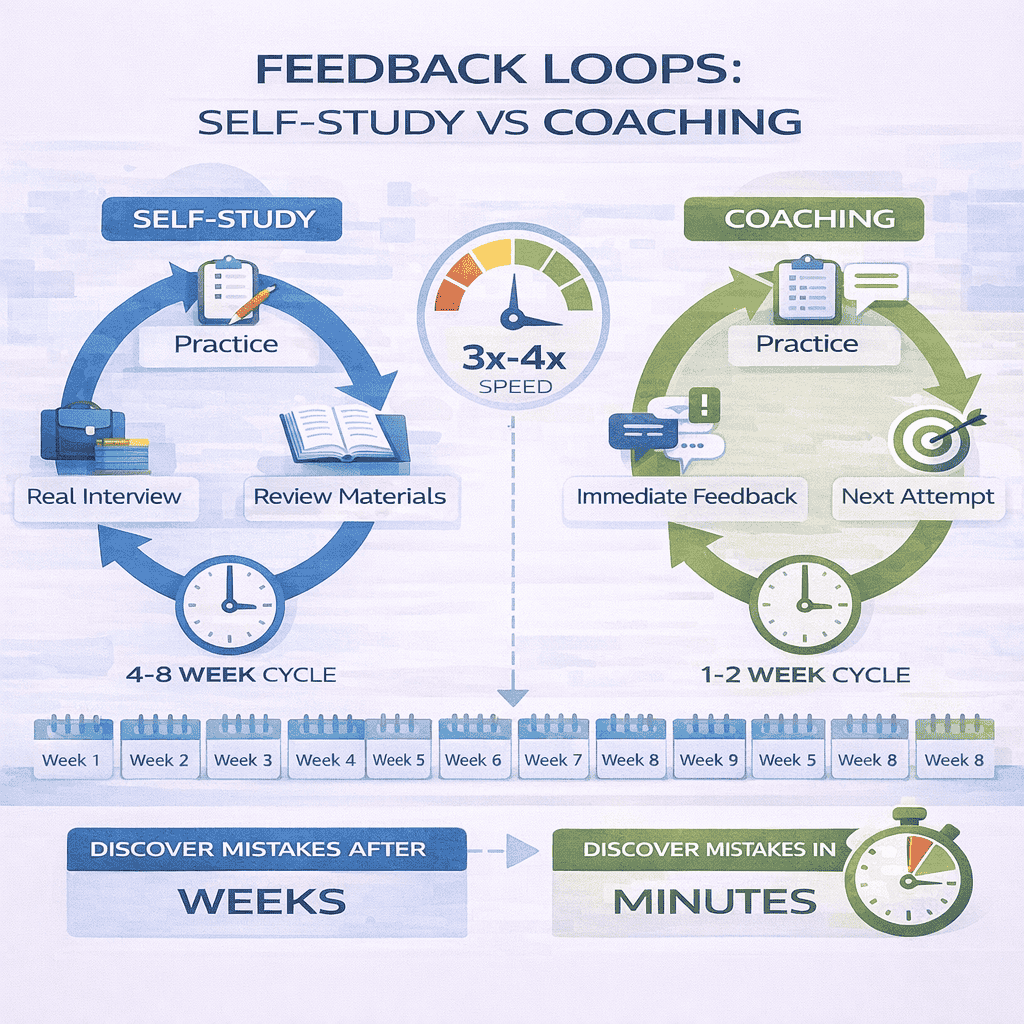
In self-study, you design a system, review materials, and hope your approach was correct. You discover mistakes weeks later during actual interviews.
In coaching, you design a system, receive correction within minutes, and adjust your mental model immediately. Mistakes become learning moments, not interview failures.
This feedback compression doesn’t mean coaching is easier. It means the learning loop is tighter.
The Materials Difference
Self-study materials are abundant. You can find excellent system design blogs,
video courses
, and books for free or low cost.
The limitation isn’t availability. It’s lack of personalization.
Generic materials can’t tell you why
your specific approach
to database sharding failed to impress the interviewer. They can’t identify whether your problem is requirement gathering, trade-off articulation, or time management.
Coaching provides that diagnostic layer.
Interview Realism Gap
Practicing alone, you might spend 90 minutes designing a system, referring to notes, and researching specific technologies. This builds knowledge.
It doesn’t replicate interview conditions. You can’t pause to look up CAP theorem details. You can’t restructure your entire approach after 30 minutes.
Mock interviews force real constraints. Time pressure. No references. Immediate clarification questions that expose gaps in your thinking.
Self-study can’t fully simulate this environment.
Time Cost Paradox
Self-study appears time-efficient because you control the schedule. Practice whenever convenient. No coordination required.
But total time to interview-readiness is typically longer. Without feedback, you repeat the same mistakes multiple times before discovering them.
Coaching compresses this timeline by frontloading corrections. You still practice extensively, but with higher signal-to-noise ratio.
Self-Study: When It Works (and When It Breaks)
Self-study gets unfairly dismissed in coaching discussions. It works well for many engineers in specific situations.
Understanding when it works and when it doesn’t helps you make an honest assessment.
When Self-Study Works Effectively
You’re early in preparation and building fundamentals.
If you’re just starting to learn distributed systems concepts, self-study is the right path. Books and courses teach core principles efficiently.
Coaching adds minimal value when you’re still learning what load balancers do or how databases replicate data.
You already know what you’re doing wrong.
Some engineers fail interviews and receive clear feedback: “You didn’t discuss data consistency” or “You skipped requirement gathering.”
If the gap is specific and known, self-directed correction works.
You have ample time and low interview pressure.
Planning to interview in 6-12 months? Self-study provides a solid foundation without timeline pressure.
You can afford the longer learning curve.
You learn best independently and methodically.
Some engineers genuinely prefer self-directed learning. They research thoroughly, take detailed notes, and improve through deliberate practice.
If this describes your learning style and you have time, self-study aligns with your strengths.
When Self-Study Commonly Breaks Down
You don’t know why you’re failing interviews.
Most engineers receive vague rejection feedback: “Not a strong hire” or “Limited system design experience.”
Without specific direction, you can’t self-correct effectively. You might fix the wrong problems.
You keep repeating the same
design mistakes
.
Recurring patterns suggest blind spots. Maybe you always over-engineer solutions. Or you consistently underestimate data storage requirements.
Self-study rarely reveals these patterns because you lack external perspective.
You lack clarity on
trade-offs
and communication.
System design interviews reward clear articulation of trade-offs. Self-study teaches the trade-offs themselves but not how to communicate them effectively.
You might understand CAP theorem perfectly but fail to explain why you chose AP over CP in a way interviewers value.
You’re preparing for high-bar interviews with limited attempts.
Staff engineer roles at top companies have stringent evaluation criteria. Each interview represents significant stakes.
Trial-and-error learning becomes expensive when you have 2-3 interview opportunities.
???? Download: Self-Study Readiness Assessment
A practical checklist to determine if self-study is appropriate for your current situation. Evaluates learning style, timeline, and feedback needs to guide your decision.
The Blind Spot Problem
Everyone has communication blind spots. Patterns you don’t notice in your own explanations.
Common blind spots in system design interviews include:
Speaking in implementation details before establishing requirements. Skipping explicitly stated assumptions. Failing to check interviewer understanding before moving forward.
Self-study can’t surface these patterns because you’re both the practitioner and evaluator.
Time Investment Reality
Effective self-study for system design interviews typically requires 3-6 months of consistent preparation. This assumes 10-15 hours weekly studying materials and practicing designs.
Many engineers underestimate this timeline. They study for 4-6 weeks and feel ready.
Then interviews reveal gaps they didn’t know existed.
Resource Quality Variation
Not all self-study materials are equal. Some system design courses teach outdated patterns. Others focus excessively on specific technologies rather than general principles.
Evaluating resource quality requires expertise you’re still building. You might invest significant time in mediocre materials without realizing it.
Coaching: What Actually Changes (and What Doesn’t)
Coaching isn’t magic. It won’t transform inadequate preparation into interview success overnight.
Understanding what coaching actually improves versus what it leaves unchanged prevents unrealistic expectations.
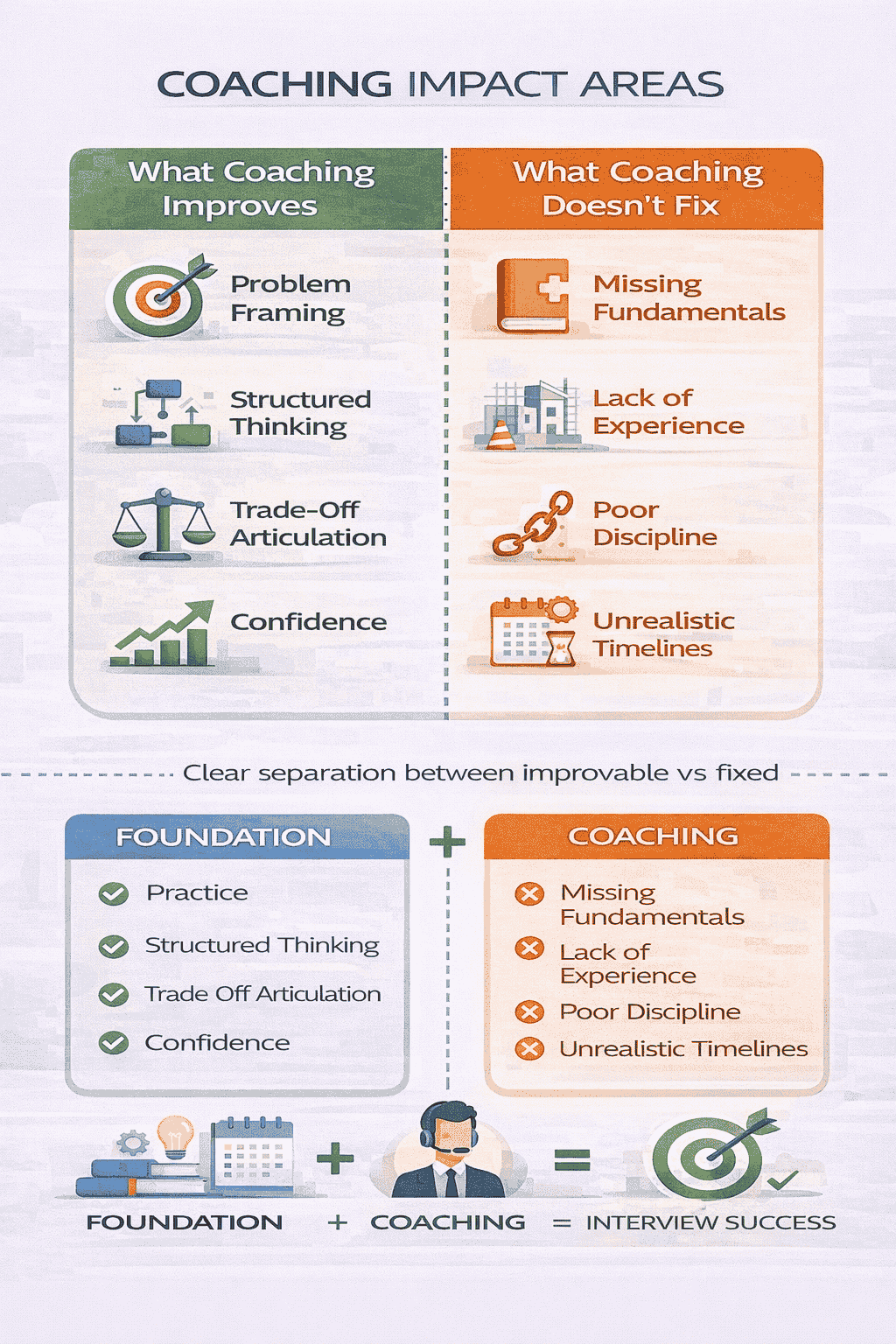
What Coaching Measurably Improves
Problem framing and requirement clarification.
Most engineers rush into solutions. Coaching teaches you to spend the first 5-7 minutes establishing clear requirements and constraints.
This shift alone dramatically improves interview performance. Interviewers value structured thinking over rapid solutions.
Structured thinking under time pressure.
You learn frameworks for organizing your approach. How to allocate 45 minutes across problem understanding, high-level design, deep dives, and bottleneck discussion.
Time management becomes intentional rather than reactive.
Trade-off articulation and system boundaries.
Coaching shows you how to verbalize trade-offs clearly. Not just “we could use Redis or Memcached,” but “Redis provides persistence at the cost of slightly higher latency, which matters given our recovery time requirements.”
This communication precision demonstrates senior-level thinking.
Confidence through repeated interview-style practice.
Mock interviews desensitize you to time pressure and scrutiny. Your tenth mock interview feels dramatically different from your first.
Reduced anxiety improves cognitive performance during actual interviews.
What Coaching Does NOT Magically Fix
Missing backend fundamentals.
If you don’t understand how databases work, indexes, or basic networking, coaching can’t fill those gaps quickly.
You need foundational knowledge first. Coaching optimizes interview performance, not fundamental learning.
Lack of hands-on system exposure.
Coaching can’t manufacture real-world architectural experience. If you’ve never debugged distributed systems or dealt with scaling challenges, that gap remains.
However, coaching helps you articulate the experience you do have more effectively.
Poor preparation discipline.
Coaching requires active participation. Attending sessions without practicing between them produces minimal improvement.
You still need 10-15 hours weekly of independent practice.
Unrealistic timelines.
If you’re interviewing in two weeks with no system design background, coaching helps but can’t guarantee success.
Reasonable preparation timelines matter regardless of coaching.
The Communication Layer
Think of your system design knowledge as the foundation and interview communication as the presentation layer. Coaching primarily improves the presentation layer.
If your foundation is weak, improving presentation helps but doesn’t compensate fully. If your foundation is strong but presentation is poor, coaching creates dramatic improvement.
Most experienced engineers have strong foundations with weak interview-specific communication. That’s why coaching often produces significant results for senior developers.
Speed of Improvement
Typical coaching engagement shows measurable improvement within 3-4 sessions. You’ll notice clearer problem framing and better time management.
Full interview readiness typically requires 6-10 sessions over 4-8 weeks, combined with independent practice. This assumes you have solid fundamentals.
Without fundamentals, double these timelines.
Mock Interview Value
Mock interviews reveal specific gaps. Maybe you struggle with estimation questions. Or you skip discussing monitoring and alerting.
Each mock produces 3-5 actionable improvements. You practice those specific areas before the next session.
This targeted iteration beats general practice by focusing effort on your actual weaknesses.
The Feedback Specificity Advantage
Generic advice says “practice trade-off discussion.” Coaching feedback says “you chose microservices without discussing operational complexity, team size constraints, or deployment coordination overhead.”
Specific correction changes behavior faster than general principles.
Side-by-Side: Self-Study vs Coaching in Real Scenarios
Abstract comparisons help. Real scenarios help more.
These situations represent common decision points for senior engineers. See which outcomes align with your risk tolerance and timeline.
???? Table: Scenario-Based Outcome Comparison
Real-world situations showing how preparation path affects outcomes. Use these scenarios to identify patterns matching your current situation and interview stakes.
| Scenario | Self-Study Likely Outcome | Coaching Likely Outcome |
|---|---|---|
| Repeated system design failures (2+ interviews) | Same mistakes repeated without identifying root cause; continued failures | Root cause identified within 1-2 sessions; corrective practice focused on specific gaps |
| Targeting product companies from service background | Unclear what product company expectations differ; generic preparation | Interview-aligned preparation teaching product-specific patterns and priorities |
| Switching from backend to full-stack senior role | Knowledge gap confusion mixing fundamentals with interview skills | Guided mindset shift separating foundational learning from interview technique |
| Limited interview attempts (1-2 companies) | High risk of wasting attempts on preventable mistakes | Controlled preparation reducing preventable errors; higher success probability |
| Staff/Principal engineer role targeting | Difficulty calibrating to elevated expectations without reference points | Clear benchmarking against senior-level performance standards |
| Career gap returning to interviews | Outdated interview patterns; slow adjustment to current expectations | Rapid calibration to modern system design interview format |
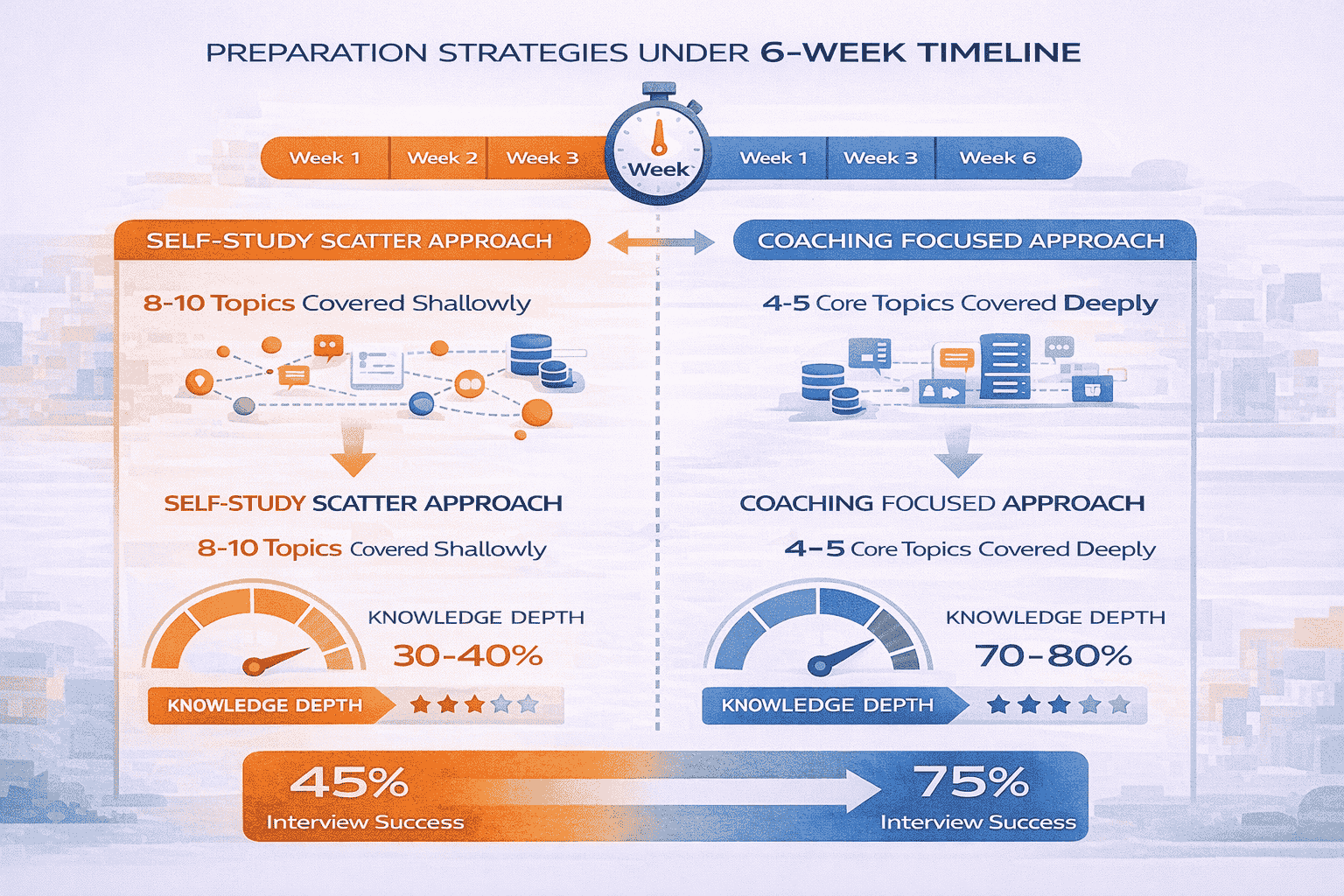
| Time pressure (interviewing in 6-8 weeks) | Fragmented preparation covering too many topics superficially | Focused preparation on high-leverage areas; efficient use of limited time |
| Strong fundamentals, poor interview performance | Frustration and confusion about disconnect between knowledge and results | Explicit separation of knowledge vs communication; rapid improvement |
Scenario Deep Dive: Repeated Failures
You’ve failed two system design interviews. Both times you felt confident. Both times you received vague feedback.
Self-study path:
You review common system design patterns. Maybe you watch more videos on scaling databases or designing notification systems.
But you don’t know what specifically went wrong. Were your solutions over-engineered? Did you fail to clarify requirements? Did you miss discussing trade-offs clearly?
Without this diagnosis, you likely repeat similar mistakes in the next interview.
Coaching path:
First mock interview reveals the pattern. Perhaps you consistently jump to solutions without establishing scope. Or you design excellent systems but fail to articulate why you made specific choices.
The coach identifies the specific communication gap. You practice correcting that exact pattern. Next interview shows measurable improvement.
Scenario Deep Dive: High-Stakes Interviews
You have one chance at your dream company. The role is staff engineer. The bar is exceptionally high.
Self-study path:
You prepare thoroughly. Read books, practice designs, study system architecture.
But you have no calibration mechanism. Is your design “good enough” for a staff role? Are you spending interview time on the right details?
The interview becomes your calibration point. If you fail, you lose the opportunity while gaining the knowledge that would have helped you succeed.
Coaching path:
Mock interviews
provide calibration before high-stakes attempts. The coach with staff-level interview experience tells you directly: “That solution works for senior level, but staff candidates need to discuss organizational impact and long-term evolution.”
You enter the real interview with clearer performance expectations.
Scenario Deep Dive: Time Pressure
You’re interviewing in six weeks. This timeline is tight but realistic with focused preparation.
Self-study path:
You try to cover everything. Load balancing, databases, caching, microservices, event-driven systems, data pipelines.
Six weeks isn’t enough time to master all topics. You end up with shallow knowledge across many areas.
Coaching path:
The coach identifies the 4-5 highest-leverage topics based on your background and target companies. You go deep on those areas instead of broad on everything.
Focused preparation produces better results than scattered coverage.
Pattern Recognition Across Scenarios
Notice the pattern. Self-study struggles most when you lack calibration, have limited attempts, or face time constraints.
Coaching adds most value when feedback speed matters, stakes are high, or you need external perspective to identify blind spots.
Neither path is universally superior. The right choice depends on your specific constraints.
Who Should Choose Coaching (Clear Answer)
Coaching makes sense for specific profiles. If you match these patterns, coaching likely produces strong ROI.
No pressure, just pattern recognition.
You’ve Failed System Design Interviews Multiple Times
Two or more system design interview failures suggest a systematic gap. Not random bad luck.
You’re repeating a pattern you can’t self-diagnose. Coaching identifies that pattern quickly.
Cost of continued failures exceeds coaching investment.
You’re Targeting Senior, Staff, or High-Bar Roles
Senior and staff roles have elevated expectations. Solutions need to consider scale, organizational impact, operational complexity, and long-term evolution.
Self-study materials often teach mid-level patterns. They don’t clearly distinguish senior from staff from principal expectations.
Coaches with high-bar interview experience provide this calibration.
You Feel Uncertain About Interviewer Evaluation
If you finish interviews unsure whether you performed well, you lack internal calibration. You can’t accurately assess your own performance.
Coaching develops that internal calibration through repeated feedback. Eventually you know during the interview whether you’re meeting the bar.
You Want Faster Clarity With Fewer Attempts
Every interview represents opportunity cost. Failed attempts delay your job search, extend current role dissatisfaction, or close doors at preferred companies.
If minimizing wasted attempts matters more than minimizing preparation cost, coaching compresses the learning timeline.
You Have Strong Fundamentals But Poor Interview Performance
This creates significant frustration. You know you can do the job. You’ve built production systems at scale.
But interviews don’t reflect your competence. The gap is communication, not capability.
Coaching addresses communication gaps directly. Your knowledge isn’t the problem, so the improvement comes quickly.
You’re Switching Contexts
Moving from service companies to product companies? Backend to full-stack? Individual contributor to architecture roles?
Context switches often bring different interview expectations. Coaching helps you understand and adapt to new evaluation criteria faster than trial-and-error.
???? Download: Coaching Fit Assessment
Evaluate whether your current situation, experience level, and constraints align with high coaching ROI. Simple scoring system helps clarify decision without pressure.
The Common Thread
Notice the pattern across these profiles. Coaching helps most when you need external perspective, have elevated stakes, or want to compress timelines.
It’s not about intelligence or capability. It’s about efficiency and risk management.
Who Should Not Choose Coaching (Equally Clear)
Honesty matters as much here as in the previous section. Coaching creates poor ROI for certain profiles.
Recognizing when coaching isn’t appropriate saves money and sets realistic expectations.
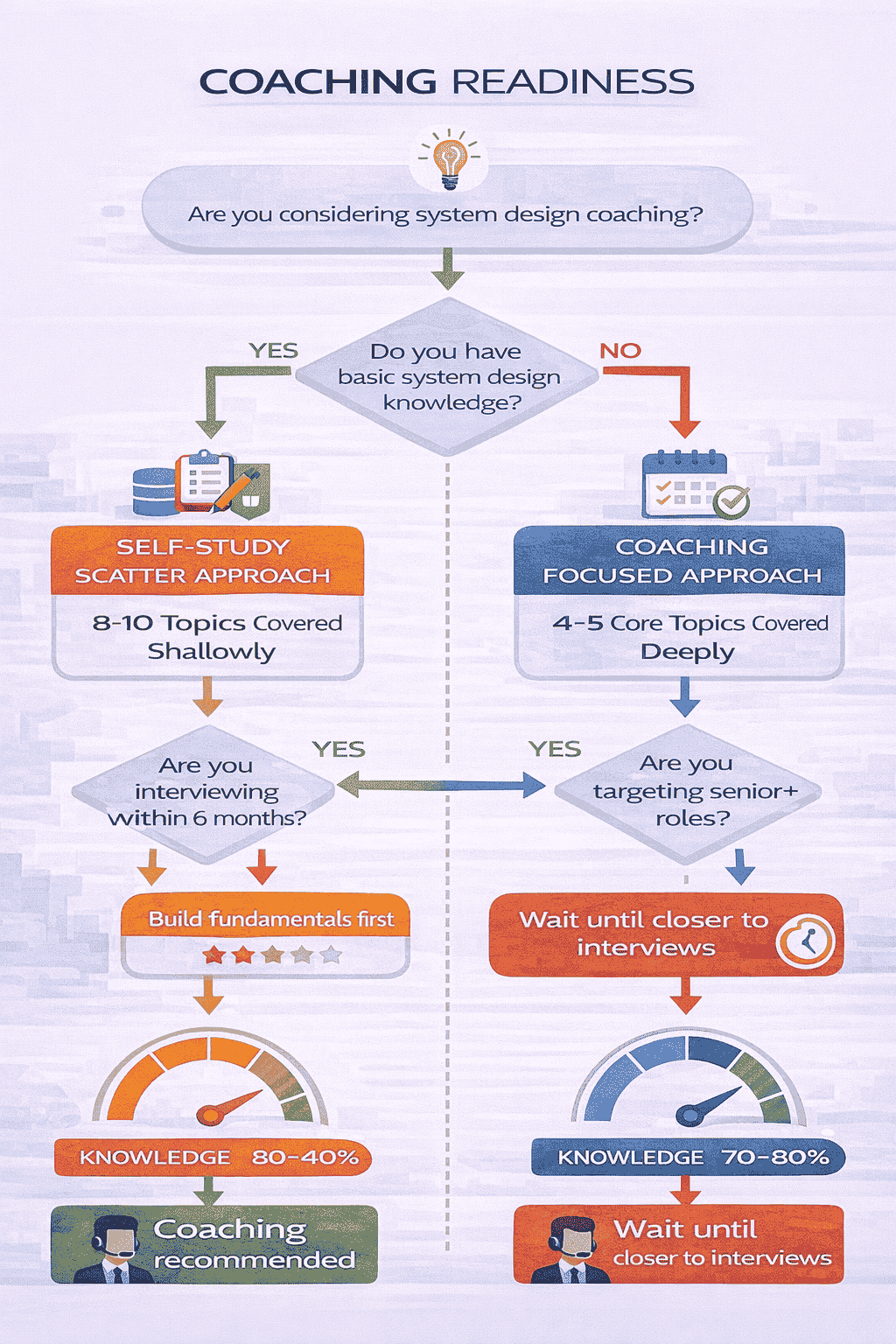
You’re Early-Career or Junior-Level
Junior and mid-level roles rarely require sophisticated system design interviews. Companies evaluate fundamentals, coding ability, and learning potential instead.
If you’re targeting roles with 0-3 years experience requirements, system design coaching is premature. Focus on coding interviews and fundamental computer science concepts.
Wait until you’re targeting senior roles before investing in system design coaching.
You Haven’t Studied System Design Basics Yet
Coaching optimizes interview performance for people who already understand core concepts. It’s not an introductory course.
If you don’t know what consistent hashing does, how databases handle replication, or basic caching strategies, start with foundational learning.
Books, courses, and self-study materials teach fundamentals more efficiently than coaching sessions. Build your knowledge base first, then consider coaching for interview technique.
You’re Not Interviewing in the Next 3-6 Months
Interview skills decay without practice. Learning communication techniques nine months before you need them wastes the investment.
Coaching works best when you apply lessons immediately in real interviews. That feedback loop reinforces learning.
If you’re more than six months from interviewing, use that time for foundational study. Add coaching 6-8 weeks before interview cycles start.
You Expect Coaching to Replace Practice
Coaching accelerates learning but doesn’t eliminate practice requirements. You still need 10-15 hours weekly designing systems, working through problems, and reinforcing concepts.
If your schedule only allows coaching sessions without independent practice, you won’t see results. The sessions provide direction, but practice creates improvement.
Coaching requires active participation and dedicated practice time.
You Need Fundamental Backend Experience
Some engineers consider coaching because they lack hands-on experience with distributed systems. Maybe they’ve worked primarily on frontend or embedded systems.
Coaching can’t manufacture experience. If you’ve never dealt with database scaling, API design, or system monitoring, those gaps remain.
You can still benefit from coaching if you understand concepts theoretically. But don’t expect it to replace actual architectural experience.
Budget Constraints Make It Genuinely Unaffordable
Coaching typically costs $100-300 per session, with 6-10 sessions recommended. Total investment ranges from $600-3000.
If this represents genuine financial hardship, self-study is viable. Many engineers successfully prepare independently.
Don’t sacrifice financial stability for interview preparation. Self-study takes longer but works with dedication.
The Hybrid Alternative
Many engineers fall between clear coaching and clear self-study categories. Hybrid approaches work well for these situations.
Start with self-study to build fundamentals. Schedule 2-3 coaching sessions for calibration and gap identification. Return to self-study with specific focus areas.
This compressed coaching engagement costs less while still providing external perspective and feedback.
Why This Section Matters
Articles pushing coaching rarely discuss when it’s inappropriate. That omission creates distrust.
Acknowledging coaching limitations builds credibility. More importantly, it helps you make decisions aligned with your actual situation rather than idealized scenarios.
If coaching doesn’t fit your current circumstances, that’s fine. Self-study works. Revisit coaching when your situation changes.
ROI Framed as Time vs Risk (Not Money Alone)
Most coaching discussions focus on dollar cost. That’s the wrong frame.
The real question is opportunity cost and risk management. Money is one input among several.
Reframing Return on Investment
Traditional ROI calculation: Coaching costs $2000. New job pays $40,000 more annually. Payback period is 18 days.
This math is accurate but incomplete. It ignores time cost, risk factors, and alternative scenarios.
Better framework: Compare total time to job offer and probability of success across preparation paths.
???? Table: Comprehensive ROI Comparison
Moving beyond simple dollar calculations to understand full opportunity cost and risk profile of each preparation approach. Time and probability matter as much as money.
| Factor | Self-Study | Coaching |
|---|---|---|
| Time spent preparing | High (3-6 months) | Lower (6-10 weeks) |
| Interview attempt risk | High (unknown blind spots) | Reduced (identified gaps) |
| Learning efficiency | Variable (trial and error) | Consistent (directed practice) |
| Confidence level during interviews | Fragile (unvalidated preparation) | Stable (calibrated performance) |
| Financial investment | Low ($0-200) | Moderate to high ($600-3000) |
| Time to first offer | Longer (more iterations) | Shorter (fewer failed attempts) |
| Wasted interview opportunities | Higher (learning on real attempts) | Lower (mock practice reduces errors) |
| Opportunity cost of delay | Higher (extended job search) | Lower (compressed timeline) |
The Time Cost Hidden in Self-Study
Self-study appears time-efficient. Study whenever you want. No scheduling constraints.
But total calendar time to interview readiness averages 3-6 months. During those months, you remain in your current role.
If you’re unhappy in that role, staying an extra 2-3 months represents significant quality of life cost. If you’re underpaid, the opportunity cost compounds weekly.
Coaching compressing timeline by 6-10 weeks might save more money than it costs through earlier job transitions.
Interview Attempt Economics
Each interview represents finite opportunity. Most engineers interview at 5-10 companies per cycle.
Wasting attempts on preventable mistakes closes doors. Some companies enforce 6-12 month waiting periods before reapplying.
Failed attempts also extend job search duration. Each round of interviews takes 4-8 weeks when you include screening, scheduling, and decision timelines.
Self-study’s higher failure rate means more interview cycles before success. More cycles mean longer search duration and extended opportunity cost.
Risk-Adjusted Returns
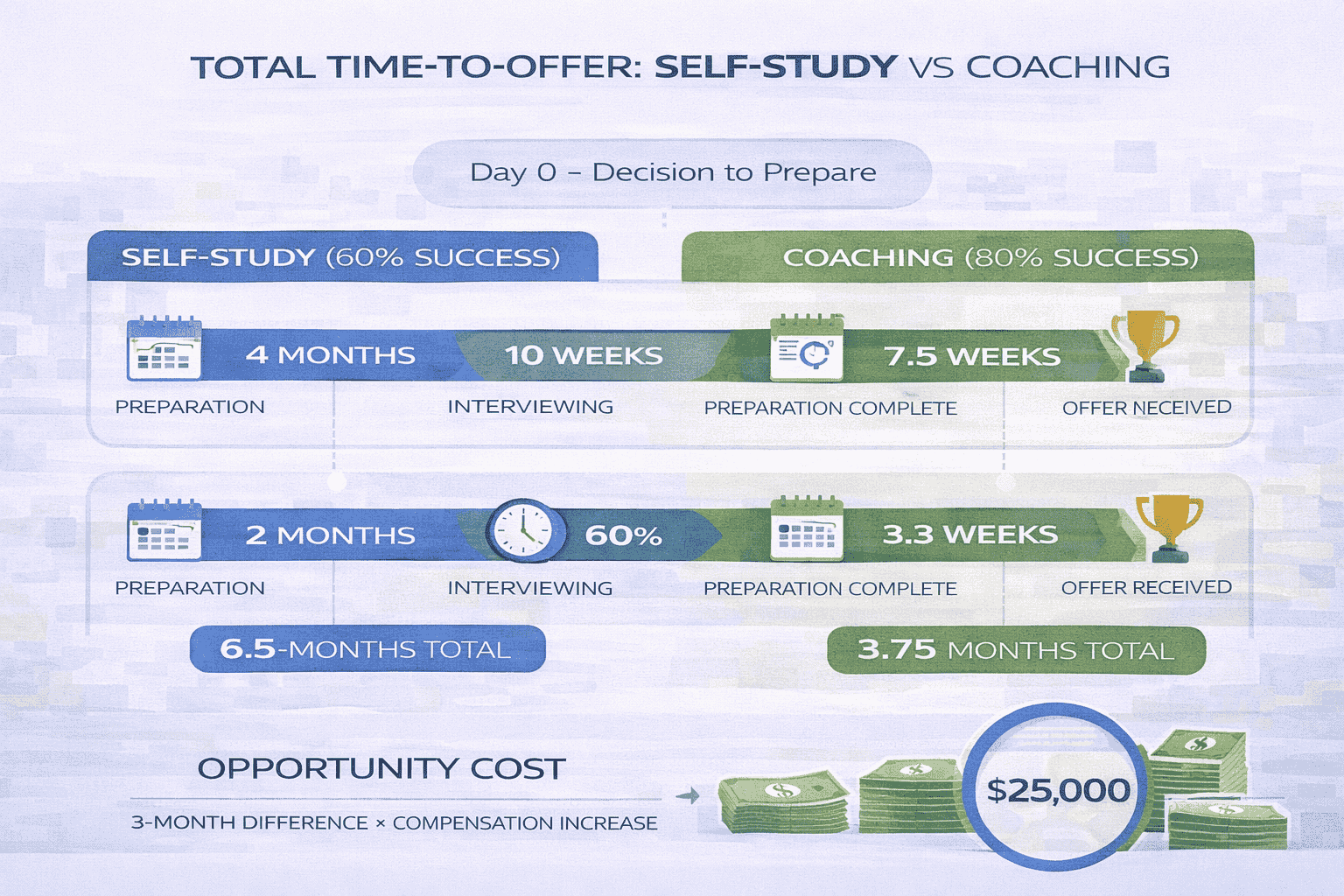
Think probabilistically. Self-study might give you 60% interview success rate after 4 months preparation. Coaching might give you 80% success rate after 2 months.
Expected time to offer with self-study: One interview cycle at 60% success takes 1.67 cycles on average. At 6 weeks per cycle, that’s 10 weeks from preparation completion.
Total time: 4 months prep + 10 weeks interviewing = 6.5 months.
Expected time with coaching: 2 months prep + one cycle at 80% success (1.25 cycles average) = 2 months + 7.5 weeks = 3.75 months.
Coaching saves roughly 3 months. If your compensation increase is $40,000 annually, three months equals $10,000 opportunity cost.
Coaching cost of $2000 produces $10,000 value through timeline compression alone, ignoring reduced stress and higher interview success.
The Confidence Premium
Quantifying confidence is difficult, but its impact is real. Walking into interviews uncertain about your preparation creates anxiety.
Anxiety degrades cognitive performance. You forget concepts you know. You struggle with time management. You second-guess reasonable decisions.
Coaching builds confidence through calibrated practice. You know your performance level because you’ve received explicit feedback multiple times.
This confidence improvement might be worth the investment independently of other factors.
When Money Constraint Is Real
Sometimes budget constraints genuinely preclude coaching. That’s valid.
In those situations, optimize self-study. Find practice partners for mock interviews. Join system design study groups. Request detailed feedback during actual interviews.
These approaches partially replicate coaching benefits at lower cost. They require more effort to coordinate but remain viable alternatives.
Decision Checklist (Final Filter)
You’ve reviewed comparisons, scenarios, and ROI frameworks. Now distill everything into a practical decision filter.
This checklist helps you self-assess honestly and choose confidently.
Core Assessment Questions
Have I failed system design interviews before?
If yes, how many times? Did I receive specific feedback about why I failed?
Multiple failures without clear diagnosis suggest coaching value. Single failure with specific feedback might indicate fixable gaps.
Do I know exactly what interviewers expect?
Can you articulate the difference between acceptable, good, and excellent system design interview performance?
If you can’t clearly describe these distinctions, you lack calibration. Coaching provides that benchmark.
Do I need faster feedback than self-study provides?
Are you willing to spend 3-6 months in self-study, or do timeline constraints require acceleration?
Honest timeline assessment matters more than aspirational goals.
Am I interviewing for high-impact roles?
Senior, staff, principal positions at competitive companies have elevated standards. Do you understand those specific expectations?
Higher-level roles benefit more from coaching because the performance bar is less obvious and margins for error are smaller.
???? Download: Final Decision Worksheet
Comprehensive evaluation combining all assessment factors into a single decision framework. Includes scoring, trade-off analysis, and personalized recommendation based on your answers.
Situational Factors to Consider
Interview timeline:
When do you plan to start interviewing? Less than 8 weeks favors coaching. More than 6 months favors initial self-study.
Current role satisfaction:
Highly dissatisfied in current role increases opportunity cost of delayed transitions. This shifts ROI toward coaching.
Number of target companies:
Applying to 3-4 dream companies requires higher success rate per attempt than applying broadly to 15+ companies.
Geographic or remote constraints:
Limited companies matching your location requirements reduce total opportunities, increasing value of preparation quality.
Red Flags Suggesting Self-Study First
You can’t explain basic distributed system concepts. You haven’t read any system design books or taken courses. You’re targeting mid-level roles.
You have 8+ months before interviewing. Budget genuinely constrains you. You learn poorly from external instruction.
Any of these suggests starting with self-study to build foundation before considering coaching.
Green Lights Suggesting Coaching Value
You’ve failed 2+ system design interviews with vague feedback. You’re targeting competitive senior/staff roles. You’re interviewing within 2-3 months.
You have solid fundamentals but poor interview performance. You want to minimize wasted attempts at preferred companies.
These patterns indicate coaching likely produces positive ROI.
The Hybrid Decision Path
Many engineers benefit from hybrid approach. Start with 4-6 weeks self-study building fundamentals. Schedule 3-4 coaching sessions for calibration and gap identification.
Return to self-study with focused practice on identified weaknesses. Schedule final 2-3 sessions before interview cycles for mock practice.
This approach reduces cost while maintaining coaching’s key benefits: external perspective and calibration.
Making the Decision Without Regret
Choose the path aligned with your constraints, not the path that sounds best in theory. Both self-study and coaching work when executed with commitment.
The worst decision is half-committing to either path. Choose one approach and execute it fully.
Your Path Forward: Making the Decision That Fits
You’ve reviewed honest comparisons, real scenarios, and comprehensive ROI analysis. Now comes the actual decision.
The right choice depends entirely on your specific situation. Not ideology, not marketing, not what worked for someone else.
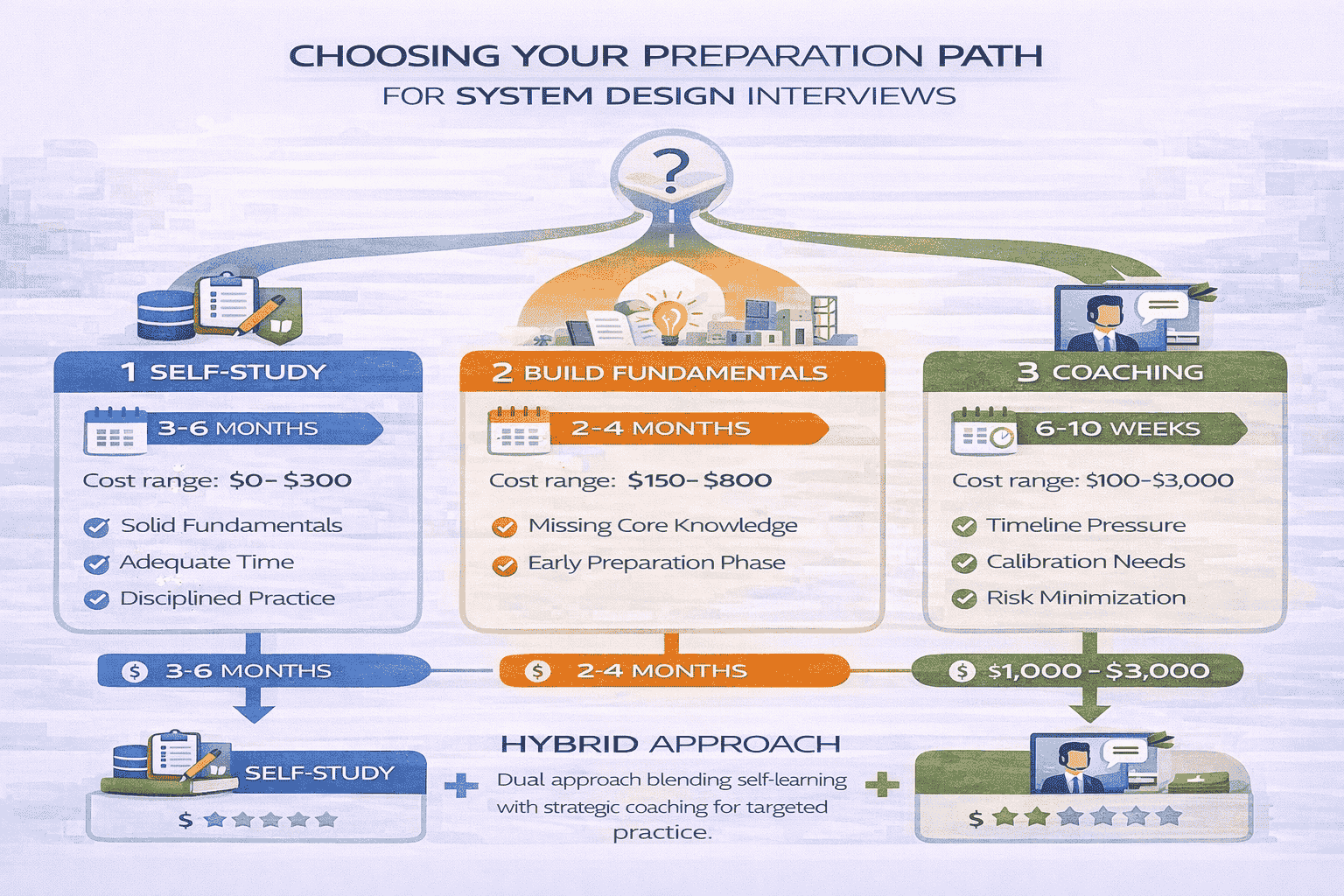
Three Clear Paths Forward
Path 1: Continue with structured self-study.
This works when you have solid fundamentals, adequate time, and disciplined practice habits.
Focus on deliberate practice designing complete systems end-to-end. Time yourself strictly. Record your designs and review them critically. Seek practice partners for peer feedback.
Recommended timeline: 3-6 months of consistent preparation before interview cycles.
Path 2: Strengthen fundamentals before advanced preparation.
If you lack core distributed systems knowledge, invest in foundational learning first.
Read comprehensive system design books. Take
structured courses
covering databases, caching, load balancing, and microservices. Build small distributed systems projects hands-on.
Recommended timeline: 2-4 months building foundation, then reassess whether coaching or continued self-study makes sense.
Path 3: Explore coaching or structured mock interviews.
This fits when you need external calibration, have timeline constraints, or want to minimize interview attempt risk.
Research coaching options focusing on experience level match and mock interview availability. Many platforms offer single-session trials before full commitments.
Recommended timeline: 6-10 weeks of intensive preparation with weekly coaching sessions.
The Hybrid Approach Worth Considering
Many engineers benefit from combining approaches strategically. Start with 4-6 weeks self-study establishing fundamentals and baseline knowledge.
Schedule 2-3 coaching sessions for calibration. Use those sessions to identify specific gaps and communication weaknesses. Return to focused self-study addressing those exact areas.
Add final 2-3 coaching sessions immediately before interviews for realistic mock practice and confidence building.
This compressed coaching engagement costs $400-900 instead of $2000+ while maintaining key benefits: external perspective, calibration, and directed feedback.
What Success Actually Requires
Regardless of path chosen, interview success requires consistent effort. Self-study demands discipline without external accountability. Coaching demands active participation and independent practice.
Neither path works with passive engagement. Both require 10-15 hours weekly of focused preparation over multiple weeks.
The difference lies in feedback speed, calibration quality, and risk management. Not in total effort required.
Resources for Each Path
For self-study:
Comprehensive system design books provide solid foundations. Online courses offer structured learning paths. Practice partner communities enable peer feedback and mock interviews.
Focus on resources teaching general principles over specific technologies. Interview questions test architectural thinking, not memorization of particular tools.
For coaching:
Research platforms offering experienced coaches with background at companies you’re targeting. Prioritize mock interview availability over pure lecture content.
Look for coaches who provide specific, actionable feedback rather than generic encouragement. Trial sessions help evaluate fit before major commitments.
Making Your Decision Without Pressure
This guide provided comparison frameworks, not prescriptive answers. Your decision should reflect honest self-assessment of your situation.
Consider your timeline constraints realistically. Evaluate your current knowledge level honestly. Assess your learning style and practice discipline accurately.
Then choose the path aligned with those realities. Not the path you wish fit your situation, but the path that actually does.
When to Revisit This Decision
Preparation paths aren’t permanent commitments. You can start with self-study and add coaching later if you identify persistent gaps.
You can begin with coaching for calibration, then shift to self-study for cost efficiency. Flexibility matters more than initial path selection.
Reassess every 4-6 weeks. Are you making measurable progress? Do you understand your weak areas? Are you confident in your interview readiness?
If progress stalls or confidence remains low despite effort, consider changing approaches.
???? Download: Preparation Progress Tracker
Weekly self-assessment tool tracking preparation effectiveness across key dimensions. Helps identify when to continue current path versus pivot to alternative approaches.
Final Thought on ROI and Investment
Whether you invest $0 in self-study or $2000 in coaching, the real investment is your time and mental energy over weeks of preparation.
That investment pays off through career advancement, compensation increases, and role satisfaction. The preparation path is merely the vehicle.
Choose the vehicle matching your constraints and execute the journey with commitment. Both paths lead to the same destination when traveled with focus.
Frequently Asked Questions
How much does system design interview coaching typically cost?
System design coaching typically ranges from $100-300 per session, with most engineers needing 6-10 sessions for comprehensive preparation. Total investment usually falls between $600-3000 depending on coach experience level and package structure. Some platforms offer subscription models at $200-400 monthly. Premium coaches with FAANG experience often charge $250-400 per hour.
Can I succeed in system design interviews without coaching?
Yes, many engineers successfully prepare through dedicated self-study. Success requires solid fundamentals, disciplined practice, and typically 3-6 months of consistent preparation. Self-study works best when you have adequate time, can identify your own weaknesses, and don’t face high-stakes interview constraints. The key is honest self-assessment of your learning style and timeline.
How long does it take to prepare for system design interviews with coaching?
With coaching, most engineers reach interview readiness in 6-10 weeks of focused preparation, assuming they have foundational distributed systems knowledge. This includes weekly coaching sessions plus 10-15 hours of independent practice. Engineers without strong fundamentals need 2-3 months even with coaching. Timeline varies based on target role level and current experience.
What’s the difference between coaching for senior vs staff level roles?
Staff-level system design interviews emphasize organizational impact, long-term system evolution, cross-team dependencies, and trade-offs at scale beyond technical implementation. Senior interviews focus more on technical design correctness and basic trade-off articulation. Coaching for staff roles requires coaches with principal/staff experience who understand these elevated expectations and can calibrate your performance accordingly.
Should I do mock interviews before paying for coaching?
Yes, conducting 2-3 self-administered or peer mock interviews before coaching helps you understand your baseline performance and specific gaps. This makes coaching sessions more effective because you can articulate concrete challenges rather than vague concerns. Many coaching platforms offer single trial sessions at reduced rates, which serve as excellent calibration points before committing to full packages.
Is coaching worth it if I’ve already failed multiple interviews?
Repeated interview failures with unclear feedback make coaching particularly valuable. Multiple failures suggest systematic gaps you’re unable to self-diagnose. Coaching typically identifies these patterns within 1-2 sessions, then provides directed practice to address specific weaknesses. The ROI is especially strong when failures at preferred companies have closed doors or when you have limited remaining interview opportunities.
Citations
-
https://www.glassdoor.com/blog/guide/system-design-interview/
-
https://www.educative.io/blog/complete-guide-to-system-design
-
https://www.tryexponent.com/blog/system-design-interview-guide
-
https://interviewing.io/guides/system-design-interview
-
https://www.levels.fyi/blog/system-design-interview-guide.html
Content Integrity Note
This guide was written with AI assistance and then edited, fact-checked, and aligned to expert-approved teaching standards by
Ram Arun
. Ram has over 10 years of experience coaching software developers through technical interviews at top-tier companies including FAANG and leading enterprise organizations. His background includes conducting 500+ mock system design interviews and helping engineers successfully transition into senior, staff, and principal roles. Technical content regarding distributed systems, architecture patterns, and interview evaluation criteria is sourced from industry-standard references including engineering blogs from Netflix, Uber, and Slack, cloud provider architecture documentation from AWS, Google Cloud, and Microsoft Azure, and authoritative texts on distributed systems design.

