
You’ve spent years building distributed systems. You’ve scaled databases, optimized APIs, and debugged production incidents at 3 AM. Yet when you sit down for a system design interview preparation session, something feels off. The interview expectations don’t match real-world engineering.
You’re not alone. Senior engineers with 8+ years of experience fail system design interviews at companies they’re overqualified for. The disconnect isn’t about technical competence—it’s about understanding what interviewers actually evaluate and how to communicate architecture decisions under pressure.
This guide gives you the complete framework: what system design interviews test, how companies score you, why capable engineers fail, and the repeatable process to prepare strategically in 2-12 weeks.
Last updated: Feb. 2026
Table of Contents
- 1. Why Senior Engineers Struggle With System Design Interviews
- 2. What a System Design Interview Really Tests
- 3. How Companies Evaluate You (The Hidden Rubric)
- 4. Why Candidates Fail (Even With Good Knowledge)
- 5. The Complete Interview Framework (Your Default Flow)
- 6. Core Building Blocks You Must Master
- 7. Reliability & Production Thinking (What Most Candidates Miss)
- 8. Security & Abuse Prevention (Interview-Ready Version)
- 9. Frequently Asked Questions
Contents








Why Senior Engineers Struggle With System Design Interviews
The expertise paradox explains why senior engineers often perform worse in system design interviews than mid-level candidates. Years of production experience create mental shortcuts and assumptions that work beautifully in real jobs but hurt in interviews.
Real-World Engineering Versus Interview Performance
In production systems, you inherit constraints. The database technology is already chosen. Caching strategies evolved over years. Architecture decisions happened before you joined.
You optimize within existing boundaries. Senior engineers excel at this—debugging bottlenecks, improving specific subsystems, and shipping incremental improvements. This is valuable work.
System design interviews test the opposite skill. Starting from zero requirements, you must make architectural choices, justify tradeoffs, and design systems that don’t exist yet. Many experienced engineers haven’t practiced this kind of greenfield thinking in years.
The Communication Gap That Kills Strong Candidates
Production engineering rewards speed and efficiency. You see a caching problem, add Redis, move on. No explanation needed—your commit speaks for itself.
Interviews reward explicit communication. The interviewer cannot see inside your head. When you jump from “we need fast lookups” to “let’s use Redis” without explaining the tradeoff between Redis versus Memcached, or why caching beats database optimization here, you lose points.
Senior engineers make these tradeoffs constantly but rarely verbalize the decision tree. The interview format penalizes this implicit knowledge.
📊 Table: Production Work vs. Interview Expectations
This comparison shows why real-world engineering skills don’t directly transfer to interview performance. Understanding these differences helps you prepare strategically.
| Production Engineering | System Design Interview | Why This Matters |
|---|---|---|
| Optimize existing systems | Design new systems from scratch | Different problem-solving mode required |
| Work within established constraints | Define constraints yourself | Must ask clarifying questions proactively |
| Implementation details matter | High-level tradeoffs matter more | Candidates often go too deep too fast |
| Code and commits speak for themselves | Must verbalize all decision-making | Communication is 50% of the evaluation |
| Single correct solution often exists | Multiple valid approaches exist | Showing tradeoff awareness beats “perfect” design |
Anxiety Amplifies the Disconnect
Capable engineers fail interviews because performance anxiety triggers self-disqualification. You know you could build this system in production. The artificial interview setting feels contrived.
This frustration creates a vicious cycle. Annoyance leads to rushing. Rushing leads to skipping requirement clarification. Skipping requirements leads to designing the wrong system. The interviewer flags lack of structured thinking, not technical incompetence.
Breaking this cycle requires recognizing that system design interviews test a specific, learnable skillset distinct from engineering ability. The preparation process addresses both the technical framework and the psychological barriers.
The Preparation Mismatch
Most engineers prepare by memorizing architecture patterns. They study Netflix’s microservices, Google’s Bigtable, Amazon’s DynamoDB. They can explain consistent hashing, CAP theorem, and eventual consistency.
Then the interview asks them to design Uber. They freeze. The pattern library doesn’t map directly to this specific problem. They try to retrofit memorized solutions, creating Frankenstein architectures that don’t address the actual requirements.
Effective preparation focuses on process over patterns. Learn the systematic approach to breaking down any problem: clarify scope, identify constraints, start simple, justify choices, handle objections. Patterns become tools you select based on requirements, not templates you force-fit.
What a System Design Interview Really Tests
System design interviews evaluate structured thinking and communication under ambiguous conditions. Companies use this format to predict how you’ll handle architectural decisions in real senior roles where requirements are incomplete and constraints emerge gradually.
The Interview Format Spectrum
Formats vary by company and level. Understanding these variations prevents surprises.
Duration ranges from 45 to 90 minutes. FAANG companies typically allocate 45 minutes. Startups and scale-ups often run 60-minute sessions. Some companies split system design across multiple rounds.
Medium choices include whiteboarding, collaborative docs, or diagramming tools. In-person interviews use physical whiteboards. Remote interviews shifted to tools like Miro, Excalidraw, or Google Docs. Some companies provide proprietary diagramming environments.
Interviewer styles range from hands-off to highly interactive. Some interviewers barely speak after stating the problem, observing how you handle ambiguity. Others actively probe decisions, challenge assumptions, and guide you toward specific areas. Neither style indicates good or bad performance—adjust your approach to match their engagement level.
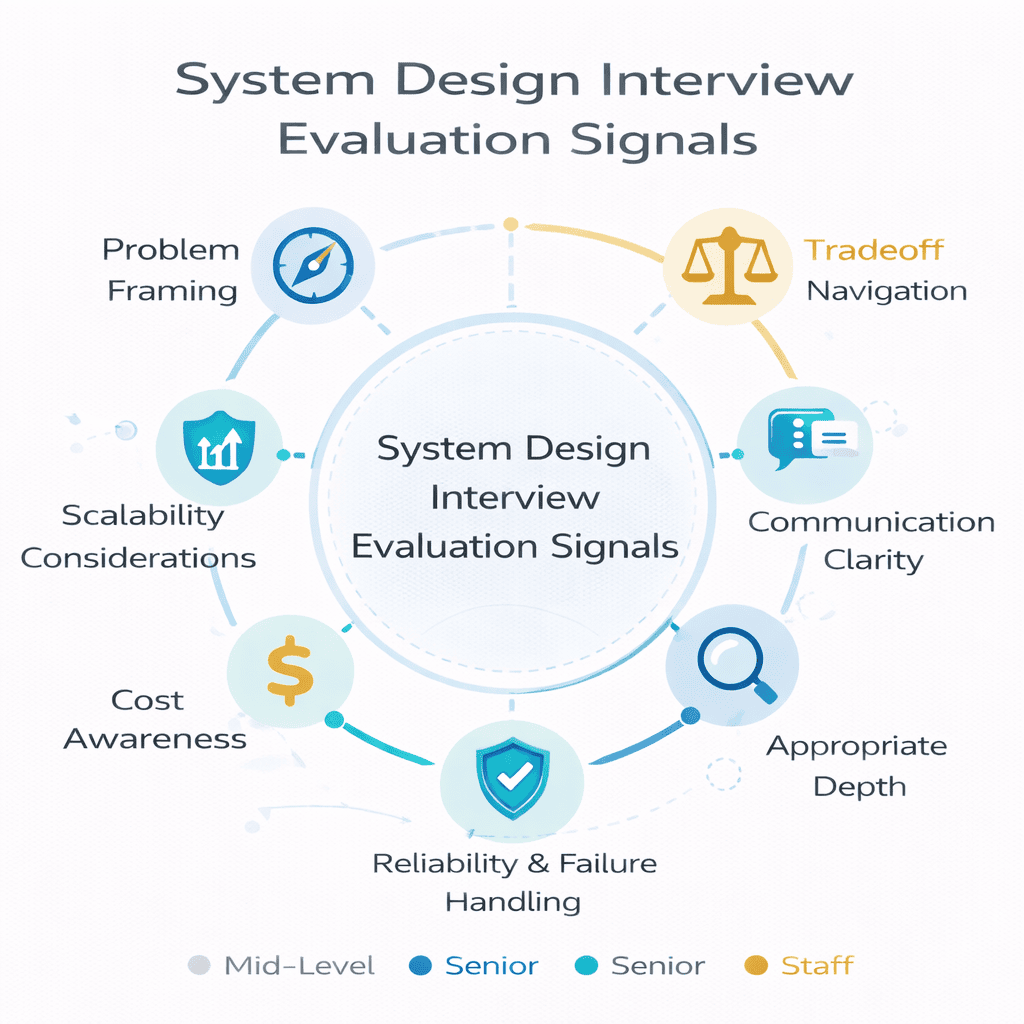
The Seven Core Evaluation Signals
Companies assess candidates across these dimensions, though weighting varies by role and level.
Problem framing: Do you clarify requirements before designing? Can you distinguish functional requirements (what the system does) from non-functional requirements (how well it performs)? Do you identify the most critical constraints upfront?
Weak candidates jump into architecture immediately. Strong candidates spend 5-7 minutes ensuring they’re solving the right problem.
Tradeoff navigation: Every architectural choice involves tradeoffs. SQL databases offer strong consistency but harder horizontal scaling. NoSQL databases scale easily but sacrifice transaction guarantees. Do you articulate these tradeoffs clearly? Can you justify why one matters more for this specific problem?
This signal differentiates senior from junior engineers. Juniors present solutions. Seniors present decisions with explicit reasoning.
Communication clarity: Can the interviewer follow your thought process? Do you state assumptions explicitly? Do you check for understanding before diving deeper? Do you structure your explanation logically?
Many technically sound designs earn “no hire” because the interviewer couldn’t follow the candidate’s reasoning. If you’re thinking faster than you’re explaining, slow down.
Appropriate depth: Knowing when to stay high-level versus when to drill deep is critical. You cannot fully design every component in 45 minutes. Strong candidates present the high-level architecture first, then selectively deepen based on interviewer interest.
Going too deep into one area signals poor time management. Staying too shallow everywhere signals superficial understanding.
Scalability considerations: Can you identify bottlenecks before they’re pointed out? Do you consider what happens at 10x scale? At 100x scale? Do you know which components become problematic first?
Scalability doesn’t mean “add more servers.” It means understanding where sequential operations create throughput limits, where data locality matters, and where coordination costs dominate.
Reliability and failure handling: Real systems fail. Drives crash, networks partition, services hang. Do you design for partial failures? Do you consider retry logic, circuit breakers, and graceful degradation?
This signal matters more for senior and staff levels. Companies want confidence you’ll build production-ready systems, not theoretical architectures.
Cost awareness: Not every problem requires Google-scale infrastructure. Do you consider operational costs? Can you justify expensive components? Do you identify opportunities to reduce cost without sacrificing requirements?
This skill becomes increasingly important as you target staff+ roles where business impact matters alongside technical execution.
How Signals Map to Seniority Levels
Expectations scale with job level. Understanding these differences helps you calibrate your preparation.
Mid-level engineers (L4/E4) should demonstrate solid problem framing, reasonable architectural choices, and awareness of basic scalability patterns. Deep tradeoff analysis and sophisticated reliability thinking are bonuses, not requirements.
Senior engineers (L5/E5) must excel at tradeoff navigation and communication. Interviewers expect you to drive the conversation, proactively identify edge cases, and handle challenging follow-up questions about failure modes and scaling bottlenecks.
Staff engineers (L6/E6+) face scrutiny on cost awareness, operational complexity, and system evolution over time. Can you design systems that teams can maintain? Do you consider migration paths and backwards compatibility? Can you balance technical purity against business constraints?
What Interviewers Probe During Deep Dives
After you present the high-level design, interviewers drill into specific areas. These probes test depth of understanding.
Bottleneck identification: “What part of this system becomes the bottleneck at 10 million requests per second?” Strong candidates immediately identify the write path, database contention points, or network I/O limits. Weak candidates guess or require heavy prompting.
Failure mode analysis: “What happens if the cache layer goes down?” This tests whether you’ve thought beyond happy path. Can you describe graceful degradation? Do you understand cascading failures?
Consistency guarantees: “Does this design guarantee that users see their own writes immediately?” This probes understanding of CAP theorem implications. Many candidates claim “eventual consistency” without understanding what that means for user experience.
Cost estimation: “How much would this cost to run at 1 million users?” This tests back-of-the-envelope calculation ability and infrastructure cost awareness. Ballpark accuracy matters more than precision.
How Companies Evaluate You (The Hidden Rubric)
Every company uses a scoring rubric to standardize interview feedback. Understanding these rubrics transforms abstract advice into concrete actions. You can optimize your performance when you know exactly what interviewers mark on their scorecards.
The Standard Rubric Structure
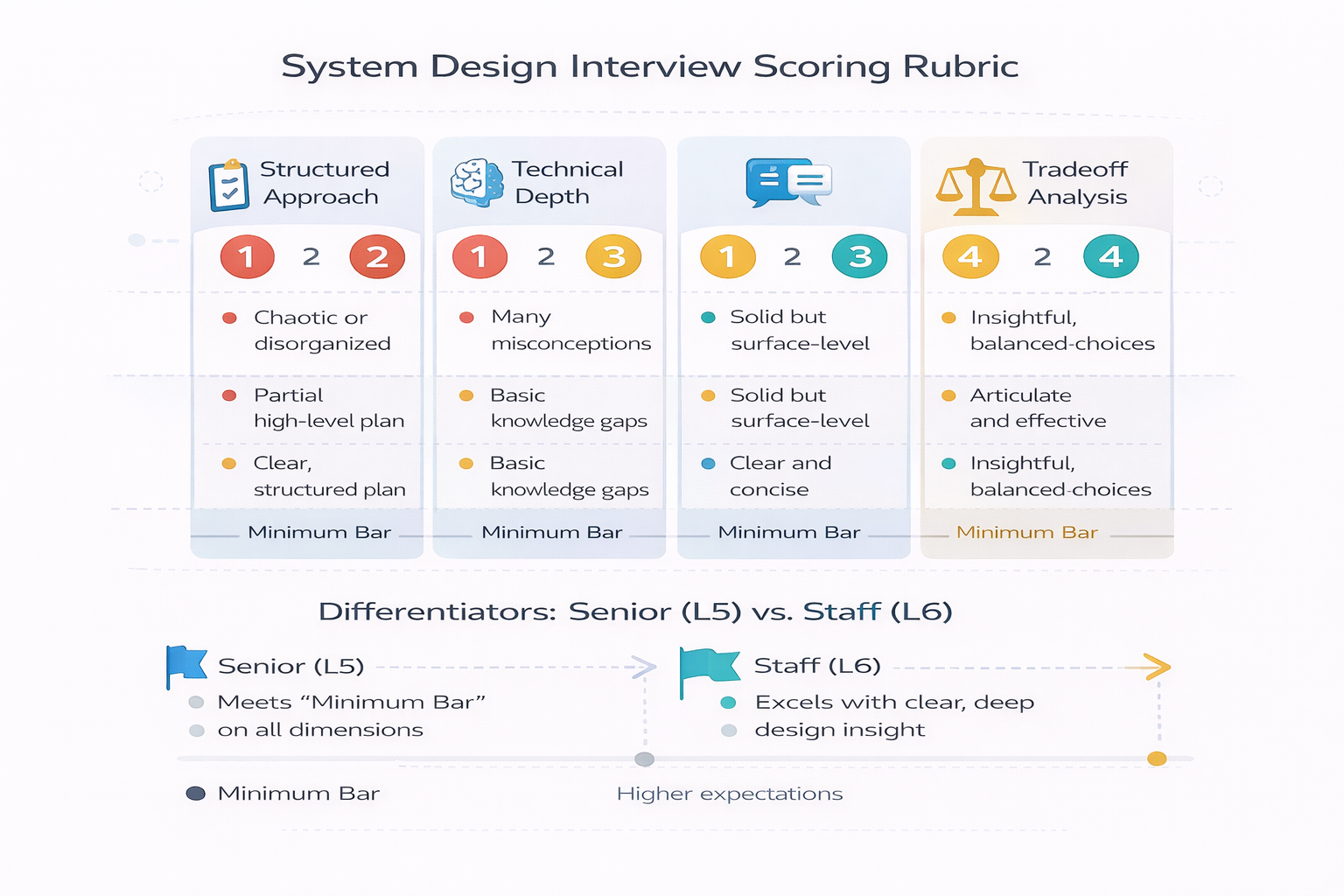
Most tech companies evaluate system design interviews across four to six categories. Each category receives a score from 1 to 4, where 1 means “significant concerns” and 4 means “exceeded expectations.”
Structured approach and problem-solving: Did the candidate ask clarifying questions? Did they define requirements before jumping into solutions? Did they break the problem into manageable pieces? This category measures your ability to handle ambiguity systematically.
A score of 2 here means you eventually got to a solution but took wrong turns or needed heavy prompting. A score of 4 means you drove the conversation methodically, anticipated edge cases, and showed clear logical progression.
Technical depth and breadth: Does the candidate understand how different components work? Can they explain why they chose specific technologies? Do they know the tradeoffs between alternatives? This tests your actual system design knowledge.
Many candidates score well on breadth (they mention caching, load balancers, databases) but poorly on depth (they can’t explain when to use Redis vs Memcached, or why). Strong candidates demonstrate both general awareness and specific expertise.
Communication and collaboration: Could the interviewer follow your thinking? Did you explain clearly? Did you respond well to questions and pushback? Did you think out loud or go silent for long periods?
This category kills otherwise strong candidates. You might design a perfect system, but if the interviewer struggled to understand your reasoning, you’ll score a 2. Remember: the interviewer cannot read your mind. Verbalize your thought process continuously.
Tradeoff analysis and decision-making: Did you articulate the pros and cons of different approaches? Did you justify your choices based on requirements? Did you show awareness of what you were optimizing for?
Weak candidates make assertions: “We’ll use a NoSQL database because it’s scalable.” Strong candidates make arguments: “Given our read-heavy workload with eventual consistency tolerance, a NoSQL database like Cassandra provides better horizontal scaling than a traditional SQL database, though we sacrifice transactional guarantees which is acceptable for this use case.”
How Senior Versus Staff Rubrics Differ
The evaluation categories stay similar across levels, but the bar for each score shifts higher. What earns a 4 at mid-level might earn a 3 at senior level.
Senior engineer expectations (L5/E5): You should drive the interview independently. The interviewer might stay quiet for 10-15 minutes while you work through requirements and initial design. You need to proactively identify failure modes, scaling bottlenecks, and operational concerns without prompting.
At this level, interviewers expect you to say things like: “Before we continue, I should verify our consistency requirements because that affects database selection” or “Let me walk through what happens when the message queue backs up.”
Staff engineer expectations (L6/E6+): Everything from senior level plus demonstrated thinking about system evolution, team scalability, and operational burden. Can you explain how this system changes when traffic grows 100x? How does the design support A/B testing? What’s the migration path if requirements change?
Staff candidates should volunteer observations about organizational complexity: “This design introduces operational overhead because now we need expertise in both PostgreSQL and Cassandra. We should consider whether the performance gains justify maintaining two database systems.”
What “Good” Actually Looks Like in Practice
Abstract rubric categories become concrete when you see example behaviors that earn high scores versus low scores.
High score behavior for structured approach: “Let me make sure I understand the requirements. We’re building a URL shortener. I’m assuming we need to support creating short URLs, redirecting users who click them, and viewing analytics on click counts. Is that correct? What scale are we targeting—thousands, millions, or billions of URLs?”
This demonstrates requirement clarification, scope definition, and scale awareness in two sentences.
Low score behavior for structured approach: “Okay, URL shortener. I’ll use a hash function to create short codes, store them in a database, and when someone clicks the link we look it up and redirect. For the database I’ll use MongoDB because it scales well.”
This jumps directly to implementation without clarifying requirements or considering alternatives. The interviewer has no insight into your thinking process.
High score behavior for tradeoff analysis: “For the database choice, I’m weighing two options. SQL databases like PostgreSQL give us strong consistency and relational capabilities, which helps if we add features like user-created collections of links. NoSQL like Cassandra gives us easier horizontal scaling and higher write throughput. Given our read-heavy workload—probably 100:1 read:write ratio—and the fact that individual links don’t need to relate to each other, I’m leaning toward Cassandra for better read scaling.”
This shows structured comparison, requirement-driven reasoning, and explicit choice with justification.
Low score behavior for tradeoff analysis: “We’ll use NoSQL because it’s more scalable and modern applications use it.”
This reveals cargo-cult thinking without understanding tradeoffs. The terms “scalable” and “modern” are vague and don’t connect to specific requirements.
Reading Interviewer Signals During the Session
Attentive candidates pick up on interviewer cues and adjust their approach. These signals help you course-correct in real-time.
Positive signals: The interviewer nods along, takes notes actively, asks clarifying questions about your reasoning (“Why did you choose X over Y?”), and probes deeper into specific areas. They might say “That’s a good point” or “Interesting approach.”
These signals mean you’re on track. Continue your current approach and maintain communication clarity.
Neutral signals: The interviewer stays quiet, doesn’t interrupt, but also doesn’t show strong engagement. They might look at their notes more than at you. They respond with “okay” or “go on” without additional questions.
Neutral signals suggest you’re not providing enough insight into your thinking. Increase verbal explanation of your reasoning. Check in more frequently: “Does this approach make sense?” or “Should I go deeper here or move on?”
Warning signals: The interviewer interrupts to redirect you, asks you to restart, or says things like “Let’s take a step back” or “I’m not sure I follow.” They might explicitly push you toward a different approach.
Warning signals mean you’ve gone off track. Stop, clarify what confused them, and reset. Don’t defend your approach defensively—interviewers test how you handle feedback and course-correction.
The Calibration Process Behind Hiring Decisions
After your interview, your scores enter a calibration meeting where hiring managers compare candidates. Understanding this process explains why borderline performance sometimes results in offers and sometimes doesn’t.
Score comparison across interviewers: If you interviewed with multiple people, they compare notes. Consistent scores (all 3s, or all 3-4s) make decisions straightforward. Mixed scores (one 4, two 2s) trigger discussion about what happened in each interview.
Comparison to interview bar: Each company maintains internal benchmarks—examples of what “strong yes” versus “weak yes” versus “no hire” looks like for each level. Your performance gets compared to these benchmarks, not just to other current candidates.
Headcount availability and urgency: Two identical candidates might receive different outcomes based on hiring timeline and open positions. Early in a hiring cycle, companies might pass on borderline candidates. Late in a cycle with unfilled roles, the same performance might convert to an offer.
This reality is frustrating but important to understand. Sometimes rejection reflects external factors beyond your control, not your actual capability.
Why Candidates Fail (Even With Good Knowledge)
The gap between knowing system design patterns and performing well in interviews explains why smart engineers repeatedly fail. These failure modes are predictable and fixable once you recognize them.
Jumping Into Architecture Without Requirements
This is the single most common failure mode. The interviewer asks “Design Instagram” and you immediately start: “Okay, we’ll need a photo storage service, a feed generation system, a notification service…”
You just wasted the entire interview. Instagram has dozens of features. Does this interview focus on photo upload, feed generation, search, direct messaging, or stories? Is the priority mobile performance, global availability, or rapid feature development?
Without clarifying requirements, you’re designing a system the interviewer didn’t ask for. Even if your architecture is technically sound, you’ll score poorly on “structured approach” and “problem-solving.”
The fix: Spend the first 5-7 minutes on requirements. Ask: “What are the core features we need to support?” “What’s the scale—users, requests per second, data volume?” “What are the key performance requirements?” “Are there geographical constraints?”
Write these down visibly. Refer back to them throughout the interview. This shows structured thinking and prevents you from designing the wrong system.
Over-Designing for Scale
You hear “design Twitter” and immediately propose a complex microservices architecture with dedicated services for timelines, notifications, recommendations, ads, messaging, and more. You add Kafka for real-time streams, Cassandra for tweets, Redis for caching, and Elasticsearch for search.
The interviewer asks “How many users?” You say “Let’s assume 10,000 initially.” Now your massive infrastructure looks absurd. You’ve over-engineered a solution that could run on a single PostgreSQL database and a basic web server.
Strong candidates start simple and scale incrementally. Design for actual requirements, then explain how you’d evolve the architecture as load increases.
The fix: Begin with the simplest architecture that meets requirements. A monolith with a database often works for the initial design. Then say: “At 100x scale, this component becomes the bottleneck because… To address that, we’d introduce…” This shows better judgment than immediately proposing Google-scale infrastructure.
Under-Designing and Staying Too Vague
The opposite problem also fails interviews. You draw boxes labeled “web server,” “cache,” and “database” without explaining what they do, how they interact, or why you chose them. When the interviewer probes deeper, you can’t explain the details.
This signals superficial understanding. Anyone can draw a three-tier architecture. The interview tests whether you understand the implications of your choices.
The fix: After presenting high-level architecture, pick 2-3 components to explain in detail. “Let me drill into the caching layer. We’re using Redis rather than Memcached because we need data structure support for leaderboards. The cache sits in front of the read path, storing feed data with a TTL of 30 minutes. Cache misses trigger database queries that populate the cache. Here’s the tradeoff: we get 10x faster reads but eventual consistency where users might not see the latest posts immediately.”
This depth shows you understand not just what the component does but why it exists and what tradeoffs it introduces.
📊 Table: Common Failure Modes and How to Avoid Them
Recognizing these patterns in your practice sessions helps you course-correct before real interviews. Each failure mode has a specific prevention strategy.
| Failure Mode | What It Looks Like | Why It Fails | How to Fix It |
|---|---|---|---|
| Skipping Requirements | Jumping straight to architecture | Solving wrong problem | Force 5-7 min requirement phase |
| Over-Engineering | Kafka + microservices for 10K users | Poor judgment on scale | Start simple, scale incrementally |
| Under-Engineering | Vague boxes without details | Shallow understanding | Deep-dive 2-3 components |
| Weak Tradeoffs | “Use NoSQL because it’s scalable” | Cargo-cult reasoning | State alternatives + criteria + choice |
| Ignoring Reliability | Only happy path, no failures | Not production-ready | Proactively mention retries, fallbacks |
| Poor Time Management | 30 min on API design, 5 min on architecture | Missed critical sections | Timebox: 7 min requirements, 25 min design, 10 min deep dive |
Providing Weak Tradeoff Explanations
You choose a technology and the interviewer asks why. You respond with vague platitudes: “It’s scalable,” “It’s fast,” “It’s what modern companies use,” “I’ve worked with it before.”
None of these answers demonstrate understanding. Everything is “scalable” given proper architecture. Everything is “fast” for some workloads and slow for others. Personal familiarity doesn’t justify architectural choices in an interview context.
The fix: Structure tradeoff explanations as: Alternative A versus Alternative B, based on Criterion X from requirements, I choose A because of specific reason Y, with tradeoff Z that I’m accepting. Example: “For the database, SQL gives us strong consistency and ACID transactions, while NoSQL gives us better horizontal scaling and schema flexibility. Given our requirement for financial transactions where consistency is critical and our scale of 100K users where a single SQL database suffices, I’m choosing PostgreSQL, accepting that we’ll need to implement read replicas rather than automatic sharding when we scale.”
Ignoring Reliability and Operations
You design a beautiful architecture for the happy path. Every component has a clear purpose. The data flows elegantly. Then the interviewer asks “What happens when the cache goes down?” and you freeze.
Production systems fail constantly. Drives fail, networks partition, deployments break things, traffic spikes overwhelm services. Designs that ignore failure modes signal lack of production experience.
The fix: After presenting your initial design, volunteer reliability considerations without prompting. “Let me talk through failure scenarios. If the cache fails, requests hit the database directly. We’ll implement circuit breakers to prevent thundering herd. If the primary database fails, read replicas can serve queries but writes fail until recovery. For critical write paths, we’d implement write-ahead logging and automatic failover with a brief service degradation window.”
This proactive reliability thinking differentiates senior candidates from junior ones.
Not Managing Time Boxes
You spend 25 minutes perfecting the API design, covering every endpoint parameter in detail. Then you have 10 minutes left to design the entire backend architecture, which you rush through superficially.
Or you get stuck on one component, spending 15 minutes debating caching strategies while ignoring database design, networking, and scaling concerns entirely.
Poor time management signals weak prioritization skills. In real senior roles, you must judge where to invest effort and where to move quickly.
The fix: Mentally allocate time before you start. In a 45-minute interview: 5-7 minutes requirements, 5 minutes high-level architecture, 20 minutes deepening 2-3 areas, 5-10 minutes handling follow-ups, 3-5 minutes discussing scalability and failure modes. Stick to these windows. If you’re running over, explicitly tell the interviewer: “I’m spending too much time here. Let me wrap up this point and move to the next component.”
Going Silent for Long Periods
The interviewer asks a question and you think for 90 seconds without speaking. Your facial expression shows active thinking, but the interviewer has no idea what’s happening in your mind. Are you stuck? Are you considering tradeoffs? Are you doing mental math?
Long silences hurt your communication score and make interviewers nervous. They can’t evaluate your thought process if you don’t share it.
The fix: Think out loud continuously. “Okay, let me work through the caching strategy. I’m considering where cache misses create bottlenecks… The read path has 100x more traffic than writes based on our requirements… That suggests cache-aside pattern makes sense… But we need to handle cache invalidation, so write-through might be better despite added write latency… Let me weigh those tradeoffs…”
This stream-of-consciousness approach might feel awkward initially, but it gives interviewers insight into your problem-solving process. Even if you don’t reach the “perfect” solution, strong reasoning visible throughout earns credit.