You know how to design scalable systems. But when you step into a system design interview communication scenario, your mind goes blank. You freeze. You ramble. The interviewer interrupts with a constraint change, and suddenly your carefully structured explanation collapses into technical jargon.
Here’s the uncomfortable truth: most senior engineers fail system design interviews not because they lack technical knowledge, but because they cannot translate their expertise into clear, structured conversation.
This guide teaches you a repeatable communication framework that works under pressure, helping you sound deliberate and senior-level regardless of the system you’re designing.
Last updated: Feb. 2026
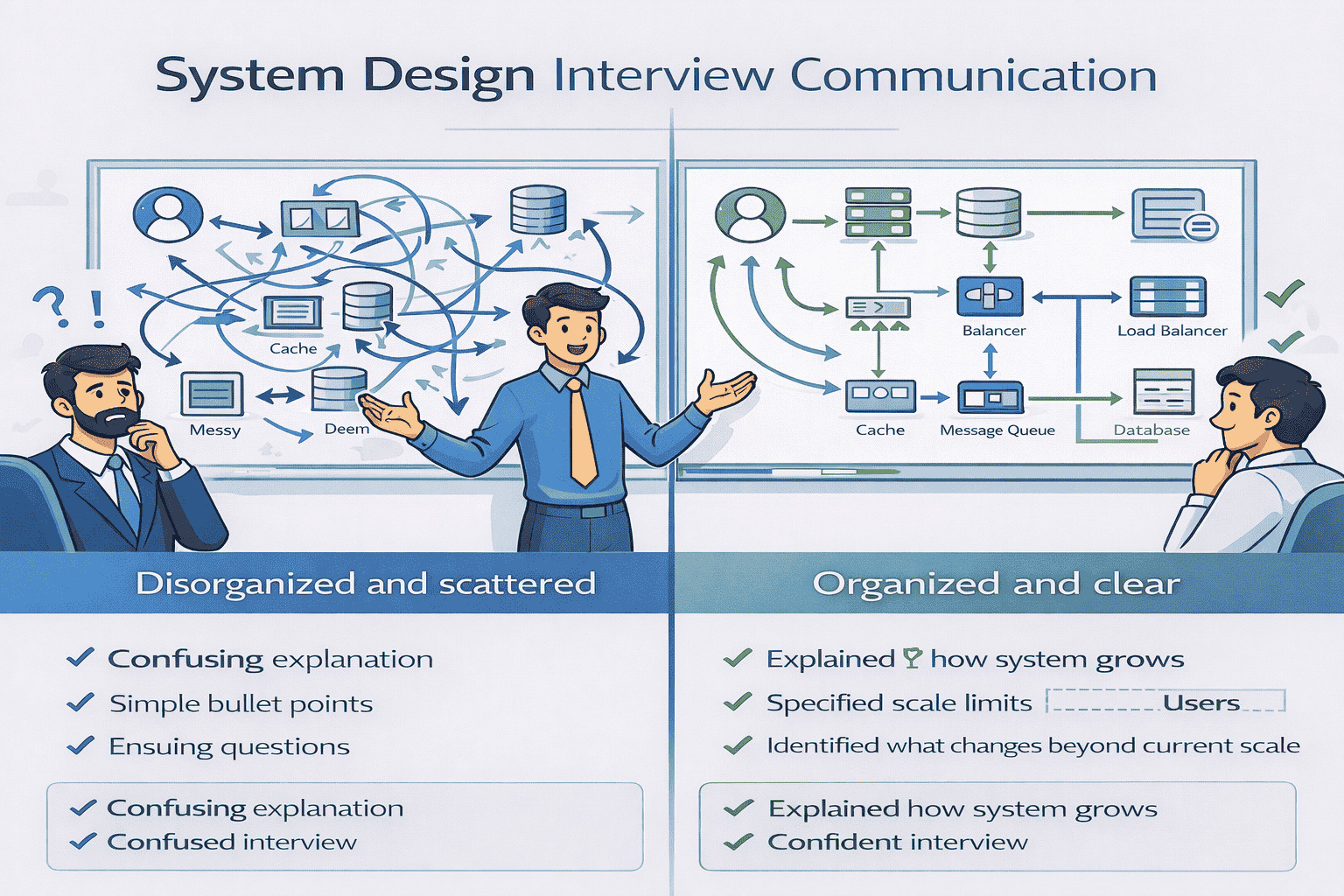
Table of Contents
- 1. Why Technically Strong Engineers Struggle to Communicate Design
- 2. Step 1: Clarify the Problem Before You Design Anything
- 3. Step 2: Set the Design Context Out Loud
- 4. Step 3: Explain the High-Level Design First
- 5. Step 4: Introduce APIs and Data Flow Clearly
- 6. Step 5: Communicate Trade-Offs Deliberately
- 7. Step 6: Handle Scalability and Bottlenecks Out Loud
- 8. Step 7: Respond to Follow-Up Questions Without Losing Structure
- 9. Step 8: Close the Design with a Clear Summary
- 10. FAQs
Contents










Why Technically Strong Engineers Struggle to Communicate Design
System design interviews test communication far more than they test architecture knowledge. Interviewers already assume you understand distributed systems, databases, and caching strategies. What they’re really evaluating is whether you can lead architectural conversations, explain decisions clearly, and collaborate under pressure.
Most engineers approach these interviews backward. They believe mastering technical depth???learning Kafka internals, studying CAP theorem edge cases, memorizing sharding algorithms???will carry them through. But when the interview starts, they discover a frustrating gap.
They know what to design. They cannot explain how they got there.
The Communication Gap: What Actually Happens
You walk into the interview. The interviewer asks you to design a URL shortener. Simple enough. You’ve built similar systems. You start drawing boxes on the whiteboard.
Then the interviewer interrupts: “How will you handle 10,000 writes per second?”
You freeze. Not because you don’t know the answer???you’ve implemented write-heavy systems before???but because you haven’t structured your explanation yet. You scramble. You mention sharding, then jump to caching, then circle back to database replication. Your explanation becomes a technical word salad.
The interviewer looks confused. You lose confidence. The interview spirals.
Why This Happens to Experienced Engineers
Senior developers often struggle more than mid-level engineers in system design interviews. This sounds counterintuitive until you understand the root cause.
In production work, you solve problems iteratively. You spike solutions, run experiments, refactor based on metrics. You have time to think, research, and validate. Communication happens asynchronously through documentation, code reviews, and design docs.
Interviews reverse this. You must narrate your thinking in real-time while designing synchronously. You cannot pause to research. You cannot write a detailed RFC. You must talk through incomplete ideas, handle interruptions gracefully, and adjust your design mid-explanation.
Production problem-solving and interview problem-solving are fundamentally different skills.
???? Table: Production Work vs Interview Communication
Understanding the stark differences between how you work in production and how you must communicate in interviews helps explain why strong engineers struggle. This table highlights the context switch you must make.
| Aspect | Production Work | Interview Context |
|---|---|---|
| Time Pressure | Days or weeks to design | 35-40 minutes total |
| Communication Style | Written docs, async reviews | Live verbal explanation |
| Decision Validation | Experiments, metrics, spikes | Hypothetical reasoning only |
| Interruptions | Minimal during deep work | Constant constraint changes |
| Completeness | Iterative, can refactor later | Must seem complete in one pass |
| Collaboration | Team consensus over days | Real-time dialogue with interviewer |
What Interviewers Are Actually Evaluating
When you walk into a system design interview, the interviewer has a mental scorecard. They’re not just checking whether you know what a load balancer does. They’re evaluating five communication competencies.
1. Structured Thinking: Can you break down ambiguous problems into clear requirements? Do you ask the right clarifying questions before jumping to solutions?
2. Narrative Clarity: Can you explain a complex system in a logical sequence? Do you walk through components one at a time, or do you overwhelm the listener with everything at once?
3. Trade-Off Articulation: When you make architectural decisions, can you explain what you’re gaining and what you’re sacrificing? Do you proactively surface downsides, or wait for the interviewer to challenge you?
4. Collaborative Adaptability: When the interviewer adds constraints or questions your choices, can you pivot gracefully? Do you defend your design dogmatically, or do you incorporate feedback naturally?
5. Appropriate Depth: Do you know when to go deep and when to stay high-level? Can you gauge what the interviewer wants to hear based on their questions?
Notice what’s missing from this list: deep technical knowledge. The interviewer assumes you already have it. What they’re testing is whether you can deploy that knowledge in conversation.
The Core Problem: Implicit vs Explicit Communication
In production, much of your architectural reasoning stays implicit. You sketch a diagram in Confluence. You mention “we’ll use Redis for caching” in a design review. Your team fills in the gaps because they share context with you.
In interviews, everything must be explicit. You cannot assume the interviewer knows why you chose Redis over Memcached. You cannot skip explaining how cache invalidation works in your design. You must narrate every decision, every trade-off, every constraint.
This shift from implicit to explicit communication is exhausting. It feels unnatural. But it’s the entire game.
What This Guide Teaches You
This guide provides a step-by-step communication protocol for system design interviews. It treats communication as a technical skill you can practice and improve, not as a talent you either have or don’t.
Each section answers one question: What exactly should I say, and in what order?
You’ll learn:
- A repeatable clarification framework that prevents misalignment before you start designing
- Exact phrasing templates for explaining components, data flow, and trade-offs
- Techniques for handling interruptions and constraint changes without losing your structure
- A closing summary protocol that leaves a strong, confident final impression
By the end, you’ll have a communication playbook you can apply to any system design interview, regardless of the specific problem.
Step 1: Clarify the Problem Before You Design Anything
The first 5-7 minutes of a system design interview determine everything that follows. This is when you establish shared understanding with your interviewer. This is when you prevent catastrophic misalignment that derails your explanation later.
Most candidates rush this phase. They hear “design Twitter” and immediately start drawing boxes. They lose the interview in the first 90 seconds.
Here’s what happens: they design a full-featured social network with feeds, mentions, and trending topics. The interviewer wanted a simplified read-heavy timeline system. The candidate just spent 30 minutes solving the wrong problem.
Why Clarification Determines Interview Success
System design problems are intentionally ambiguous. “Design a URL shortener” could mean:
- A simple key-value store with redirect logic
- A link analytics platform with click tracking and geography data
- An enterprise-grade system supporting custom domains and expiration policies
Which version should you design? You cannot know without asking. The interviewer will not clarify unless you explicitly request it.
Candidates who skip clarification make two fatal mistakes. First, they solve the wrong scope, wasting precious time on features the interviewer doesn’t care about. Second, they signal to the interviewer that they jump to solutions without understanding requirements???exactly what senior engineers should never do.
The Clarification Framework: What to Ask and When
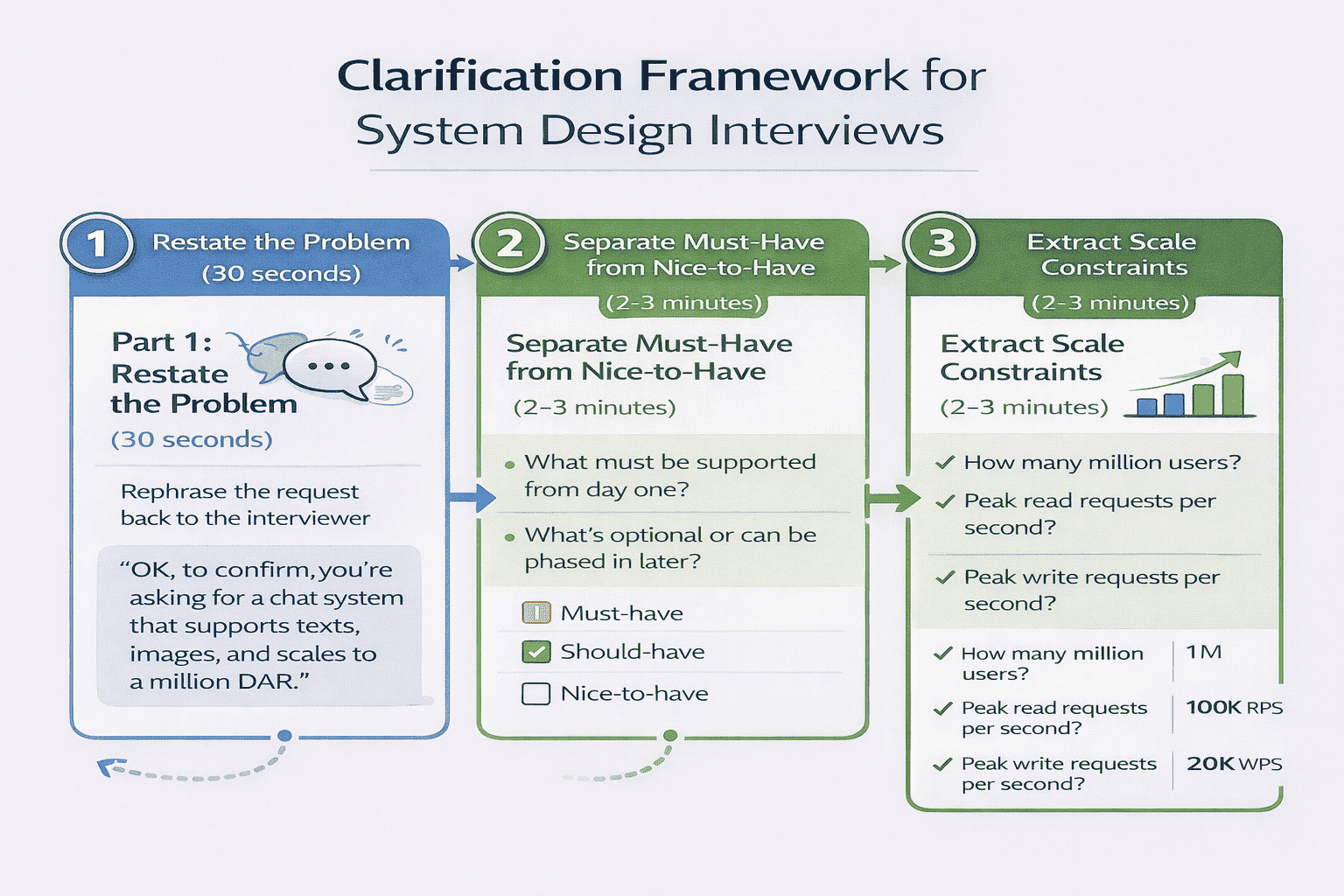
Use this three-part structure every time. It takes 5-7 minutes but saves the entire interview.
Part 1: Restate the Problem in Simple Terms (30 seconds)
Start by paraphrasing what you heard. This forces you to slow down and gives the interviewer a chance to correct misunderstandings immediately.
Example: “Just to make sure I understand correctly???we’re designing a system that takes long URLs, generates short codes, and redirects users when they visit those short codes. Is that the core functionality?”
This sounds obvious. Most candidates skip it. They assume they understood the problem correctly and jump straight to asking about scale. This creates hidden misalignments that only surface 20 minutes later.
Part 2: Separate Must-Have from Nice-to-Have Features (2-3 minutes)
System design problems always have a minimum viable version and optional extensions. You need to know which is which.
Ask directly: “For this interview, which features are required, and which can we treat as extensions if we have time?”
Then list specific features: “Should we support custom short codes, or is random generation sufficient? Do we need expiration policies? Analytics and click tracking? Link editing after creation?”
The interviewer will tell you what to prioritize. This clarity prevents you from over-engineering features that don’t matter or under-designing critical requirements.
Part 3: Extract Scale and Performance Constraints (2-3 minutes)
Numbers matter. A system handling 100 requests per second looks completely different from one handling 100,000 requests per second. You need to know the scale before proposing any architecture.
Ask specific questions: “What’s the expected read-to-write ratio? How many URLs will we create daily? How many redirects per second should we handle? What’s the acceptable latency for redirects?”
If the interviewer says “assume Twitter scale,” don’t accept that. Push for numbers: “Twitter scale could mean different things???are we talking about 500 million daily active users, or 6,000 tweets per second, or a specific read-write pattern? Could you help me pin down the key metrics?”
This accomplishes two things. First, you get the data you need to make design decisions. Second, you demonstrate that you think in systems, not hand-waving abstractions.
Example Clarification Dialogue: URL Shortener
Here’s how the clarification phase sounds when executed well.
Candidate: “Just to make sure I’m understanding correctly???we’re building a service that takes long URLs, generates short unique codes, stores the mapping, and redirects users when they visit the short URL. Is that the core problem?”
Interviewer: “Yes, exactly.”
Candidate: “Great. Before I start designing, I want to make sure I’m solving the right scope. Which of these features are must-haves for this interview? Custom short codes chosen by users, or is random generation fine? Link expiration after a certain time period? Analytics tracking how many times each link is clicked? The ability to edit URLs after they’re created?”
Interviewer: “Focus on random generation and basic redirect. We can treat analytics as a stretch goal if we have time.”
Candidate: “Perfect. Now for scale???what kind of traffic should I design for? How many new URLs are we creating per day? What’s the read-to-write ratio? And what’s the target latency for redirects?”
Interviewer: “Let’s assume 100 million new URLs per month, so roughly 40 writes per second on average. Read-heavy system???maybe 100:1 read-to-write ratio. Redirects should be under 100 milliseconds.”
Candidate: “Got it. So 40 writes per second, 4,000 reads per second, sub-100ms latency for redirects, and no custom codes or editing. I’ll design for that scope. Does that sound right?”
Interviewer: “Yes, let’s proceed.”
Notice what just happened. The candidate confirmed scope, ruled out features that would complicate the design, extracted specific numbers, and explicitly summarized the constraints. Total time: under 3 minutes. The interviewer now knows the candidate thinks like a senior engineer.
Step 2: Set the Design Context Out Loud
After clarifying requirements, most candidates immediately start drawing boxes. They sketch a client, an API gateway, a few microservices, and a database. They believe they’re making progress.
They’re making a critical mistake. They skipped establishing context.
Before you propose any architecture, you must communicate the constraints that shape your design. You must verbalize the scale parameters, usage patterns, and system characteristics that justify your upcoming decisions. This step transforms you from someone drawing boxes to someone reasoning about systems.
Why Context Matters More Than Components
Imagine two candidates designing a video streaming platform. Both draw the same components: CDN, origin servers, encoding pipeline, metadata database. Both designs look identical on the whiteboard.
Candidate A jumps straight to drawing. Candidate B spends 90 seconds establishing context first: “We’re optimizing for a read-heavy system with a 10,000:1 read-to-write ratio. Most videos are watched within 24 hours of upload, creating a hot-cold data pattern. Users expect sub-2-second startup time but tolerate buffering after playback begins. These constraints mean…”
Which candidate sounds senior? Candidate B. Why? Because they demonstrated that every architectural decision flows from system constraints, not arbitrary technology choices.
Context separates engineers who design systems from engineers who assemble components.
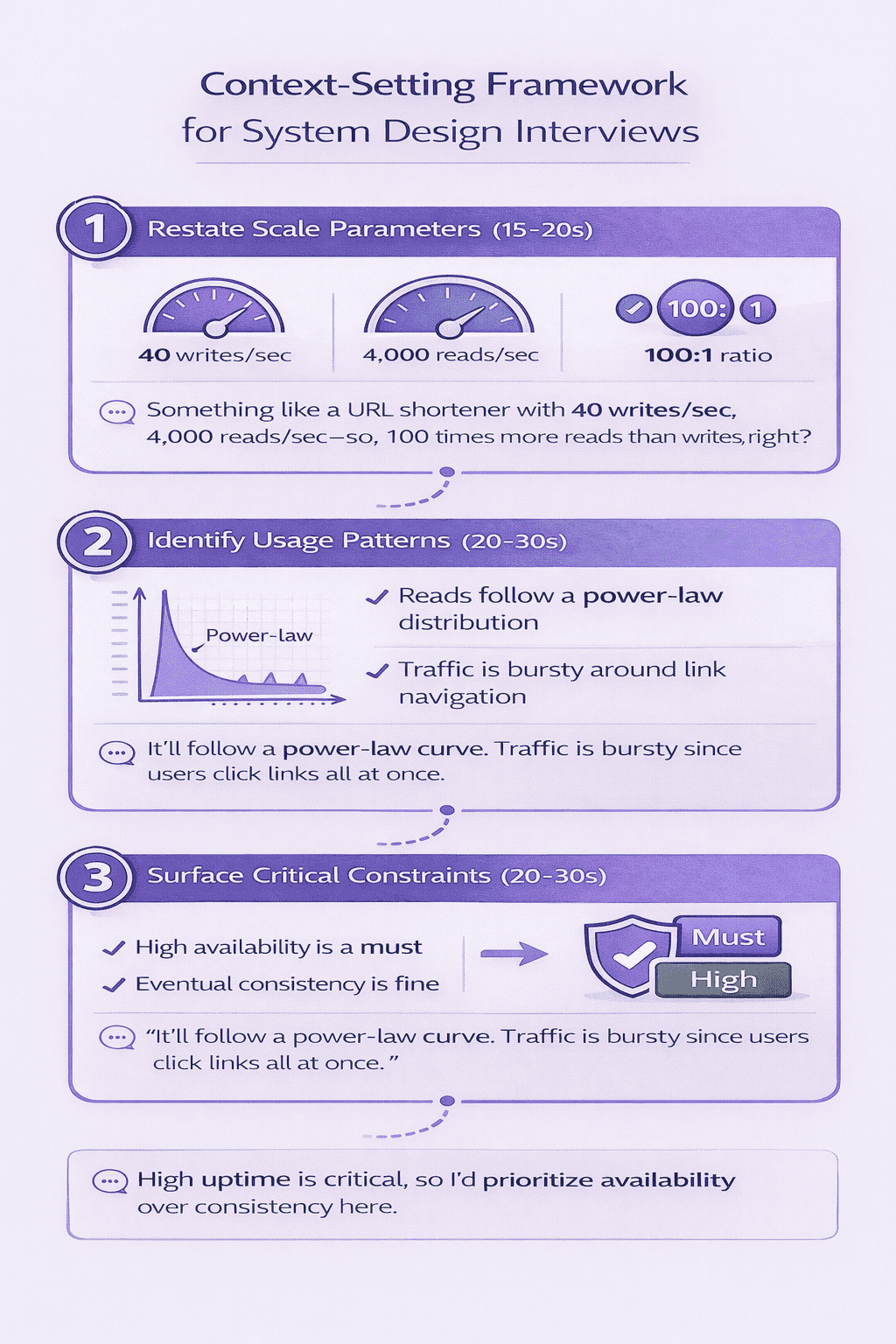
The Context-Setting Framework: What to Verbalize
Use this structure immediately after clarification and before drawing anything. It takes 60-90 seconds but completely changes how the interviewer perceives your explanation.
1. Restate Scale Parameters (15-20 seconds)
Repeat the numbers you extracted during clarification, but frame them as design inputs: “Based on our discussion, we’re designing for 40 writes per second, 4,000 reads per second, with a 100:1 read-to-write ratio. Sub-100-millisecond redirect latency is critical.”
This accomplishes two things. First, it confirms you captured the requirements correctly. Second, it signals that these numbers will drive your design decisions.
2. Identify Usage Patterns (20-30 seconds)
Describe how the system will actually be used. Are requests evenly distributed or bursty? Is data accessed uniformly or does it follow a power law? Do users expect immediate consistency or can they tolerate eventual consistency?
For a URL shortener: “URL creation will likely be bursty???marketing campaigns, social media events. Redirects will follow a power-law distribution where a small percentage of URLs account for most traffic. Users won’t notice if a newly created URL takes a few seconds to propagate globally, but redirect latency must be instant.”
Notice how this sets up architectural decisions before you propose them. You just explained why caching makes sense (power-law distribution), why eventual consistency is acceptable (users tolerate propagation delay), and why read optimization matters more than write optimization.
3. Surface Critical Constraints (20-30 seconds)
Call out the system characteristics that create the hardest design challenges. Is availability more important than consistency? Must the system scale globally or serve a single region? Are there security or compliance requirements?
For a URL shortener: “The biggest challenge here is ensuring globally distributed redirects stay fast while handling viral traffic spikes. We need high availability???if the service goes down, all shortened links break, which is unacceptable. We can tolerate eventual consistency for newly created URLs, but once a URL is live, the redirect mapping must be reliable.”
You just previewed the hard problems your design will solve. The interviewer now knows you’re thinking about the right challenges.
 Share this infographic -->
Example Context-Setting Dialogue
Here’s how this sounds in a real interview after you’ve completed clarification.
Candidate: “Before I start designing, let me set the context we’re working with. We’re building for 40 writes per second and 4,000 reads per second???a 100:1 read-heavy ratio. Redirect latency needs to be under 100 milliseconds.”
Candidate: “I’m assuming URL creation will be bursty, especially during marketing campaigns or viral events. Redirects will likely follow a power-law distribution where maybe 10% of URLs drive 90% of traffic. Users probably won’t notice if a new URL takes a few seconds to become active globally, but once it’s live, redirects must be instant and reliable.”
Candidate: “The critical constraint here is high availability. If this service goes down, every shortened link breaks, which is catastrophic. Given the read-heavy pattern and power-law distribution, caching will be essential. And since we can tolerate brief propagation delays for new URLs, eventual consistency is acceptable???we don’t need strong consistency for this use case.”
Candidate: “Does that context align with what you’re looking for?”
Interviewer: “Yes, that’s exactly right. Go ahead and design.”
Total time: 75 seconds. What just happened? You eliminated ambiguity, previewed your architectural thinking, and got explicit buy-in before drawing a single box. The interviewer now trusts that your design will be thoughtful, not random.
Common Context-Setting Mistakes
Candidates who understand the importance of context still make execution errors. Avoid these three patterns.
Mistake 1: Stating Context as Solutions
Weak: “We’ll need caching because this is read-heavy.”
Strong: “The 100:1 read-to-write ratio and power-law access pattern suggest we’ll need aggressive caching. I’ll design the read path with that in mind.”
The difference is subtle but critical. The weak version jumps to a solution (caching) without connecting it to constraints. The strong version treats the constraint as the driver and hints at the solution without committing yet.
Mistake 2: Over-Specifying Numbers
Don’t invent precise numbers the interviewer didn’t give you. If they said “high traffic,” don’t claim “approximately 47,000 requests per second.” Work with the level of precision you were given.
If you need more specificity, ask: “When you say high traffic, should I assume hundreds, thousands, or hundreds of thousands of requests per second? That changes the design significantly.”
Mistake 3: Skipping the Verbal Step
Some candidates mentally understand context but never say it out loud. They think through scale and patterns internally, then start drawing. This is a mistake.
Verbalizing context accomplishes three things. First, it confirms your assumptions with the interviewer. Second, it demonstrates that you think in constraints, not just components. Third, it creates a shared mental model that makes your later explanations clearer.
Always speak your context out loud, even if it feels redundant.
Adapting Context to Different Problem Types
The context-setting framework applies to every system design problem, but the emphasis shifts based on the problem type. Here’s how to adapt it.
For Data-Intensive Systems (e.g., Analytics Platform, Search Engine):
Emphasize data volume, query patterns, and data freshness requirements. Example: “We’re processing 10TB of log data daily with queries running across 30-day windows. Users expect query results within 5 seconds but don’t need real-time data???15-minute staleness is acceptable.”
For User-Facing Applications (e.g., Social Feed, Chat System):
Emphasize user experience expectations and consistency models. Example: “Users expect their own posts to appear immediately in their feed, but they can tolerate seeing their friends’ posts with a few seconds of delay. We need optimistic UI updates with eventual consistency in the backend.”
For Infrastructure Systems (e.g., Rate Limiter, Distributed Cache):
Emphasize reliability, performance SLAs, and failure modes. Example: “The rate limiter must operate even during partial system failures. A false negative (allowing a request that should be blocked) is acceptable occasionally, but false positives (blocking legitimate requests) are unacceptable.”
The pattern is consistent: identify what matters most for this specific system, state it explicitly, and preview the design tensions you’ll need to resolve.
Step 3: Explain the High-Level Design First
You’ve clarified requirements. You’ve established context. Now you’re ready to design. This is where most candidates make their biggest communication mistake: they design and explain simultaneously, overwhelming the interviewer with details.
The solution is counterintuitive. Design less. Explain more.
Start with the simplest possible architecture that satisfies the core requirements. Explain it clearly. Only then add complexity. This approach???high-level first, details later???is how senior engineers actually communicate architecture in production.
Why High-Level Design Matters
When you present a complete, detailed system all at once, the interviewer cannot follow your reasoning. They see 15 boxes, 30 arrows, and multiple data stores. They lose the narrative thread.
When you present the high-level design first???maybe 4-6 boxes???the interviewer builds a mental model. Then when you add details later, they understand how each piece fits into the bigger picture.
Think of it like explaining a building. You don’t start with plumbing diagrams and HVAC schematics. You start with “three-story structure, residential on top, commercial on bottom, parking underground.” Then you zoom into systems.
The High-Level Design Framework
Follow this structure every time. It works for any system design problem.
Step 1: Draw the Absolute Minimum Viable Architecture (30-45 seconds)
Start with the fewest boxes that could possibly work. For a URL shortener: client ??? API server ??? database. That’s it. Three boxes.
Don’t add caching yet. Don’t add load balancers. Don’t add message queues. Draw the simplest possible system that performs the core function.
Step 2: Narrate the Core Flow (30-45 seconds)
Walk through what happens for the main use case. Describe it as a story, not a technical specification.
For URL creation: “When a user submits a long URL, the client sends a POST request to our API server. The server generates a unique short code???we’ll discuss the generation algorithm in a moment???and stores the mapping in the database. It returns the short URL to the client.”
For URL redirect: “When a user visits a short URL, the client sends a GET request with the short code. The API server looks up the code in the database, retrieves the original long URL, and returns a 302 redirect to the client.”
Notice three things. First, you’re using present tense (“the server generates”) not future tense (“the server will generate”). This makes the explanation more concrete. Second, you’re narrating a specific flow, not listing component capabilities. Third, you’re deferring implementation details (“we’ll discuss the generation algorithm in a moment”).
Step 3: Explicitly State What’s Missing (15-20 seconds)
This step separates strong candidates from exceptional ones. After presenting your minimal design, acknowledge what you intentionally left out.
“This basic architecture works but has obvious problems. No caching means every redirect hits the database. No load balancing means we can’t scale beyond one server. No replication means a database failure breaks everything. I’ll address these next.”
Why does this matter? Because it shows you’re thinking ahead. It demonstrates that your simple design isn’t naive???it’s a deliberate starting point. It also gives the interviewer confidence that you’ll cover the important details.
???? Download: High-Level Design Communication Checklist
This one-page checklist walks you through the exact steps for presenting a high-level design clearly. Print it and practice with it during mock interviews to build the habit.
Download PDFExample High-Level Design Dialogue
Here’s how this sounds in practice.
Candidate draws three boxes: Client, API Server, Database.
Candidate: “Let me start with the simplest architecture that satisfies our core requirements. We have clients making requests, an API server handling the logic, and a database storing the URL mappings.”
Candidate: “For URL creation, the flow is straightforward. A user submits a long URL to the client. The client sends a POST request to our API server. The server generates a unique short code, stores the long URL and short code mapping in the database, and returns the short URL to the client.”
Candidate: “For redirects, a user visits the short URL. The client sends a GET request with the short code to the API server. The server queries the database using the short code, retrieves the long URL, and returns a 302 redirect to the client. The browser then navigates to the long URL.”
Candidate: “This minimal design works functionally but has clear limitations. Every redirect requires a database query, which won’t meet our sub-100ms latency target at 4,000 reads per second. We have a single point of failure in both the API server and database. And we’re not handling the viral traffic spikes we discussed earlier. I’ll address these next by adding caching, load balancing, and replication.”
Candidate: “Does this high-level structure make sense before I add those layers?”
Interviewer: “Yes, go ahead.”
Total time: about 90 seconds. What just happened? You established a clear foundation. The interviewer understands the basic flow. You demonstrated that you build complexity incrementally, not all at once. You previewed the problems you’ll solve next, creating a natural narrative progression.
Component Explanation Pattern: One at a Time
When you introduce each component in your high-level design, follow this pattern: name it, define its responsibility, explain why it exists.
Weak: “Here’s the API server.”
Strong: “The API server handles all business logic???short code generation, validation, and database interactions. We need a stateless middle tier because we’ll run multiple instances behind a load balancer for horizontal scaling.”
The strong version answers three questions immediately: What is it? What does it do? Why does the design need it?
Apply this pattern to every component. It creates clarity and demonstrates thoughtful design decisions.
Step 4: Introduce APIs and Data Flow Clearly
After presenting your high-level design, the interviewer understands the major components. Now they need to understand how those components communicate. This is where you introduce APIs and trace data flow through the system.
Most candidates handle this poorly. They say “the client calls the API” without specifying endpoints, request formats, or response structures. They gesture vaguely at arrows without explaining what data moves where.
Strong candidates make the invisible visible. They define specific APIs, describe request and response payloads, and narrate data transformations step by step.
Why API Clarity Demonstrates Seniority
API design reveals whether you think about systems from first principles or just memorize patterns. When you define clear APIs, you’re making implicit decisions explicit.
Saying “POST /shorten” versus “POST /api/v1/urls” signals different design thinking. The first is vague. The second shows you’re considering versioning, namespacing, and RESTful conventions.
Describing the request payload???”The client sends JSON with a ‘url’ field and an optional ‘custom_code’ field”???shows you’re thinking about data contracts, validation, and optional features.
Specifying the response???”The server returns 201 Created with the short URL in the response body, or 400 Bad Request if validation fails”???demonstrates you understand HTTP semantics and error handling.
These details take 20 extra seconds to verbalize but dramatically elevate your explanation.
The API Definition Framework
For each major API in your system, provide this structure.
1. Endpoint and HTTP Method (5 seconds)
State the endpoint path and HTTP verb clearly: “POST /api/v1/urls for creating short URLs” or “GET /api/v1/{shortCode} for redirects.”
This precision matters. Don’t say “we have an API for creating URLs.” Say exactly what the endpoint looks like.
2. Request Payload (10-15 seconds)
Describe what the client sends: “The request body is JSON containing the long URL as a required field and optionally a custom short code if the user wants to choose their own.”
If relevant, mention headers: “We’ll include an API key in the Authorization header for rate limiting and abuse prevention.”
3. Core Processing Logic (15-20 seconds)
Explain what happens server-side: “When the server receives the request, it validates the URL format, checks if a custom code was provided and if it’s available, generates a random code if needed, stores the mapping in the database, and constructs the short URL.”
You don’t need to dive into implementation details here. You’re describing the logical steps, not the code.
4. Response Structure (10 seconds)
Specify what the server returns: “On success, we return 201 Created with JSON containing the short URL. On validation failure, 400 Bad Request with an error message. If the custom code is already taken, 409 Conflict.”
Mentioning error cases shows you think about failure scenarios, not just happy paths.
???? Table: URL Shortener API Specification
This table provides a complete API reference for the URL shortener system, demonstrating how to document endpoints, payloads, and responses clearly during an interview.
| Endpoint | Method | Request Body | Success Response | Error Responses |
|---|---|---|---|---|
| /api/v1/urls | POST | { "url": "https://...", "customCode": "optional" } |
201 Created{ "shortUrl": "https://short.ly/abc123" } |
400 Bad Request (invalid URL) 409 Conflict (code taken) |
| /api/v1/{code} | GET | None (code in path) | 302 Found Location header with long URL |
404 Not Found (code doesn’t exist) |
| /api/v1/urls/{code} | DELETE | None | 204 No Content | 404 Not Found 401 Unauthorized (not owner) |
Data Flow Narration: The Request Trace Technique
After defining APIs, trace a single request through the entire system. This technique???called a request trace or data flow walkthrough???ensures the interviewer understands how all components interact.
Pick the most common operation (usually a read operation for read-heavy systems) and narrate every step.
Example: URL Redirect Data Flow
“Let me trace what happens when a user clicks a short URL. The user’s browser sends a GET request to our load balancer with the short code in the path. The load balancer routes the request to one of our API server instances using round-robin distribution.”
“The API server first checks the cache using the short code as the key. If there’s a cache hit???which will happen for about 80-90% of requests based on our power-law access pattern???the server immediately retrieves the long URL from the cache, bypasses the database entirely, and returns a 302 redirect. Total latency: under 10 milliseconds.”
“On a cache miss, the server queries the database. The database looks up the short code in the URL mappings table, returns the long URL, and the server stores it in the cache with a TTL of 24 hours before returning the redirect. Cache-miss latency: 50-80 milliseconds, still within our 100ms target.”
“The browser receives the 302 response with the Location header containing the long URL and automatically redirects the user to the destination.”
Notice the level of detail. You specified where caching happens, what the cache hit rate is, what database query runs, what the cache TTL is, and what latency numbers look like. This takes 45-60 seconds but completely eliminates ambiguity.
Step 5: Communicate Trade-Offs Deliberately
This is the most important step in the entire interview. More candidates fail here than anywhere else. Not because they make wrong decisions, but because they cannot articulate why they made them.
Every architectural decision involves trade-offs. Choosing Redis over Memcached. Picking eventual consistency over strong consistency. Using synchronous APIs versus message queues. None of these choices is universally correct. Each optimizes for some outcomes while sacrificing others.
Senior engineers don’t just make trade-offs. They verbalize them proactively, explaining what they gain and what they give up. This is the skill that separates Staff engineers from Senior engineers.
Why Trade-Off Communication Matters
Imagine two candidates designing a notification system. Both choose to use a message queue between the API and notification workers. Same architectural decision.
Candidate A: “We’ll use a message queue here for asynchronous processing.”
Candidate B: “I’m introducing a message queue between the API and notification workers. This adds architectural complexity and introduces a new failure point, but it gives us three critical benefits. First, the API can return immediately without waiting for notifications to send, improving user experience. Second, we can scale notification workers independently of API servers based on queue depth. Third, if the notification service is temporarily down, messages persist in the queue rather than being lost. The trade-off is that users won’t know immediately if a notification failed???we’ll need a separate monitoring system for that.”
Which candidate gets the offer? Candidate B. Why? Because they demonstrated they don’t just apply patterns???they understand the engineering economics behind every decision.
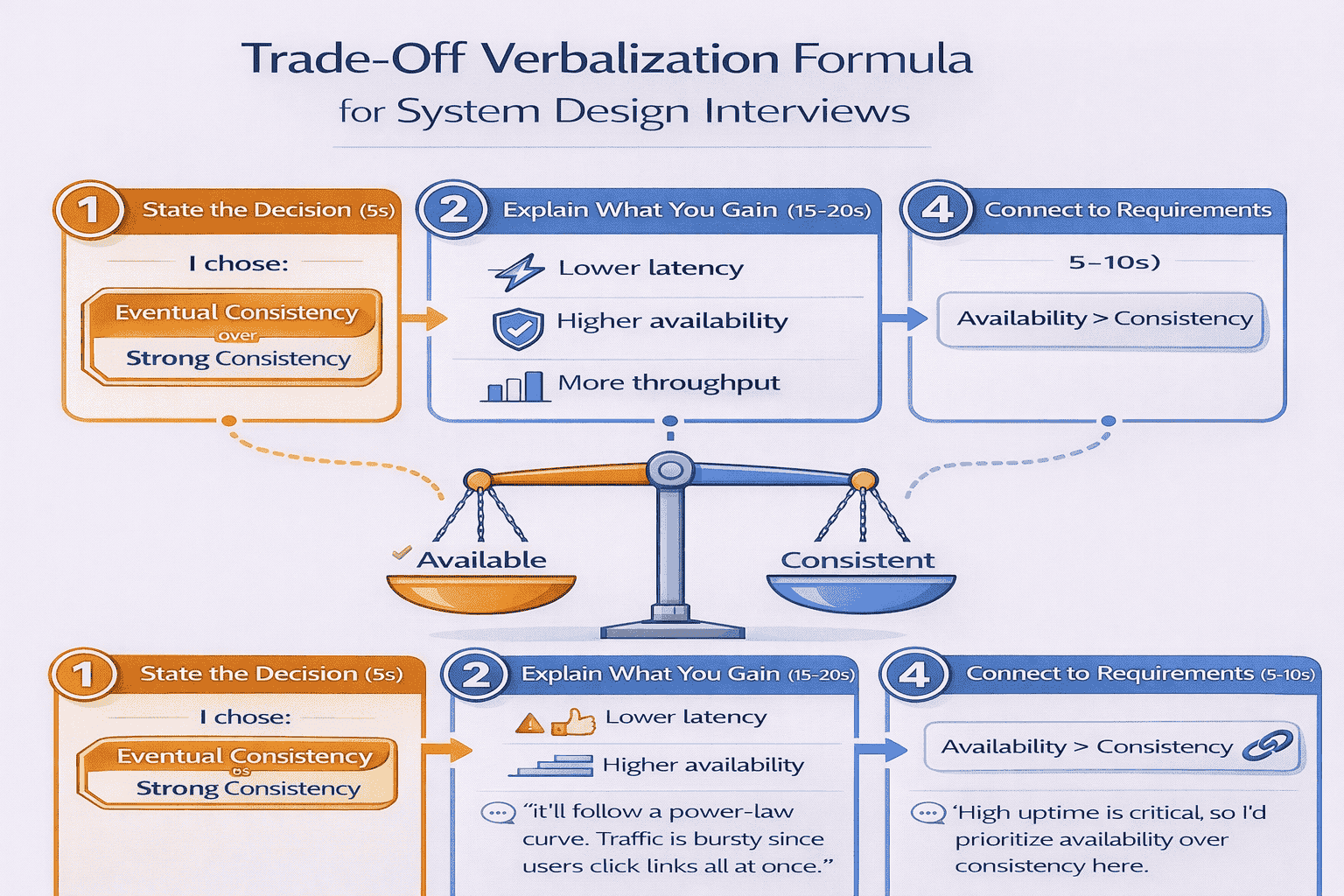
The Trade-Off Verbalization Formula
Use this exact structure every time you make a significant architectural choice. It works for any decision, any system, any trade-off.
1. State the Decision Clearly (5 seconds)
Name the specific choice you’re making: “I’m choosing eventual consistency over strong consistency for the user feed.” Don’t be vague. Don’t say “we’ll use consistency.” Say exactly which consistency model and where.
2. Explain What You’re Gaining (15-20 seconds)
Describe the benefits in concrete terms, tied to the requirements you established earlier: “This choice gives us three advantages. First, read latency drops dramatically because we can serve feeds from local replicas without cross-region coordination. Second, the system remains available during network partitions???users can still read feeds even if databases can’t communicate. Third, write throughput increases because we don’t need distributed locks or two-phase commits.”
3. Acknowledge What You’re Sacrificing (10-15 seconds)
This is the step most candidates skip. Explicitly state the downside: “The trade-off is that users might see stale data. If Alice posts something, Bob might not see it in his feed for a few seconds. For a social feed, this is acceptable???users already expect some delay. But for financial transactions or inventory systems, this would be unacceptable.”
4. Connect to Requirements (5-10 seconds)
Link your decision back to the constraints you established during context-setting: “Given our requirements???prioritizing user experience and availability over perfect consistency???this trade-off makes sense.”
Total time: 35-50 seconds. This sounds long, but it’s the most valuable 50 seconds of your interview.
 Share this infographic -->
Common Trade-Offs and How to Verbalize Them
Here are the most frequent architectural trade-offs you’ll encounter in system design interviews, with verbalization templates for each.
SQL vs NoSQL Database
“I’m choosing a NoSQL document store like MongoDB over a relational database. This gives us flexible schema evolution???we can add new fields to user profiles without migrations???and horizontal scaling through sharding. The trade-off is we lose ACID transactions across documents and complex join operations. Given our requirement for flexible user profiles and the fact that most queries access a single user’s data, this trade-off favors NoSQL.”
Synchronous vs Asynchronous Processing
“I’m using asynchronous message queues for notification delivery instead of synchronous API calls. This improves API response time???the endpoint returns immediately???and provides fault tolerance through message persistence. The downside is we lose immediate feedback about notification success or failure, and we add operational complexity with queue management. Since our requirement prioritizes fast API responses and notifications aren’t critical-path, asynchronous processing makes sense here.”
Vertical vs Horizontal Scaling
“I’m designing for horizontal scaling by adding more application servers rather than vertical scaling by upgrading individual machines. This gives us better fault tolerance???losing one server doesn’t impact capacity significantly???and we can scale gradually as traffic grows. The trade-off is increased operational complexity with load balancing and stateless design requirements. Given our unpredictable traffic spikes and the need for high availability, horizontal scaling is the right choice.”
Caching Layer
“I’m adding Redis as a caching layer between the application and database. This dramatically reduces database load and improves read latency from 50ms to under 5ms for cached data. The downsides are cache invalidation complexity???we need a strategy for keeping cache and database synchronized???and increased memory costs. Given our 100:1 read-to-write ratio and sub-100ms latency requirement, the cache is worth the added complexity.”
Notice the pattern. Every verbalization follows the formula: decision ??? gains ??? sacrifices ??? justification based on requirements.
How to Handle Challenging Trade-Off Questions
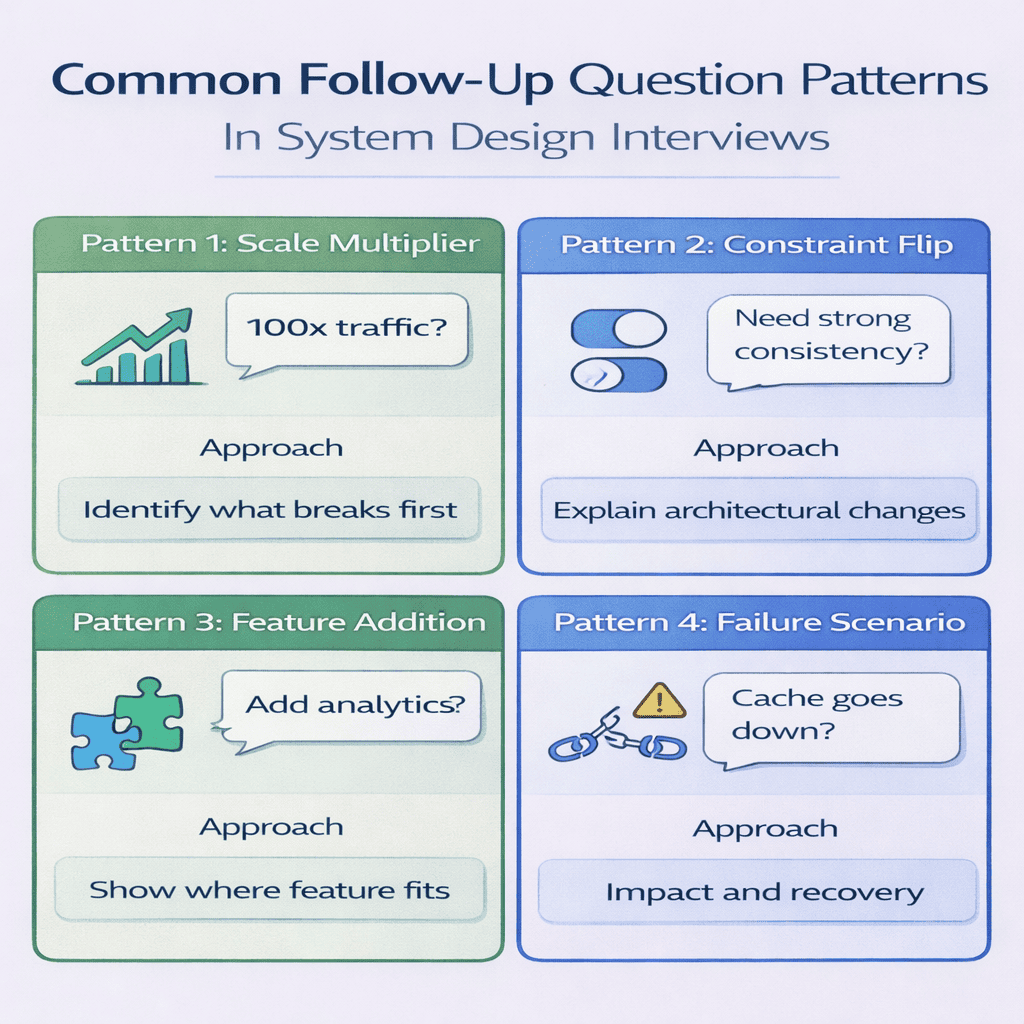
Sometimes the interviewer will push back on your trade-off explanation. They’ll ask “What if we needed strong consistency?” or “How would this change if we couldn’t tolerate data loss?”
This is not criticism. This is the interviewer testing your ability to think through alternatives and constraints. Handle these moments with this structure.
Acknowledge the Alternative Constraint (5 seconds)
“That’s a great question. If strong consistency were required, the design would change significantly.”
Explain the Alternative Architecture (20-30 seconds)
“Instead of eventual consistency with async replication, we’d need synchronous replication or distributed consensus like Raft. Every write would need to be acknowledged by a quorum of replicas before returning success. We could use a system like Spanner or CockroachDB that provides strong consistency at global scale.”
State the New Trade-Offs (15-20 seconds)
“This would give us linearizability???reads always reflect the latest write???but write latency would increase from 10ms to potentially 100-200ms for cross-region consensus. Availability would decrease because we can’t complete writes during network partitions. Given the original requirements prioritized availability and user experience over perfect consistency, the eventual consistency model is better suited.”
Circle Back to Original Requirements (5 seconds)
“But if the requirements changed to prioritize consistency???for example, if this were a financial ledger instead of a social feed???I’d absolutely redesign around strong consistency.”
What just happened? You demonstrated flexibility, showed you understand multiple approaches, and proved you make decisions based on requirements, not dogma.
The Power of Proactive Trade-Off Surfacing
Here’s an advanced technique that impresses interviewers: surface trade-offs before the interviewer asks about them.
When you introduce a component or make a decision, immediately acknowledge the obvious downside without being prompted.
“I’m introducing a CDN for static asset delivery. This gives us geographic distribution and reduces origin server load. The obvious downside is cache invalidation???if we update an asset, users might see stale versions until the CDN cache expires. We can mitigate this with versioned URLs or cache purge APIs, but it’s a complexity we’re accepting in exchange for performance.”
Why does this work? Because it shows you think about failure modes and downsides naturally, not just when challenged. It signals senior-level judgment.
Try to proactively surface at least one downside for every major architectural decision. The interviewer will notice.
???? Table: System Design Trade-Off Quick Reference
This reference table catalogs common architectural trade-offs you’ll encounter in interviews, organized by what you optimize for and what you sacrifice. Memorize these patterns to verbalize decisions faster under pressure.
| Decision | What You Gain | What You Sacrifice | Best For |
|---|---|---|---|
| NoSQL over SQL | Schema flexibility, horizontal scaling, high write throughput | ACID transactions, complex joins, referential integrity | Flexible schemas, massive scale, document storage |
| Eventual consistency | Lower latency, higher availability, partition tolerance | Temporary stale reads, reconciliation complexity | Social feeds, product catalogs, non-critical data |
| Message queue | Async processing, decoupling, fault tolerance | Immediate feedback, ordering complexity, operational overhead | Background jobs, email/notifications, event-driven systems |
| Microservices | Independent deployment, team autonomy, tech diversity | Distributed complexity, network overhead, data consistency | Large teams, polyglot needs, independent scaling |
| Caching layer | Read latency reduction, database offloading | Cache invalidation complexity, memory costs, stale data | Read-heavy workloads, expensive queries, hot data |
| Denormalization | Read performance, simpler queries, fewer joins | Storage costs, update complexity, data duplication | Analytics, reporting, read-optimized systems |
| Horizontal scaling | Fault tolerance, incremental growth, no single bottleneck | Load balancing complexity, stateless requirements, higher cost | Unpredictable traffic, high availability needs |
Step 6: Handle Scalability and Bottlenecks Out Loud
After establishing your core design and explaining trade-offs, the interviewer will inevitably ask: “How does this scale?” or “What are the bottlenecks?”
This is not a trick question. The interviewer wants to see if you can identify failure points proactively and reason about scaling strategies systematically. Most candidates panic here. They start listing random techniques: “We’ll shard the database and add more cache and use CDN and…”
Strong candidates approach scalability as structured reasoning, not a technology checklist.
The Scalability Communication Framework
When discussing scale, follow this three-part structure. It demonstrates methodical thinking rather than pattern matching.
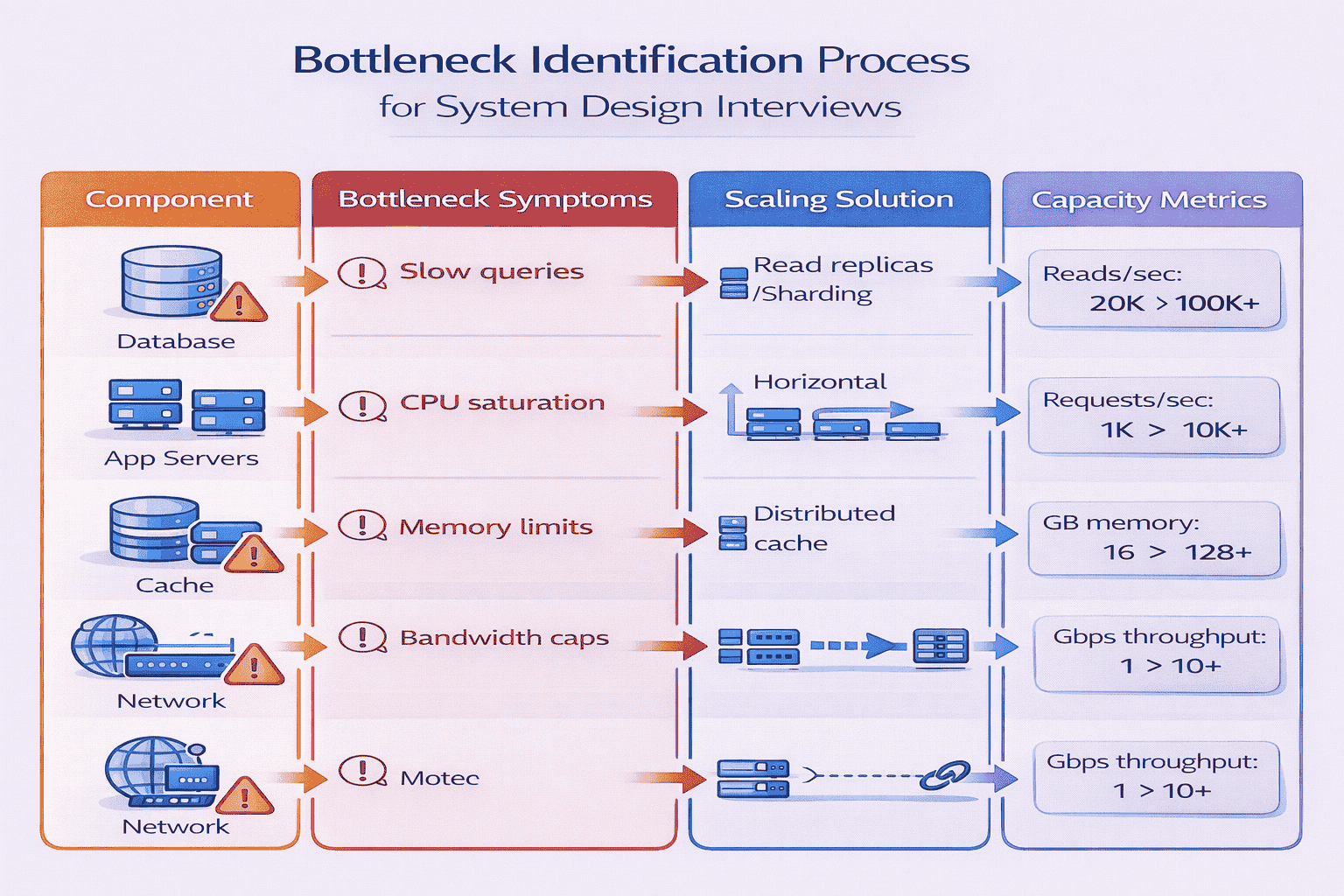
Part 1: Identify Bottlenecks by Component (20-30 seconds)
Walk through your architecture component by component, calling out where bottlenecks will appear first as load increases.
“As traffic scales, we’ll hit bottlenecks in this order. First, the database becomes overwhelmed???at 4,000 reads per second, even with caching we’re still hitting the database for cache misses and all writes. Second, the API servers could become CPU-bound during short code generation if we’re using cryptographic hashing. Third, the cache itself could become a bottleneck if our working set exceeds available memory.”
Notice you’re identifying bottlenecks in priority order based on the system’s characteristics. This shows you understand where pressure points emerge.
Part 2: Propose Solutions with Scaling Metrics (30-45 seconds)
For each bottleneck, explain how you’d scale and what limits you’d hit.
“To scale the database, I’d implement read replicas. We can distribute read traffic across multiple replicas, scaling read capacity linearly???each replica adds another 4,000 reads per second capacity. For writes, we’d eventually need to shard by short code hash, partitioning the keyspace across multiple database instances. This gets us to millions of writes per second before we hit other limits.”
“For API server scaling, horizontal scaling with a load balancer handles this naturally. Each server can process maybe 1,000 requests per second, so we’d add servers based on traffic. Since they’re stateless, this scales indefinitely.”
“Cache scaling is similar???we can use consistent hashing to distribute the cache across multiple Redis instances, sharding by short code.”
You’re not just naming solutions. You’re explaining capacity numbers and scaling characteristics.
Part 3: Acknowledge Remaining Hard Problems (15-20 seconds)
After explaining how to scale each component, call out what doesn’t scale easily.
“The remaining hard problem is globally distributed deployments. If we need sub-100ms redirects worldwide, we’ll need regional deployments with eventually consistent replication across regions. This introduces geo-distribution complexity and cross-region synchronization challenges.”
This shows you distinguish between tractable scaling challenges and genuinely difficult distributed systems problems.
Scalability Discussion Example
Here’s how this sounds in a real interview.
Interviewer: “How would you scale this system to handle 10x the traffic?”
Candidate: “Let me walk through the bottlenecks we’d hit and how to address them. At 10x traffic, we’re looking at 400 writes per second and 40,000 reads per second.”
Candidate: “The database hits capacity first. With our current single-instance setup, we can’t handle 40,000 reads per second even with aggressive caching. I’d add read replicas???probably 5-6 replicas to handle the read load comfortably. Each replica can serve about 7,000-8,000 reads per second with proper indexing. For writes, 400 per second is still manageable on a single primary, but at 100x we’d need to shard.”
Candidate: “API servers scale horizontally behind the load balancer. At 40,000 total requests per second and assuming 1,000 requests per second per server, we’d need about 40-50 API server instances. This is straightforward since they’re stateless.”
Candidate: “The cache layer needs to scale too. If our working set is 1 million hot URLs and each mapping is about 1KB, we need roughly 1GB of cache. At 10x traffic, we might have a 10GB working set. We can either vertically scale to a larger Redis instance or horizontally shard across multiple Redis nodes using consistent hashing.”
Candidate: “The one challenge that doesn’t scale trivially is global distribution. If we need low-latency redirects worldwide, we’d deploy regional clusters in different geographic zones???US East, US West, Europe, Asia. This introduces cross-region data replication complexity, but it’s necessary for global performance.”
Interviewer: “How would you handle the cross-region replication?”
Candidate: “For new URL creation, we’d write to the local region’s database and asynchronously replicate to other regions. Redirects would always read from the local region. This means a URL created in US East might not be immediately redirectable in Asia for a few seconds, but given our earlier discussion about tolerating eventual consistency, this is acceptable.”
This entire discussion took about 90 seconds and demonstrated systematic scalability thinking, not random pattern application.
Common Scalability Questions and How to Answer Them
Interviewers often ask specific scalability questions to probe your understanding. Here’s how to handle the most common ones.
“What happens if the database goes down?”
This tests fault tolerance, not just performance scaling. Answer with both immediate impact and recovery strategy.
“If the primary database fails, writes immediately stop working???users can’t create new short URLs. Reads continue working for cached URLs but fail for cache misses. To mitigate this, I’d use database replication with automatic failover. If the primary fails, a read replica gets promoted to primary within 30-60 seconds. During that window, we’d return 503 Service Unavailable for writes and continue serving cached reads. For critical systems, we could use synchronous replication to a standby with even faster failover.”
“How do you prevent duplicate short codes across distributed servers?”
This tests your understanding of distributed coordination.
“There are two approaches. First, we could use a centralized ID generation service like Twitter’s Snowflake, which generates guaranteed unique IDs across all servers. Each server gets a unique server ID, and IDs include timestamp plus server ID plus sequence number. Second, we could partition the keyspace???give each server a range of possible codes to generate. Server 1 generates codes starting with ‘a’, server 2 starts with ‘b’, etc. The first approach is simpler but introduces a dependency. The second approach is more complex but fully distributed.”
“What’s your database schema and how does it scale?”
This tests whether you think about data modeling, not just architecture boxes.
“The core table is simple: short_code as primary key, long_url as the value, created_at timestamp, and optional user_id if we’re tracking ownership. The primary key is the short code, so lookups are fast???single-key reads. To scale reads, we add read replicas. To scale writes, we’d shard by short_code hash. One optimization: we could denormalize and duplicate frequently accessed metadata like click counts directly in this table to avoid joins.”