
You’re 15 minutes into a system design interview. The question is open-ended: design a URL shortener that handles 100 million requests per day. You sketch a database, add some servers, and mention caching. The interviewer leans forward and asks, “Why did you choose eventual consistency over strong consistency here?” You freeze. You know both terms. You’ve read about CAP theorem. But articulating exactly why you made that choice—and what you’re sacrificing—suddenly feels impossible.
This scenario plays out in thousands of senior engineering interviews every week. Strong candidates know the concepts. Great candidates can explain their system design trade offs interview decisions clearly, confidently, and convincingly. This guide teaches you how to become the latter.
By the end of this comprehensive resource, you’ll have a repeatable framework for identifying trade-offs early, structuring your architectural reasoning, and communicating decisions under pressure—the exact skills that separate mid-level engineers from those landing Staff and Principal roles.
Last updated: Feb. 2026
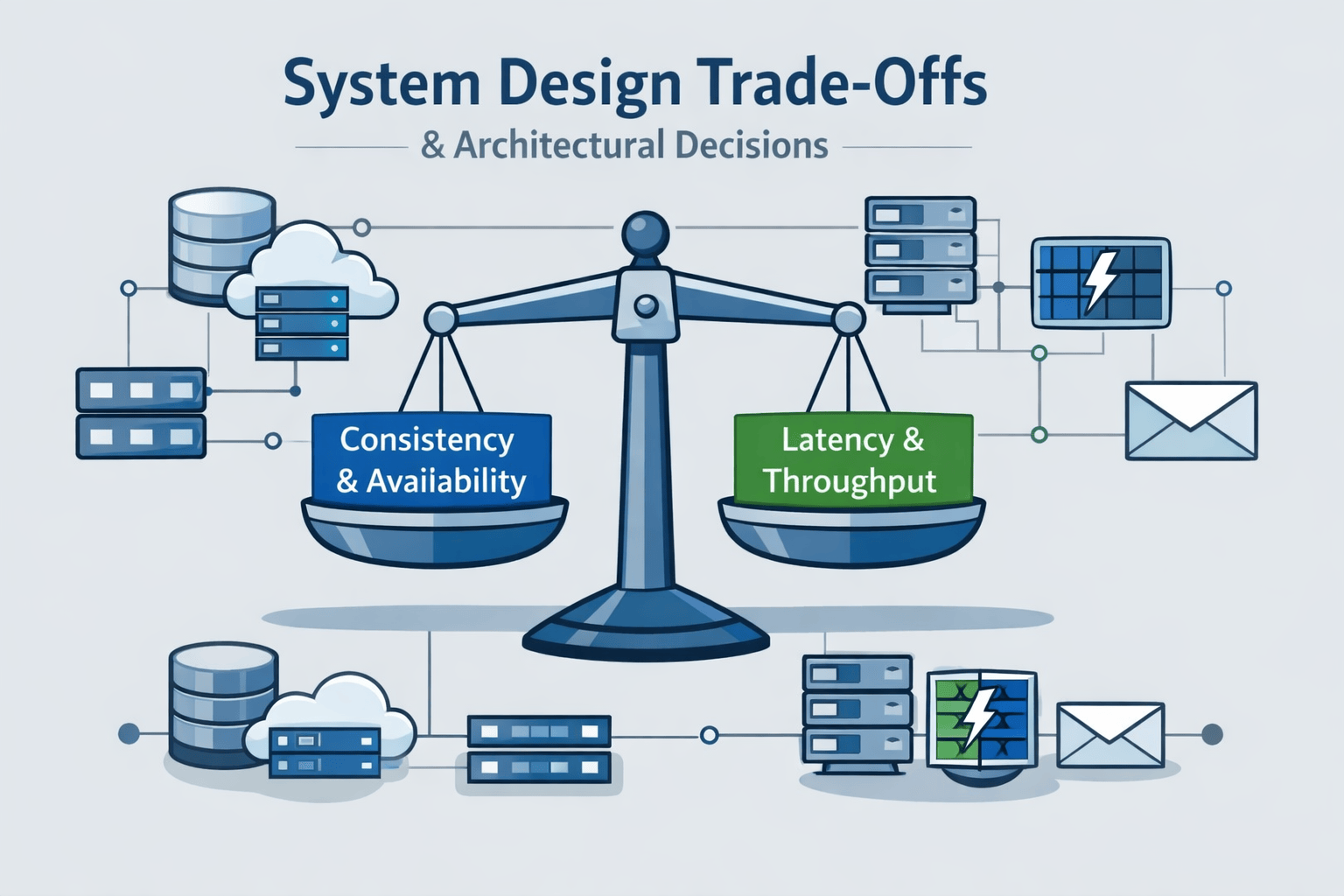
Table of Contents
- 1. Why Trade-Off Mastery Separates Senior Engineers from Everyone Else
- 2. Step 1: Identify the Trade-Off the Interviewer Is Testing
- 3. Step 2: Narrow the Trade-Off Using Context, Not Assumptions
- 4. Step 3: Compare Viable Options Side by Side
- 5. Step 4: Justify a Decision Using Interview-Friendly Reasoning
- 6. Step 5: Apply the Process to Real Interview Scenarios
- 7. Step 6: Handle Follow-Up Challenges and Constraint Changes
- 8. Step 7: Use a Final Trade-Off Checklist Before You Finish
- 9. Your Next Steps: From Reading to Interview-Ready
- 10. Frequently Asked Questions
Contents










Why Trade-Off Mastery Separates Senior Engineers from Everyone Else
System design interviews have a dirty secret. The technical knowledge isn’t the hard part.
After conducting over 150 mock system design interviews with senior developers and architects, I’ve watched brilliant engineers stumble on the same obstacle. They know distributed systems. They understand databases, caching, and message queues. They can diagram microservices architectures from memory.
But when asked to explain why they chose Redis over Memcached, or why they picked eventual consistency over strong consistency, they freeze. Their answers become vague: “It’s faster” or “It scales better.” These responses signal to interviewers that you’re pattern-matching from tutorials rather than reasoning from first principles.
What Interviewers Actually Evaluate in Trade-Off Discussions
Senior-level interviews aren’t testing whether you know what a load balancer does. They’re evaluating your ability to make and defend architectural decisions under constraints.
When an interviewer asks about trade-offs, they’re really asking three questions.
First: Can you identify competing goals? Real systems optimize for multiple objectives that conflict. High availability versus strong consistency. Low latency versus high throughput. Operational simplicity versus cost efficiency. Engineers who immediately recognize these tensions demonstrate architectural maturity.
Second: Can you tie decisions to requirements? The “best” database doesn’t exist in a vacuum. The best database for a financial trading platform differs completely from the best database for a social media feed. Strong candidates connect every technical choice back to specific system requirements.
Third: Can you articulate what you’re sacrificing? Every architectural decision involves giving something up. Engineers who only advocate for their chosen approach without acknowledging its weaknesses appear inexperienced. Those who explicitly state “We’re trading X for Y because this system prioritizes Y” sound like architects.
📊 Table: What Interviewers Hear When You Discuss Trade-Offs
This comparison shows how different responses to trade-off questions signal different experience levels to interviewers evaluating system design candidates.
| What You Say | What Interviewer Hears | Impact on Evaluation |
|---|---|---|
| “NoSQL is better for this” | Pattern-matching without reasoning | Junior signal |
| “We need high availability” | Requirement stated, not analyzed | Mid-level signal |
| “I’d use eventual consistency here because user feeds tolerate slight delays, but we’d need strong consistency for the payment service” | Context-aware reasoning with explicit trade-off acknowledgment | Senior signal |
| “This creates operational complexity but reduces latency by 200ms at p99, which matters more than ops cost for this use case” | Quantified trade-off with clear prioritization | Staff/Principal signal |
The Three Failure Modes I See Repeatedly
Most trade-off failures fall into predictable patterns. Recognizing these helps you avoid them.
Failure Mode 1: Premature Convergence You hear “design a messaging system” and immediately start drawing Kafka. You’ve decided on the solution before understanding the constraints. This leads to awkward backpedaling when the interviewer reveals the system only needs to handle 100 messages per second, not 100,000.
Strong candidates pause. They ask about scale, latency requirements, ordering guarantees, and failure tolerance before proposing solutions. This pause isn’t hesitation—it’s deliberate information gathering.
Failure Mode 2: Abstract Generalities You say things like “distributed systems are hard” or “CAP theorem forces trade-offs” without connecting them to the specific system you’re designing. This signals theoretical knowledge without practical application.
Effective candidates make trade-offs concrete. Instead of “we need to handle failures,” they say “if the cache layer fails, we’ll serve stale content for up to 60 seconds while the system recovers, because user experience degrades less from slightly stale data than from slow page loads.”
Failure Mode 3: Single-Sided Advocacy You present your chosen approach and only discuss its benefits. You skip past or minimize its weaknesses. This makes you sound like you’re selling a solution rather than analyzing it.
Experienced engineers openly acknowledge downsides. “Sharding the database by user ID improves query performance dramatically, but it makes cross-user aggregation queries significantly more complex. For this system, individual user queries happen 100x more frequently than cross-user reports, so that trade-off works in our favor.”
Why Most Preparation Resources Miss This
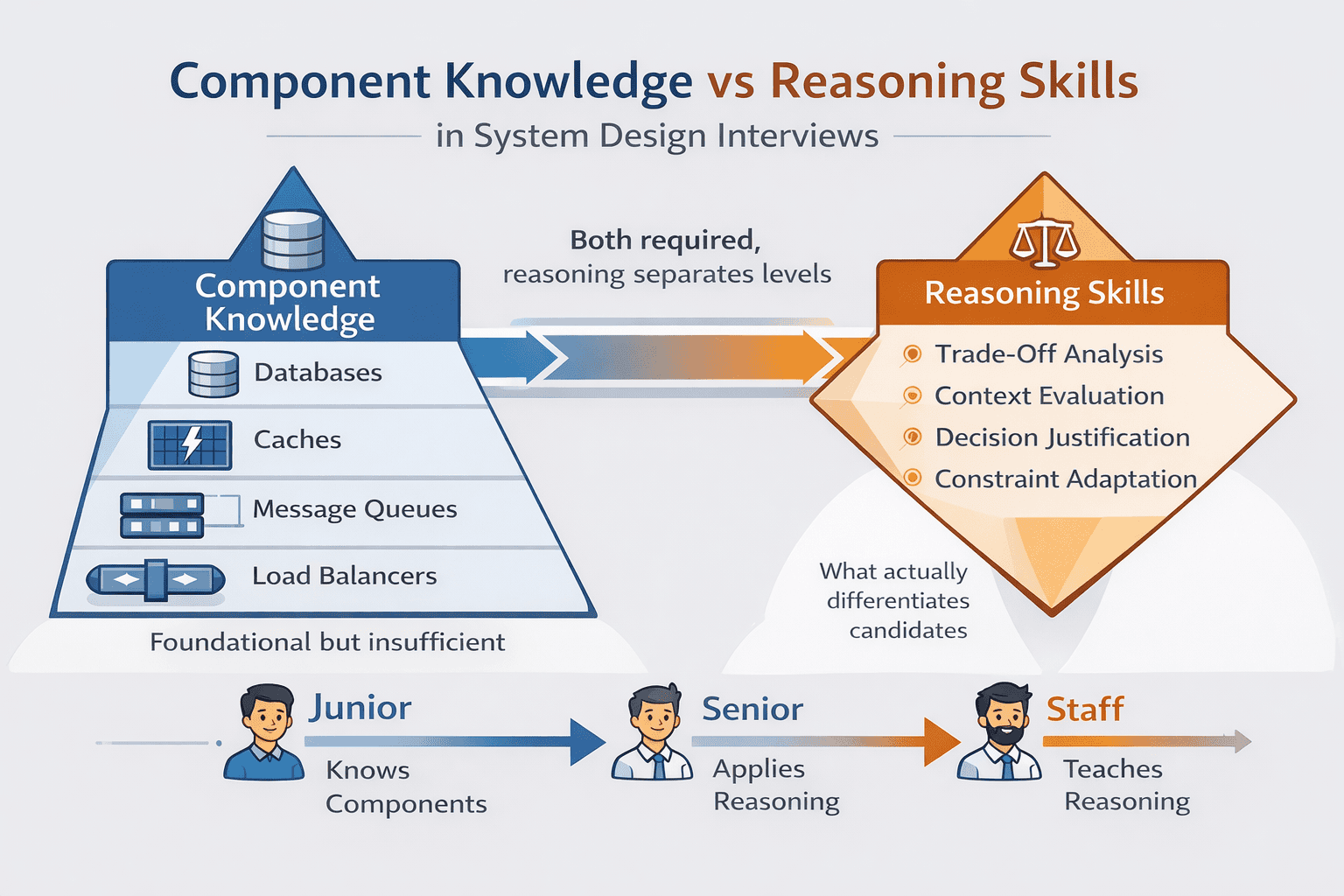
The majority of system design courses teach components and patterns. You learn about load balancers, databases, caches, and message queues. You study example designs for URL shorteners, social networks, and notification systems.
But knowing that “Facebook uses Cassandra” doesn’t teach you when Cassandra is the right choice for a given problem. It doesn’t teach you how to verbally justify that choice in 90 seconds. It doesn’t prepare you for the follow-up: “What if we change the consistency requirements?”
Trade-off reasoning is a meta-skill that sits on top of component knowledge. You can memorize every database architecture in existence and still fail system design interviews if you can’t explain why you’re choosing one over another for specific circumstances.
The Framework This Guide Teaches
This guide presents trade-off reasoning as a seven-step process you can apply to any open-ended system design question. Each step addresses a specific failure mode.
Step 1 teaches you to recognize when trade-off discussion is required. You’ll learn the interviewer signals that indicate “this question has no single right answer—I want to see your reasoning.”
Step 2 shows you how to gather the context that makes trade-offs decidable. Without this context, you’re guessing. With it, you’re analyzing.
Steps 3 and 4 provide the structure for comparing options and explaining your choice clearly. This is where most candidates become vague. You’ll get specific phrasing you can practice.
Steps 5 and 6 apply the framework to real scenarios and teach you how to adapt when constraints change mid-interview. This flexibility demonstrates architectural judgment.
Step 7 gives you a mental checklist to run before concluding your answer, ensuring you’ve addressed the dimensions interviewers care about most.
By the end, you won’t just know what trade-offs exist. You’ll be able to identify them, structure decisions around them, and communicate your reasoning under time pressure. That’s the difference between explaining what you built and explaining why you built it that way.
Step 1: Identify the Trade-Off the Interviewer Is Testing
The first 60 seconds of a system design interview determine whether you’ll spend the next 40 minutes in control or scrambling. Most candidates hear the question and immediately start sketching boxes. They draw users, servers, databases, and caches before understanding what the interviewer actually wants to discuss.
Strong candidates pause. They recognize when a question is designed to explore trade-offs rather than test component knowledge.
Common Interviewer Signals That Trade-Offs Are Central
Certain phrases appear repeatedly in system design questions that have trade-offs at their core. Learning to recognize these saves you from proposing solutions before you understand the problem space.
“Design a system that handles X requests per second.” Any question that specifies scale is testing whether you understand capacity versus cost trade-offs. A system handling 100 requests per second has completely different architectural requirements than one handling 100,000. The interviewer wants to see if you’ll ask about budget constraints, acceptable latency, and failure tolerance before choosing a scaling approach.
“The system needs to be highly available.” This is code for “let’s discuss the CAP theorem in practice.” The interviewer is probing whether you understand that availability and consistency exist on a spectrum, not as binary choices. They want to hear you ask about acceptable data staleness, what “high availability” means numerically (99.9% versus 99.99%), and which user operations must complete even during partial failures.
“Users expect fast response times.” Latency-focused questions test whether you’ll blindly add caching everywhere or thoughtfully consider where latency actually matters. Different parts of a system have different latency budgets. Reading a social media feed might tolerate 200ms, but autocomplete search must respond in under 50ms. Strong candidates ask which operations users perceive as slow.
“Design this for global users.” Geographic distribution creates trade-offs between consistency, latency, and operational complexity. The interviewer wants to see if you’ll discuss data residency requirements, synchronization strategies, and whether the system can tolerate different user experiences in different regions.
“The system must handle failures gracefully.” This opens discussion about graceful degradation, which service components can fail without bringing down the entire system, and what “graceful” means for different features. You might keep users able to read existing content but prevent them from posting new content during a database failure.
How to Surface Trade-Offs Before Proposing Solutions
Once you recognize a trade-off-heavy question, you need a verbal strategy to make the trade-off explicit rather than implicitly assuming your way into the wrong answer.
Use this pattern: “Before I start designing, I want to clarify the priorities because they’ll drive different architectural decisions. For example, with [REQUIREMENT], we typically trade off between [OPTION A] and [OPTION B]. Which matters more for this system?“
Here’s how this sounds in practice with a URL shortener question:
“Before I start designing, I want to clarify the priorities because they’ll drive different architectural decisions. With 100 million requests per day, we’re looking at about 1,200 requests per second average, with likely 3-5x spikes. For a system at this scale, we typically trade off between strong consistency guarantees and ultra-low latency. If two people shorten the same URL simultaneously, do we need them to always get the exact same short code, or is it acceptable for them to get different codes that both redirect correctly? The first requires coordination that adds latency; the second allows faster response times.”
Notice what this accomplishes. You’ve calculated scale implications. You’ve identified a specific trade-off. You’ve explained the consequences of each choice. And you’ve asked for direction without appearing uncertain—you’re demonstrating that you know multiple valid approaches and need business context to choose between them.
📊 Table: Question Patterns and Their Hidden Trade-Off Dimensions
This table helps you quickly identify which trade-off categories a question is testing based on how it’s phrased. Recognizing the pattern lets you ask clarifying questions immediately.
| Question Pattern | Trade-Off Being Tested | Example Clarifying Question |
|---|---|---|
| “Handle X million users/requests” | Scalability vs. Cost vs. Complexity | “What’s our budget for infrastructure? Should we optimize for lowest cost or easiest scaling?” |
| “Highly available” or “Always on” | Availability vs. Consistency | “During a partition, should we serve potentially stale data or return errors?” |
| “Fast response” or “Low latency” | Latency vs. Throughput vs. Cost | “What’s our acceptable p99 latency? Is it okay to cache aggressively to hit that target?” |
| “Global” or “Worldwide users” | Consistency vs. Latency vs. Complexity | “Can users in different regions see slightly different data, or must the system be globally consistent?” |
| “Handle failures” or “Resilient” | Reliability vs. Complexity vs. Cost | “Which features must remain operational during partial failures, and which can gracefully degrade?” |
| “Real-time” or “Immediate updates” | Consistency vs. Performance | “Does ‘real-time’ mean within 100ms, within 1 second, or within 5 seconds?” |
The Pause That Signals Seniority
Junior engineers hear a question and start drawing immediately. They want to demonstrate they know how to build things. Senior engineers pause for 30-60 seconds to clarify requirements. They want to demonstrate they know how to think about problems.
This pause isn’t empty time. You’re doing three things simultaneously.
First, you’re calculating rough scale implications. If the question says “100 million users,” you’re thinking: active users per day, requests per second, data storage requirements, bandwidth needs. You don’t need exact numbers—order of magnitude is sufficient. This calculation informs whether you’re dealing with a caching problem, a distribution problem, or an operational simplicity problem.
Second, you’re identifying constraint conflicts. Requirements rarely align perfectly. “High availability” conflicts with “strong consistency.” “Low cost” conflicts with “handles traffic spikes.” “Simple operation” conflicts with “minimal latency.” Naming these conflicts out loud shows architectural maturity.
Third, you’re forming hypothesis questions. Based on the conflicts you’ve identified, what information would change your architectural approach? These become your clarifying questions.
Practice Exercise: Trade-Off Recognition Drill
Take any system design question. Before designing anything, spend 60 seconds writing down:
- Three numerical constraints explicitly stated or implied by the question
- Two pairs of requirements that potentially conflict with each other
- One clarifying question that would change your architectural approach depending on the answer
For example, with “Design a notification system for 50 million users”:
Numerical constraints: 50M users, assume 10% daily active = 5M users, assume 5 notifications per user per day = 25M notifications per day = 290 notifications per second average, likely 5-10x spike during peak hours.
Conflicting requirements: (1) Deliver notifications instantly (low latency) versus handle peak load efficiently (batching improves throughput). (2) Ensure every notification arrives (reliability) versus keep costs reasonable (retries and persistence add expense).
Clarifying question: “Are there different priority levels for notifications? For example, must security alerts arrive within seconds while marketing notifications can tolerate minutes of delay? That would let us use different delivery strategies for different notification types.”
This drill trains you to see trade-offs before they become problems in your design. After practicing with 10-15 questions, the pattern becomes automatic.
Step 2: Narrow the Trade-Off Using Context, Not Assumptions
You’ve identified that a trade-off exists. Now comes the part where most candidates stumble: gathering enough context to make the trade-off decidable rather than guessing at the “right” answer.
Trade-offs in system design aren’t solved—they’re navigated using context. The same architectural question has different answers for different systems. Understanding how to extract and apply that context separates candidates who reason from first principles from those who pattern-match from examples.
The Five Context Dimensions That Drive Trade-Off Decisions
Every system design trade-off becomes clearer when you understand five specific dimensions of the system you’re building. These aren’t “nice to know” background details—they’re decision inputs.
Traffic Characteristics: How users interact with the system determines which architectural patterns make sense. Is it read-heavy (99% reads, 1% writes) like a news site, or write-heavy like a metrics collection system? Are requests evenly distributed across 24 hours, or do they spike during business hours? Does traffic grow gradually or do viral events cause 100x spikes with no warning?
These characteristics change everything. A read-heavy system can aggressively cache and use read replicas. A write-heavy system needs partitioning and asynchronous processing. Gradual growth lets you scale horizontally by adding servers. Viral spikes require either massive over-provisioning (expensive) or graceful degradation strategies (complex).
Data Freshness Requirements: How quickly must changes propagate through the system? Some applications need instant consistency—a bank balance must be accurate immediately after a transaction. Others tolerate eventual consistency—your social media follower count can be off by a few for several seconds without user impact.
This dimension determines your consistency model, caching strategy, and synchronization approach. If you can tolerate staleness, you unlock faster reads, simpler architecture, and better availability during failures. If you can’t, you accept slower operations and more complex failure handling.
User Experience Sensitivity: Which operations do users perceive as slow, and which delays go unnoticed? Reading a dashboard might tolerate 500ms, but typing into a search box feels laggy above 100ms. Uploading a video can take minutes; loading a thumbnail should take milliseconds.
This tells you where to invest in latency optimization and where you can accept higher latency for better throughput or lower cost. You don’t optimize everything—you optimize the operations users actually notice.
Failure Tolerance: What happens when components fail? Not “if”—when. Every system has failures. The question is which failures the system must mask from users and which failures can surface as errors.
Can users keep reading during a database failure if they can’t post new content? Must the system remain operational if an entire data center goes offline? Should it prioritize correctness (return errors) or availability (return potentially stale data) during network partitions? These answers shape your redundancy strategy, failover mechanisms, and data replication approach.
Operational Constraints: Who operates this system, and what’s their capability? A team of 50 SREs at Google can run complexity that would overwhelm a startup’s 3-person engineering team. Infrastructure budget matters too—unlimited AWS credits enable different architectures than limited on-premise hardware.
Operational constraints force simplicity when teams are small, favor managed services over custom infrastructure, and determine whether you can use complex distributed systems that require specialized expertise to maintain.
How to Extract Context Through Strategic Questions
Interviewers want you to ask questions. They’re evaluating whether you gather information before making decisions. But random questions waste time. Strategic questions reveal decision-critical context.
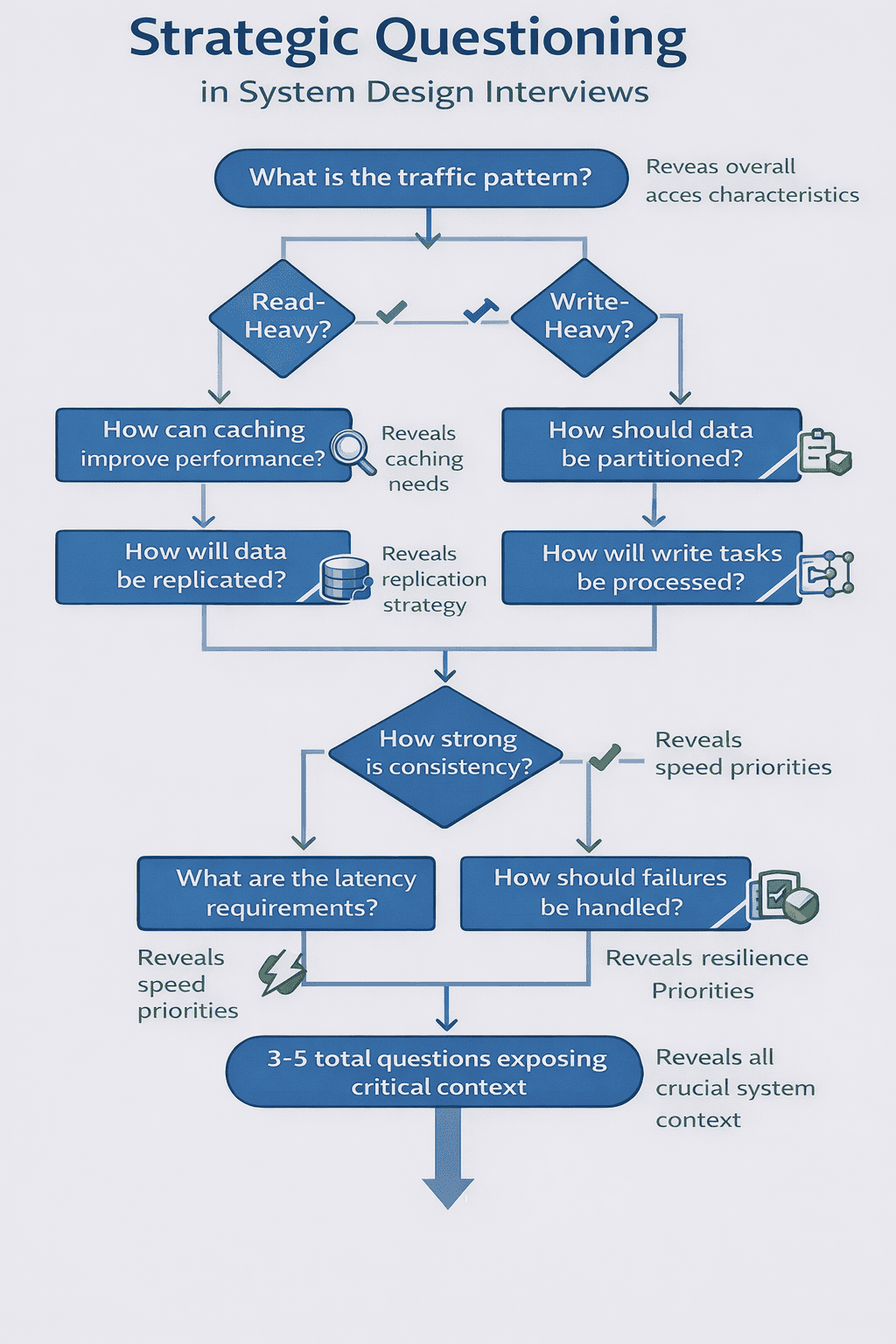
Use this pattern: Start broad, then narrow based on answers. Don’t ask 20 questions—ask 3-5 high-yield questions that expose the constraints that matter most.
Traffic pattern question: “Can you tell me about traffic patterns? Specifically, the read-to-write ratio and whether we see predictable daily patterns or unexpected viral spikes?”
This single question reveals whether you need to optimize reads or writes, whether you can cache aggressively, and whether you need elastic scaling or can provision for peak load.
Consistency requirement question: “When data changes, how quickly must all users see that change? Are there operations where stale data is acceptable and others where it isn’t?”
This exposes whether you can use eventual consistency, need strong consistency everywhere, or (most commonly) need different consistency models for different features.
Latency tolerance question: “What operations do users interact with directly, and what happens behind the scenes? For the user-facing operations, what latency do they currently experience and expect?”
This tells you which components need aggressive optimization and which can use simpler, higher-latency approaches.
Failure behavior question: “During partial failures—say, a database replica goes down or a cache cluster becomes unavailable—should the system prioritize returning potentially stale data to keep the user experience working, or prioritize correctness and return errors?”
This reveals whether availability or consistency matters more during failure scenarios, which shapes your entire redundancy strategy.
Context Application: Same Trade-Off, Different Decisions
Let’s see how context changes decisions. Consider the consistency versus availability trade-off in three different systems.
System 1: E-commerce product inventory. Traffic is read-heavy (100:1 reads to writes). Users tolerate slight delays in inventory updates. The business prefers showing a product as available when it just sold out (happens rarely, handled at checkout) over showing accurate counts that sacrifice page load speed.
Decision: Use aggressive caching with 10-second TTL. Accept eventual consistency. Optimize for read latency. The occasional oversell costs less than slower page loads.
System 2: Financial trading platform. Trade executions must be instantly consistent across all views. A trader seeing stale balance data causes regulatory violations and financial losses. The system serves far fewer users than e-commerce but has stricter correctness requirements.
Decision: Use strong consistency with synchronous replication. Accept higher latency (50-100ms). Sacrifice availability during network partitions rather than show incorrect balances. Compliance and correctness outweigh speed.
System 3: Social media follower counts. Updates happen frequently. Users don’t notice or care if counts are off by a few followers for several seconds. Hundreds of millions of users create massive read traffic. The business wants instant page loads more than precise counts.
Decision: Use heavy caching with eventual consistency. Counts update asynchronously. Optimize aggressively for read latency. Users never complain about follower count delays; they do complain about slow pages.
Same trade-off (consistency versus performance), three completely different decisions, all correct for their context.
Avoiding the “Best Practice” Trap
Many candidates learn patterns from case studies: “Netflix uses Cassandra, so I’ll use Cassandra.” “Uber uses microservices, so microservices are best.” This breaks down immediately when context changes.
Netflix uses Cassandra because they have extreme read volume, can tolerate eventual consistency for recommendations, and employ a team capable of operating complex distributed databases. If you’re building an internal CRUD app for 50 employees, Cassandra introduces enormous complexity for zero benefit. PostgreSQL with simple replication is correct here.
The trap is thinking architectural decisions exist independently of context. They don’t. Every “best practice” has conditions under which it’s best. Your job in interviews isn’t to recite what successful companies use—it’s to reason about what makes sense for the specific constraints you’ve identified.
When you catch yourself saying “I’d use X because that’s what [famous company] uses,” pause. Ask yourself: what context made X right for them? Do those conditions apply here? If not, what does apply?
Step 3: Compare Viable Options Side by Side
You’ve identified the trade-off. You’ve gathered context. Now comes the moment that exposes weak versus strong architectural thinking: comparing your options explicitly rather than implicitly favoring one approach.
Most candidates present their chosen solution and explain why it works. They skip the comparison step entirely. This makes it impossible for the interviewer to evaluate your decision-making process because you never showed them the alternatives you considered.
Strong candidates outline two or more valid approaches, explain what each optimizes for, and make the trade-offs visible before committing to one path.
The Comparison Framework: What Improves, What Degrades
Every architectural choice improves some dimensions while degrading others. Your job isn’t to find the option with no downsides—that doesn’t exist. Your job is to make those improvements and degradations explicit so your choice becomes obviously justified by the context.
Use this four-part structure for each option you’re comparing:
What improves: Which system qualities get better with this approach? Be specific. Not “it’s faster” but “read latency drops from 200ms to 50ms at the 99th percentile.”
What degrades: Which qualities get worse? Again, be specific. “Write latency increases from 100ms to 300ms because we’re writing to multiple replicas synchronously.”
What risks emerge: What new failure modes or edge cases does this approach introduce? “If the cache becomes stale, users might see outdated inventory for up to 60 seconds.”
What operational costs increase: Does this approach require more infrastructure, monitoring, or human expertise? “Running three database replicas across regions triples our database costs but eliminates single points of failure.”
Example Comparison: Consistency Models for a Social Feed
Let’s walk through a concrete comparison. The question: “Design a news feed that shows posts from users you follow.” You’ve determined this is read-heavy (users scroll feeds far more than they post) and that the interviewer cares about latency.
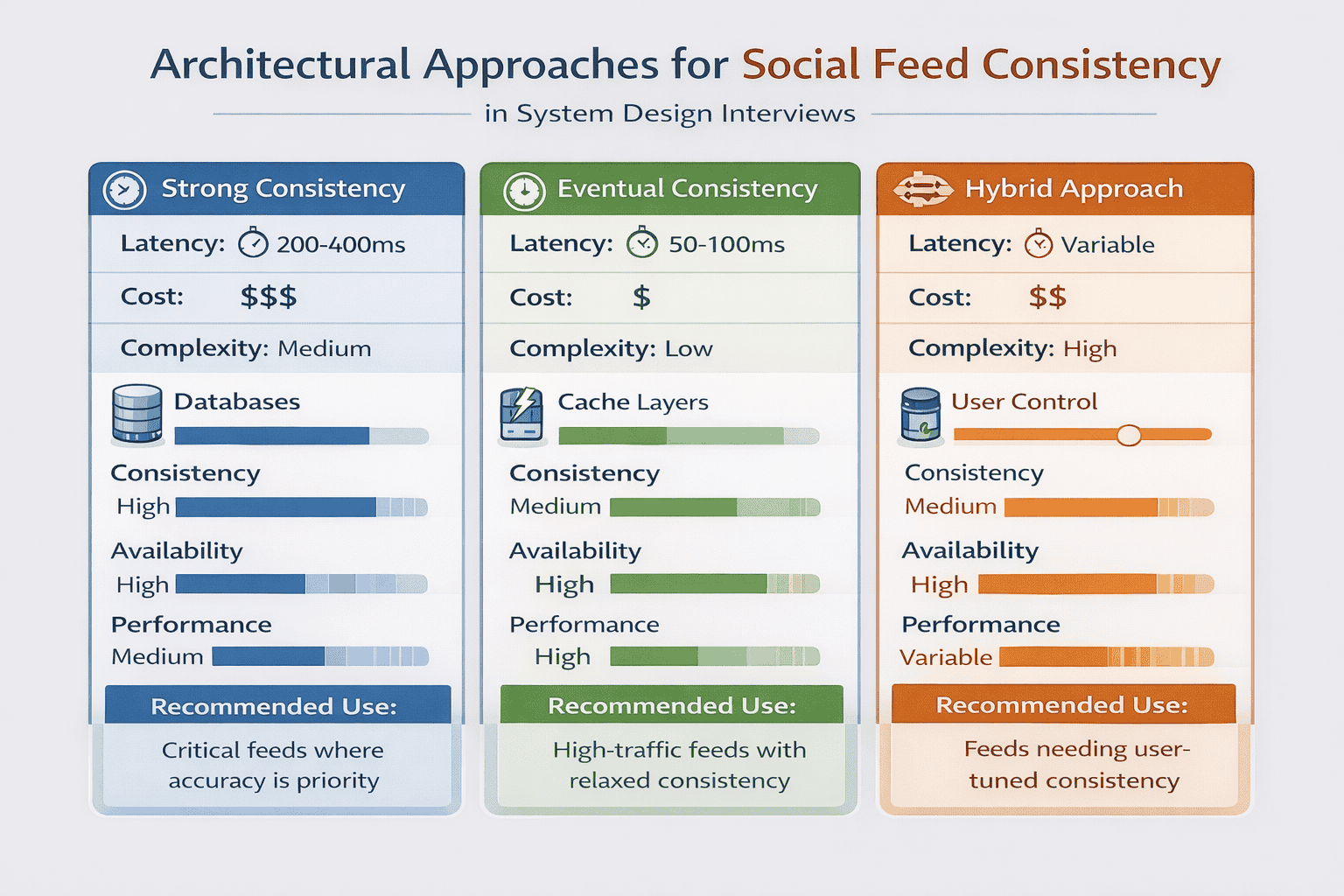
The trade-off: consistency versus read performance. You’re comparing strong consistency versus eventual consistency for feed generation.
Option A: Strong Consistency
What improves: Users always see the absolute latest posts. If someone just posted 2 seconds ago, it appears immediately in followers’ feeds. No confusion about missing content.
What degrades: Feed generation becomes slower because we must query the database directly or use a cache with very short TTL (under 5 seconds). At scale, this means more database load and higher p99 latencies—potentially 200-400ms for feed rendering instead of 50-100ms with aggressive caching.
What risks emerge: During traffic spikes, the database becomes a bottleneck. High load on the database can cascade into full system slowdown. We’d need significant over-provisioning to maintain latency targets during peak usage.
What operational costs increase: Database infrastructure costs rise substantially—we need faster hardware, more replicas, and sophisticated connection pooling. Monitoring becomes more complex because we must track database performance closely to catch degradation early.
Option B: Eventual Consistency with Aggressive Caching
What improves: Feed loads become extremely fast—typically under 50ms because we’re serving from cache layers. The system handles traffic spikes gracefully because caches absorb load that would otherwise hit the database. Infrastructure costs are lower because cache is cheaper than database capacity.
What degrades: Feed freshness decreases. With a 30-second cache TTL, users might not see new posts for up to 30 seconds after they’re published. For very active feeds, the cached version could be noticeably stale.
What risks emerge: Cache invalidation becomes critical. If we don’t invalidate properly when posts are deleted or users are blocked, stale content stays visible. The complexity of cache invalidation logic increases maintenance burden.
What operational costs increase: We need cache infrastructure (Redis clusters, CDN layers) and must implement cache warming strategies to prevent thundering herd problems when cache expires. Team needs expertise in cache management.
Option C: Hybrid Approach
What improves: We get fast reads for most users through caching, but allow users to explicitly “pull to refresh” which forces a fresh database query. This gives users control over freshness versus speed trade-off based on their immediate needs.
What degrades: System complexity increases because we’re maintaining both code paths. The pull-to-refresh path still hits the database, so we still need database capacity to handle refresh bursts.
What risks emerge: Users might overuse pull-to-refresh if they don’t trust the cached version, essentially defeating the caching strategy. We’d need rate limiting on forced refreshes.
What operational costs increase: We’re running both systems—cache infrastructure plus database capacity for refreshes. Monitoring becomes more complex because we track two different read paths.
How to Structure Verbal Comparison in Interviews
On a whiteboard or in conversation, you don’t have time to write paragraphs. You need a crisp verbal structure that makes the comparison clear in 60-90 seconds.
Use this pattern: “I’m considering [NUMBER] approaches here. Let me outline them quickly, then explain which makes sense given our requirements.”
Then for each option, give a one-sentence description followed by the key trade-off: “[OPTION NAME]: [WHAT IT DOES]. This optimizes for [BENEFIT] but sacrifices [COST].”
Here’s how this sounds for the feed example:
“I’m considering three approaches here. Let me outline them quickly, then explain which makes sense given our requirements.
Option one is strong consistency with direct database reads. This optimizes for correctness—users always see the latest posts—but sacrifices read latency and requires expensive database capacity.
Option two is eventual consistency with aggressive caching. This optimizes for read speed and cost efficiency but sacrifices freshness—posts might not appear in feeds for 30 seconds after publishing.
Option three is a hybrid where we cache by default but allow users to pull-to-refresh for fresh data. This gives users control but adds system complexity.
Given that this is a social feed where users typically care more about fast scrolling than seeing posts the instant they’re published, and our scale requirements favor caching, I’d start with option two—eventual consistency with 30-second cache TTL—and monitor whether users complain about staleness. If they do, we can add the pull-to-refresh mechanism from option three.”
Notice the structure. Three options outlined quickly. Each with its clear trade-off stated. Then a decision tied back to the requirements you established earlier.
Common Comparison Dimensions Across System Design Problems
Certain trade-off dimensions appear repeatedly across different system design questions. Learning these patterns helps you structure comparisons faster.
Consistency versus Availability: When network partitions occur, do you keep serving requests with potentially stale data (high availability) or reject requests until you can guarantee correct data (strong consistency)? Financial systems choose consistency. Social media chooses availability.
Latency versus Throughput: Do you optimize for individual request speed (low latency) or total system capacity (high throughput)? Real-time chat needs low latency. Batch processing needs high throughput. Sometimes you can’t have both—optimizing for one degrades the other.
Simplicity versus Performance: Is it worth adding complexity to squeeze out performance gains? A single PostgreSQL database is simple but limited in scale. Sharding across 20 database nodes is complex but handles massive scale. Early-stage systems favor simplicity. Large-scale systems accept complexity.
Compute Cost versus Storage Cost: Should you compute results on-demand (higher compute, lower storage) or precompute and cache results (lower compute, higher storage)? Aggregating metrics in real-time uses more CPU but less disk. Pre-aggregating and storing uses more disk but less CPU. Your traffic patterns determine which is cheaper.
Flexibility versus Optimization: Do you build a general solution that handles many cases adequately or a specialized solution that handles one case excellently? Generic systems are easier to extend but slower. Optimized systems are faster but harder to modify. Mature systems often start generic, then optimize hot paths.
📊 Table: Trade-Off Comparison Template
Use this template structure when comparing architectural options in interviews. Fill in specific details for your system, but maintain this framework to ensure you’re evaluating options comprehensively.
| Dimension | Option A | Option B | Decision Driver |
|---|---|---|---|
| What Improves | [Specific metric/quality that gets better] | [Different metric/quality that gets better] | Which improvement matters more for this system? |
| What Degrades | [Specific metric/quality that gets worse] | [Different metric/quality that gets worse] | Which degradation is more acceptable? |
| Risks Introduced | [New failure modes or edge cases] | [Different failure modes or edge cases] | Which risks can we mitigate more easily? |
| Operational Cost | [Infrastructure, monitoring, expertise needed] | [Different infrastructure, monitoring, expertise] | What are our operational constraints? |
| Recommended When | [Conditions under which Option A is best] | [Conditions under which Option B is best] | Which conditions match our requirements? |
When to Stop Comparing and Choose
You can’t compare options forever. Interviews are time-boxed. How do you know when you’ve compared enough?
Compare until you’ve covered the decision-critical dimensions. For most system design questions, that means comparing on:
- Performance characteristics (latency, throughput, or both)
- Consistency guarantees or data freshness
- Operational complexity or cost
If you’ve addressed those three and tied them to your requirements, you have enough to make a justified decision. Additional comparison often provides diminishing returns.
The goal isn’t exhaustive analysis. The goal is demonstrating you can identify multiple valid approaches and evaluate them systematically against requirements. Two well-compared options beats five poorly-compared options every time.
Step 4: Justify a Decision Using Interview-Friendly Reasoning
You’ve compared your options. You know which approach fits the requirements best. Now comes the most common failure point in system design interviews: explaining why.
I’ve watched brilliant engineers choose the right architecture and then completely fumble the explanation. They say things like “this seems better” or “I’ve seen this pattern work before” or—worst of all—they just start drawing without stating their reasoning.
Interviewers don’t read minds. If you don’t verbalize your thought process, they have no way to evaluate your decision-making ability. The architecture you chose might be perfect, but if you can’t explain why it’s perfect for this specific context, you lose credit.
The Four-Part Justification Structure
Every architectural decision can be justified using the same four-part structure. Practice this pattern until it becomes automatic.
Part 1: State the chosen option clearly. Don’t hedge. Don’t say “we could maybe try using…” Say “I would use [SPECIFIC APPROACH].”
Clarity signals confidence. Even if you’re internally uncertain, stating your choice clearly allows the interviewer to evaluate your reasoning. If your reasoning is sound but your choice doesn’t match what they expected, they’ll probe further. That’s a productive conversation. If you hedge, they can’t evaluate anything.
Part 2: Explain what you’re optimizing for. Connect your choice to a specific system requirement or quality attribute you identified earlier.
Use this exact phrasing: “This optimizes for [SPECIFIC QUALITY] because [REQUIREMENT].”
For example: “This optimizes for read latency because we established that 90% of traffic is users scrolling their feeds, and every 100ms of delay measurably reduces engagement.”
Part 3: Acknowledge what you’re sacrificing. Name the downside explicitly. This demonstrates you understand trade-offs rather than thinking your chosen approach is perfect.
Use this phrasing: “We’re trading [WHAT YOU LOSE] for [WHAT YOU GAIN].”
For example: “We’re trading data freshness for response speed. Feeds might be up to 30 seconds stale, but load times drop from 300ms to 50ms.”
Part 4: Tie it back to system goals. Explain why this particular trade-off aligns with the system’s priorities based on the context you gathered.
Use this phrasing: “For this system, [BENEFIT] matters more than [SACRIFICE] because [CONTEXT-SPECIFIC REASON].”
For example: “For this system, response speed matters more than instant freshness because users care more about smooth scrolling than seeing posts the second they’re published. Our usage data shows users refresh manually when they want latest content.”
Complete Example: Justifying a Database Choice
Let’s apply this structure to a common decision point: choosing between a relational database and a NoSQL database for a user profile service.
The question is: “Design a user profile service that stores user data (name, email, preferences, activity history) for 50 million users. The service needs to support both reading individual profiles and running analytics queries across user populations.”
You’ve compared options. Now justify your choice:
“I would use PostgreSQL as the primary data store. [Part 1: Clear statement]
This optimizes for query flexibility because we need to support both point lookups (reading individual profiles) and analytical queries (aggregating across user populations). [Part 2: What you’re optimizing for]
We’re trading some horizontal scalability for query power. A NoSQL database like DynamoDB would give us easier sharding and potentially lower latency for point lookups, but it would make our analytics queries significantly more complex and expensive. [Part 3: Acknowledge sacrifice]
For this system, query flexibility matters more than ultra-low latency point lookups because while users do read their own profiles frequently, the business depends heavily on analytics to understand user behavior patterns. With 50 million users, we’re at a scale where PostgreSQL with read replicas and appropriate indexing can handle our read load while still allowing us to run the analytical queries we need. If we scaled to 500 million users, we’d revisit this, but at 50 million, the query flexibility PostgreSQL provides outweighs the scaling benefits of NoSQL.” [Part 4: Tie to system goals]
This justification took 30 seconds to deliver. It covered every dimension the interviewer cares about. And it demonstrated architectural judgment—you know when to use each technology based on specific requirements, not just which technology exists.
Common Justification Mistakes and How to Fix Them
Most justification failures fall into predictable patterns. Recognizing these helps you avoid them in real interviews.
Mistake 1: Circular Reasoning
Bad: “I’d use microservices because we need a microservices architecture.”
This doesn’t explain anything. You’ve just restated your choice without justification.
Fix: “I’d use microservices because different teams will own different features, and microservices allow independent deployment cycles. We’re trading some operational complexity for team autonomy, which matters more for this organization than operational simplicity because we have 15 feature teams who currently block each other during deployments.”
Mistake 2: Vague Benefits
Bad: “This approach is more scalable and performs better.”
Scalable in what dimension? Better performance for which operations? Generic claims suggest pattern-matching rather than analysis.
Fix: “This approach scales horizontally—we can handle 10x traffic growth by adding cache nodes without database changes. Read latency improves from 200ms to 50ms at the 99th percentile, which matters because our user research shows engagement drops sharply above 100ms response times.”
Mistake 3: Ignoring Downsides
Bad: “Caching solves all our latency problems.”
Nothing solves “all” problems. Claiming perfection signals inexperience.
Fix: “Caching reduces read latency from 200ms to 50ms, but it introduces staleness—users might see outdated data for up to 30 seconds. For a social feed, this trade-off works because users care more about fast scrolling than instant updates. For a financial dashboard, we’d need a different approach.”
Mistake 4: Appeals to Authority
Bad: “Netflix uses Cassandra, so we should too.”
Netflix’s requirements aren’t your requirements. This shows you memorized case studies without understanding the reasoning behind them.
Fix: “Netflix uses Cassandra because they have extreme read volume, can tolerate eventual consistency for recommendations, and employ teams capable of operating complex distributed databases. Our system has similar read patterns and consistency tolerance, so Cassandra’s architecture maps well. However, we don’t have Netflix’s operational expertise, so we’d use a managed Cassandra service like Amazon Keyspaces rather than running our own clusters.”
📥 Download: Decision Justification Template
This one-page reference guide provides fill-in-the-blank templates for justifying architectural decisions in system design interviews. Print it and practice with different scenarios to build the verbal reasoning muscle.
Download PDFHandling “Why Not [Alternative]?” Questions
After you justify your choice, interviewers often ask: “Why didn’t you choose [different option]?”
This isn’t a challenge—it’s an invitation to demonstrate you considered alternatives. If you compared options properly in Step 3, you already have the answer.
Use this pattern: “I considered [ALTERNATIVE] because it offers [BENEFIT], but I chose [YOUR CHOICE] instead because [REQUIREMENT] matters more than [ALTERNATIVE’S BENEFIT] for this specific system.”
For example:
Interviewer: “Why not use DynamoDB instead of PostgreSQL?”
You: “I considered DynamoDB because it offers better horizontal scalability and potentially lower point-lookup latency. But I chose PostgreSQL instead because our analytical query requirements matter more than ultra-low latency point lookups for this specific system. DynamoDB would make our cross-user analytics queries either very expensive or require maintaining a separate analytical data store, which adds complexity. With 50 million users, PostgreSQL with read replicas handles our scale while keeping our query flexibility.”
This answer shows you understand DynamoDB’s strengths, you made a conscious trade-off decision, and you can defend that decision with reference to specific requirements.
Quantifying When Possible
Numbers make justifications more convincing. When you can quantify the impact of your decision, do it.
Instead of: “Caching improves performance.”
Say: “Caching reduces p99 read latency from 200ms to 50ms, which matters because our engagement data shows 15% more users bounce when page loads exceed 100ms.”
Instead of: “This approach costs more.”
Say: “Running three database replicas across regions triples our database infrastructure cost from approximately $500/month to $1,500/month, but it eliminates our single point of failure and gives us sub-100ms latency for users in Europe and Asia instead of the 300ms they’d experience with a single US region.”
You don’t need perfect numbers. Order-of-magnitude estimates work fine. “This costs about 3x more” or “This reduces latency by roughly 75%” demonstrates quantitative thinking even without exact figures.
Avoid quantifying when you don’t have reasonable estimates. Saying “this is 27.3% faster” when you have no basis for that number is worse than saying “this is significantly faster.” Precision without accuracy damages credibility.
Step 5: Apply the Process to Real Interview Scenarios
You’ve learned the framework. Now let’s apply it to three common system design questions that candidates frequently struggle with because multiple trade-offs collide simultaneously.
These walkthroughs show the complete process: identifying trade-offs, gathering context, comparing options, and justifying decisions. Pay attention to how the same framework adapts to different problem types.
Scenario 1: URL Shortener Service
The Question: “Design a URL shortening service like bit.ly that handles 100 million redirects per day. Users can create short URLs and the system tracks click analytics.”
Step 1: Identify the Trade-Offs
First, calculate scale: 100 million redirects per day = roughly 1,200 requests per second average, likely 3-5x peak = 4,000-6,000 requests per second at peak.
This immediately surfaces three potential trade-off areas:
- URL generation: Pre-generate codes for instant creation (uses storage) versus generate on-demand (saves storage, adds compute)
- Redirect performance: Optimize heavily for read latency since reads vastly outnumber writes, versus keep architecture simple
- Analytics accuracy: Real-time precise analytics (expensive) versus eventual consistency in analytics (cheaper)
Step 2: Gather Context
Strategic questions to ask:
“For the 100 million redirects per day, what’s the ratio of new URL creation to redirects? Is it closer to 1:100 or 1:1000?” This reveals whether to optimize writes or reads.
“When users create a short URL, do they need to use it immediately, or is there typically a delay before sharing? And do they expect analytics to update in real-time or is hourly aggregation acceptable?” This exposes latency and consistency requirements.
Assume the interviewer responds: “New URL creation is maybe 1% of total traffic—most requests are redirects. Users typically create URLs and immediately share them, so creation should be fast. Analytics can be eventually consistent—hourly updates are fine.”
Step 3: Compare Options for Key Decision Points
Major decision: How to generate short codes.
Option A: Hash the long URL and use first 6-7 characters. Simple, deterministic—same long URL always gets same short code. Trades uniqueness (possible collisions) for simplicity.
Option B: Auto-increment counter converted to base62. Guarantees uniqueness, simple to implement. Trades distributed scalability (single counter is a bottleneck) for uniqueness guarantees.
Option C: Pre-generate random codes in batches, store in database, mark as used when assigned. Trades storage space and complexity for fast creation and guaranteed uniqueness.
Step 4: Justify the Decision
“I would use Option B—an auto-increment counter with base62 encoding—with a modification to make it distributed.
This optimizes for guaranteed uniqueness and simplicity. Each application server gets a range of IDs (for example, server 1 gets 1-1,000,000, server 2 gets 1,000,001-2,000,000). The server converts its current ID to base62 when creating a URL.
We’re trading perfect sequential IDs for distributed scalability. IDs will have gaps when servers request new ranges, but that doesn’t matter—users don’t care about ID sequence.
For this system, guaranteed uniqueness matters more than perfect sequentiality because users expect every short URL to work reliably. With only 1% of traffic being URL creation, we can handle the coordination of assigning ID ranges without it becoming a bottleneck.”
For redirects: “I would use Redis cache with write-through to PostgreSQL. Popular URLs stay in cache, unpopular ones go to database. This trades infrastructure cost (running Redis) for read latency (sub-10ms cache hits versus 50ms database reads). For a redirect service, response time directly impacts user experience, so the cost is justified.”
Scenario 2: Real-Time Messaging System
The Question: “Design a messaging system like WhatsApp where users can send text messages to other users or groups. The system should show delivery and read receipts.”
Step 1: Identify the Trade-Offs
This question immediately presents several competing requirements:
- Message delivery guarantees versus system complexity
- Real-time delivery versus infrastructure cost
- Message ordering versus distributed scalability
- Read receipt accuracy versus performance
Step 2: Gather Context
“For delivery guarantees, is it acceptable for a message to be delivered twice if there’s a network retry, or must we guarantee exactly-once delivery?” This exposes whether at-least-once (simpler) or exactly-once (complex) semantics are required.
“When users are offline, how long should we store undelivered messages? And should offline users still receive messages in order when they come back online?” This reveals storage and ordering requirements.
“For read receipts, is it critical that they’re accurate to the second, or is ‘read in the last few minutes’ acceptable?” This determines whether real-time updates are necessary.
Assume responses: “Duplicate messages are acceptable if rare—at-least-once is fine. Store undelivered messages for 30 days. Messages must appear in sent order. Read receipts should update within a few seconds.”
Step 3: Compare Options
Major decision: Message delivery architecture.
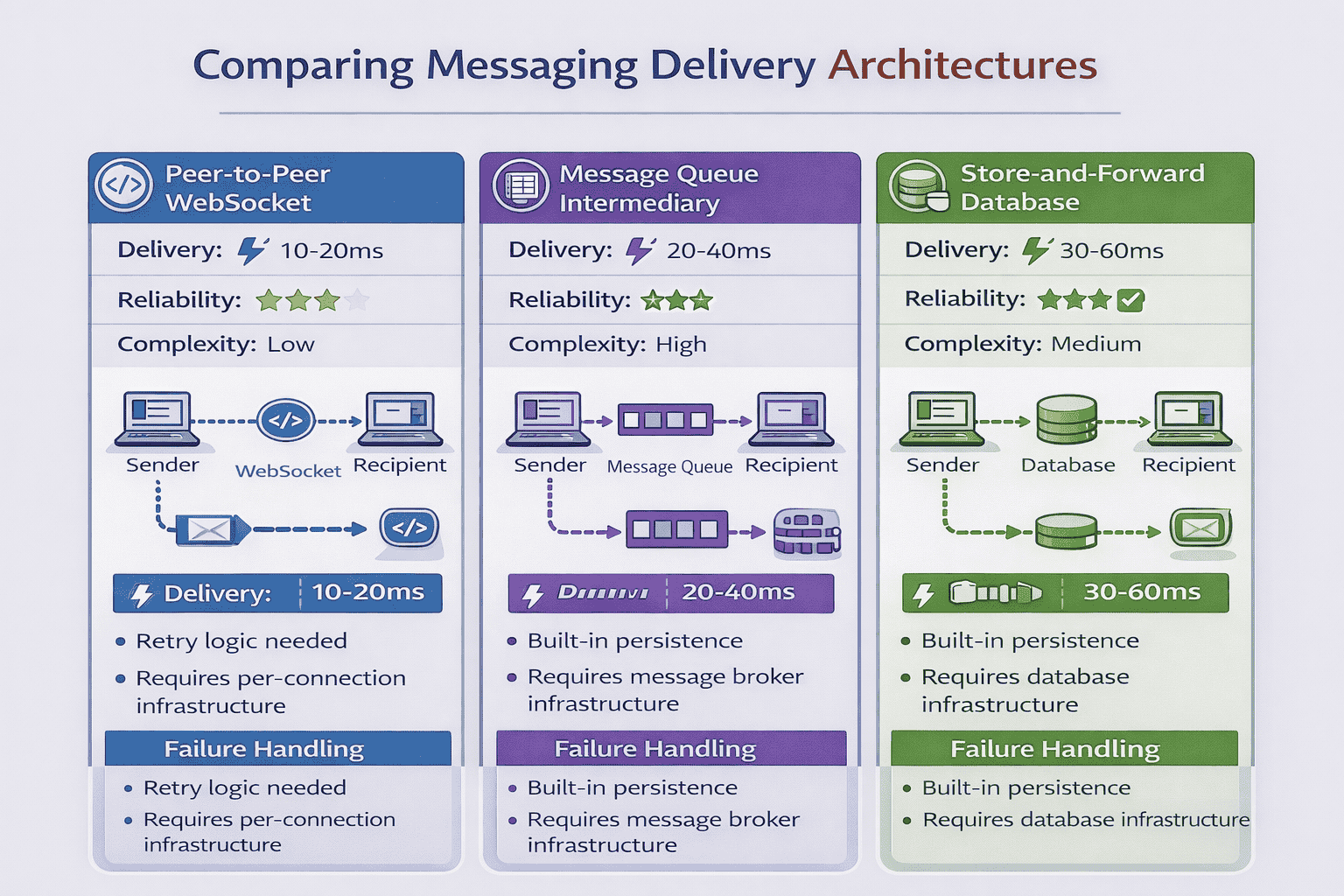
Option A: Direct peer-to-peer via WebSocket when both users online, database queue when recipient offline. Simple but requires sender to wait for delivery confirmation.
Option B: Message queue (like Kafka) as intermediary. Sender publishes to queue, recipient subscribes. Decouples sender/recipient but adds infrastructure complexity.
Option C: Store-and-forward via database. All messages written to database immediately, delivery happens asynchronously. Reliable but potentially slower.
Step 4: Justify the Decision
“I would use Option C—store-and-forward via database—with WebSocket connections for notification when recipients are online.
This optimizes for delivery reliability. Every message is immediately persisted, so we can’t lose messages even if servers crash. The sender gets confirmation that their message is stored, not just sent.
We’re trading some real-time delivery speed for guaranteed durability. There’s a small delay (10-50ms) while we write to database before notifying the recipient. Direct WebSocket would be slightly faster but riskier—if the recipient’s connection drops during transfer, we’d need retry logic that’s essentially rebuilding the queue we avoided.
For this system, reliability matters more than shaving 30ms off delivery because users expect messaging to just work. They’d rather have a message arrive reliably in 50ms than risk it not arriving at all to save 30ms.
For ordering, we use a per-conversation sequence number stored with each message. Clients request messages >= last seen sequence number when reconnecting. This guarantees order without requiring complex distributed locking.”
Scenario 3: News Feed Ranking System
The Question: “Design a news feed that shows users personalized content ranked by relevance. The system serves 500 million users with 10 billion posts per day.”
Step 1: Identify the Trade-Offs
Scale calculation: 10 billion posts per day = 115,000 posts per second average. 500 million users checking feeds creates massive read load.
Critical trade-offs:
- Ranking accuracy versus computation cost
- Feed freshness versus latency
- Personalization depth versus scalability
Step 2: Gather Context
“For ranking, does the system need to factor in real-time signals like who’s currently online, or can it use signals from the last hour? And is it more important that feeds show the absolute best content or that they load quickly?”
“When a user opens their feed, is it acceptable to show them posts from the last few hours, or must they see posts from the last few minutes?”
Assume responses: “Ranking can use hourly-updated signals—real-time isn’t critical. Users care more about fast loads than seeing posts from the last minute. Showing content from the last 2-3 hours is fine.”
Step 3: Compare Options
Option A: Compute feed ranking in real-time when user requests it. Personalized and always fresh, but slow and computationally expensive.
Option B: Pre-compute feeds for all users periodically (every 30 minutes). Fast serving, but feeds become stale and pre-computing for 500M users is expensive.
Option C: Hybrid—pre-rank candidate posts by general quality, then personalize on-demand from candidates. Balances freshness, performance, and cost.
Step 4: Justify the Decision
“I would use Option C—hybrid pre-ranking with on-demand personalization.
Here’s how it works: Every 15 minutes, we run a batch job that scores all recent posts by general quality metrics—engagement rate, recency, source credibility. This produces a ranked list of maybe 10,000 ‘candidate’ posts that are objectively good.
When a user opens their feed, we fetch these 10,000 candidates, then apply personalization in real-time using their follow graph and interaction history. This narrows 10,000 candidates to their personalized top 100 in under 50ms.
This optimizes for the sweet spot between personalization quality and serving latency. We’re trading perfect personalization (which would require scoring all 10 billion daily posts per user) for fast, good-enough personalization (scoring only top candidates).
For this system, loading speed matters more than showing every possible post because users won’t scroll beyond the first 50-100 items anyway. As long as those 100 are relevant and load fast, the experience works. Option A would take seconds to compute, which users wouldn’t tolerate. Option B would show stale content and waste compute on users who don’t check their feeds.”
Common Mistakes in Scenario Application
When applying this framework to real questions, watch for these failure modes:
Over-engineering early. Don’t start with “we’ll use Kafka and Cassandra and Redis and…” for a system serving 1,000 users. Match your complexity to actual scale requirements.
Under-questioning constraints. If you don’t know whether consistency or availability matters more, ask. Don’t assume.
Ignoring obvious simplifications. If the simple solution works, use it. Distributed systems complexity should be justified by scale, not added for its own sake.
Forgetting to revisit decisions. End each scenario with: “If X changes (like traffic 10x-ing), we’d need to revisit Y.” This shows you understand your decisions are context-dependent.
Step 6: Handle Follow-Up Challenges and Constraint Changes
You’ve designed your system. You’ve justified your decisions. Then the interviewer says: “What if traffic suddenly increases 100x?” or “What if we need strong consistency instead of eventual consistency?”
This is where most candidates panic. They think the interviewer is telling them their design is wrong. They start apologizing and trying to redesign everything from scratch.
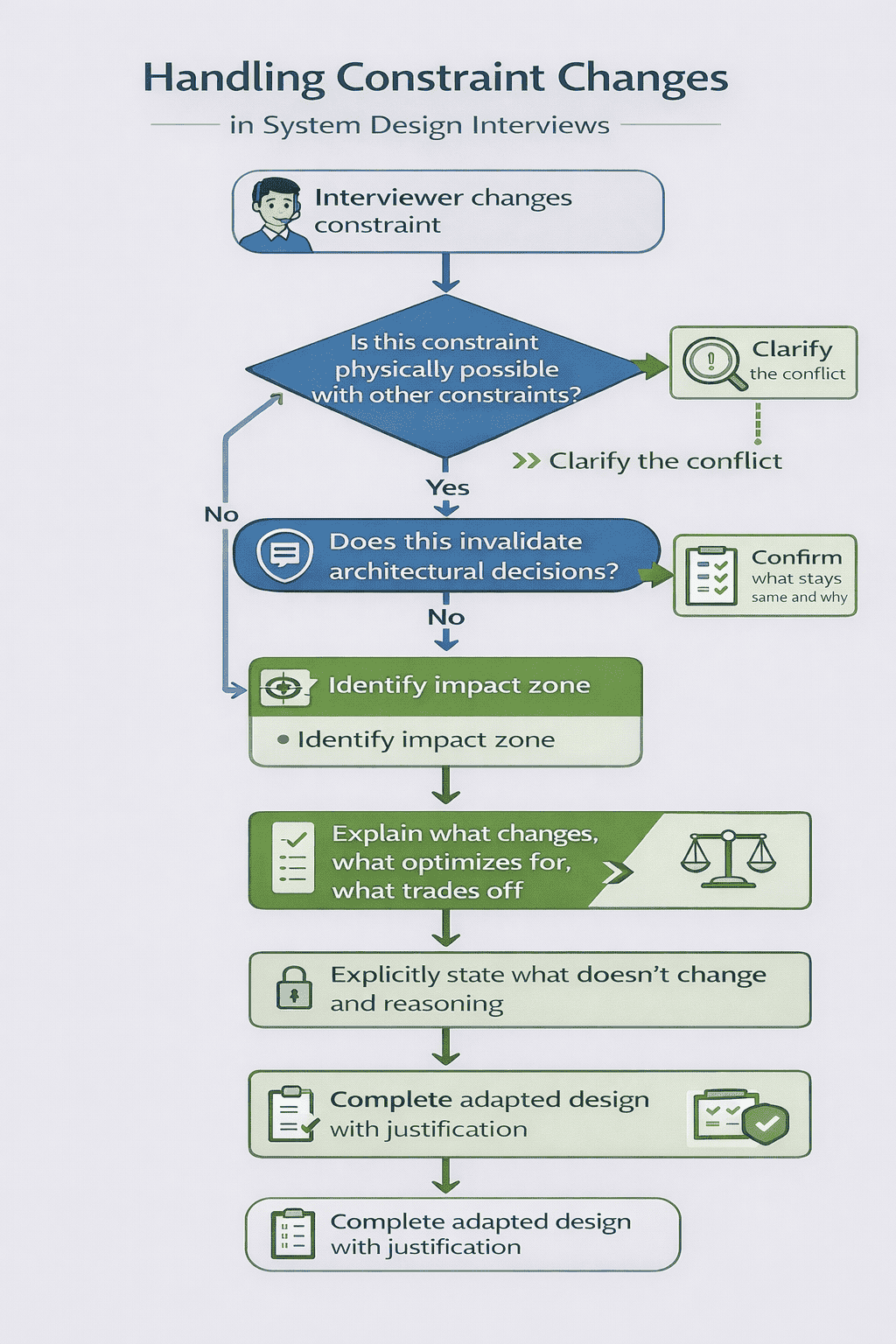
Wrong approach. Constraint changes aren’t gotchas—they’re opportunities to demonstrate architectural flexibility and judgment. The interviewer wants to see if you can adapt your design systematically rather than starting over or getting defensive.
Why Interviewers Change Constraints Mid-Interview
Understanding the interviewer’s intent helps you respond effectively. They’re testing three specific capabilities.
First: Can you identify which parts of your design need to change? When a constraint changes, good engineers don’t rebuild everything. They identify the specific components or decisions that are invalidated by the new constraint and target those for revision.
If traffic increases 100x, your database choice might still be fine but your caching strategy needs updating. If you change from eventual to strong consistency, your storage layer might need replacement but your API layer stays unchanged. Demonstrating this surgical approach shows system thinking.
Second: Can you preserve sound decisions while adapting others? Some architectural decisions are constraint-dependent, others aren’t. When constraints change, strong candidates explicitly state what stays the same and why.
“We’d need to change the database from single-instance PostgreSQL to a sharded setup, but our use of Redis for caching remains valid because that decision was based on read-heavy traffic patterns, which haven’t changed in this new scenario.”
Third: Can you reason about second-order effects? Changing one part of a system often creates ripple effects. When you switch databases, your backup strategy changes. When you add sharding, your query patterns become more complex. Acknowledging these downstream impacts demonstrates architectural maturity.
The Three-Step Response Pattern for Constraint Changes
When the interviewer changes a constraint, use this structured response:
Step 1: Acknowledge the change and identify the impact zone. Restate the new constraint and explicitly name which components or decisions it affects.
“Okay, so instead of 1,000 requests per second, we’re now looking at 100,000 requests per second—a 100x increase. This primarily impacts our database layer and caching strategy, since those were sized for the original scale. Our API design and business logic remain valid because they’re not scale-dependent.”
Step 2: Explain what you’d change and why. For each impacted component, describe the modification using the same justification structure you used initially: what you’re changing, what it optimizes for, what you’re trading.
“For the database, we’d move from a single PostgreSQL instance to a sharded setup partitioned by user ID. This trades operational simplicity for horizontal scalability—we can now add database capacity by adding shards. The trade-off makes sense at 100,000 RPS because a single instance tops out around 5,000-10,000 RPS depending on query complexity.”
Step 3: Explicitly state what doesn’t change and why. This shows you’re making targeted modifications, not redesigning randomly.
“What stays the same: Our Redis caching layer still makes sense because the read-heavy pattern hasn’t changed. Our message queue for async processing still works because we designed it to scale horizontally from the start. Our API contract remains unchanged because it’s not tied to backend scale.”
Common Constraint Change Scenarios and How to Handle Them
Certain constraint changes appear frequently across different system design questions. Practicing these patterns builds reflexes for handling them smoothly.
Scenario: “What if traffic increases 10x?”
This tests whether you understand which components scale linearly and which don’t. Your response should identify bottlenecks that emerge at higher scale.
Weak response: “We’d need bigger servers.”
Strong response: “At 10x traffic, our stateless application servers scale fine horizontally—we just add more instances behind the load balancer. The bottleneck becomes the database. We have two options: vertical scaling to a bigger instance, which works up to maybe 5-10x, or sharding for true horizontal scale. Given we’re at 10x, I’d first try vertical scaling—moving from a db.m5.large to db.m5.4xlarge—because it’s operationally simpler. If we expected continued growth to 20-30x, I’d invest in sharding instead.”
Scenario: “What if we need strong consistency instead of eventual consistency?”
This tests whether you understand the relationship between consistency models and your chosen components.
Weak response: “We’d make sure the database is strongly consistent.”
Strong response: “Strong consistency eliminates our ability to use aggressive caching with 60-second TTLs. We’d need to either: (1) Cache with much shorter TTLs, maybe 1-2 seconds, accepting higher cache miss rates and database load, or (2) Implement cache invalidation so we actively purge cache entries when data changes, which adds complexity but maintains low latency. I’d choose option 2 because our write rate is low enough that we can afford to invalidate cache entries on every write without overwhelming the system.”
Scenario: “What if we need to support global users across multiple regions?”
This tests whether you understand the complexity introduced by geographic distribution.
Weak response: “We’d put servers in multiple regions.”
Strong response: “Geographic distribution introduces a latency versus consistency trade-off. We have three approaches: (1) Keep one primary region and serve all others from there—simple but high latency for non-primary regions. (2) Replicate data to all regions with eventual consistency—low latency everywhere but users in different regions temporarily see different data. (3) Use a coordination service for strong consistency across regions—consistent but adds 100-300ms of cross-region latency to writes.
Given that [reference earlier context about consistency requirements], I’d choose [specific option] because [reasoning tied to system goals].”
Scenario: “What if the system must remain operational even when an entire data center fails?”
This tests whether you understand high availability requirements and their costs.
Weak response: “We’d use multiple data centers.”
Strong response: “Surviving data center failure requires running active replicas in at least two data centers. This roughly doubles our infrastructure cost. For the database, we’d use synchronous replication to a secondary data center—writes must commit to both before succeeding. This adds latency (typically 20-50ms depending on data center proximity) but guarantees no data loss during failover.
For stateless services, we’d run active-active across both data centers with a global load balancer that automatically routes traffic away from a failed data center. The trade-off: doubled cost and increased complexity, but we meet the requirement of surviving data center failure without extended downtime.”
📊 Table: Constraint Changes and Their Impact Zones
This table maps common constraint changes to the system components they typically affect, helping you quickly identify where to focus your adaptation.
| Constraint Change | Primary Impact Zone | Typical Modifications | What Usually Stays Same |
|---|---|---|---|
| 10x traffic increase | Database, Cache, Load Balancing | Add read replicas, horizontal scaling, better caching | API design, business logic, consistency model |
| 100x traffic increase | Database Architecture, All layers | Sharding, distributed caching, CDN, async processing | API contracts, core business rules |
| Eventual → Strong consistency | Caching strategy, Database reads | Cache invalidation, shorter TTLs, read-after-write | Database choice, write path, storage layer |
| Single region → Global | Data replication, Latency handling | Multi-region replicas, CDN, geo-routing | Application logic, data schemas, API structure |
| Must survive data center failure | Redundancy, Failover mechanisms | Multi-AZ deployment, synchronous replication, health checks | Application code, data models, user-facing features |
| Real-time → Batch processing | Processing architecture, User expectations | Message queues, scheduled jobs, async workflows | Data storage, API endpoints, authentication |
How to Pivot Without Losing Credibility
Some candidates worry that adapting their design makes them look indecisive or wrong. The opposite is true—inability to adapt signals inexperience.
Production systems evolve constantly. Requirements change. Traffic patterns shift. New constraints emerge. Engineers who can adapt existing systems outperform those who can only design greenfield systems.
To pivot credibly, use this framing: “My original design was optimized for [ORIGINAL CONSTRAINT]. With the new constraint of [NEW REQUIREMENT], the trade-offs shift. What was optimal before is no longer optimal now, so we’d adapt by [SPECIFIC CHANGE].”
This positions your original design as correct for its constraints, not wrong in general. You’re not backpedaling—you’re demonstrating that good architecture is context-dependent.
Example: “My original design used eventual consistency with aggressive caching because you mentioned analytics could update hourly. That trade-off optimized for read latency at the cost of real-time accuracy. With the new requirement for strong consistency, that trade-off no longer works. We’d adapt by implementing cache invalidation on writes and using read-after-write consistency. The core database choice of PostgreSQL still works—we’re just changing how we cache around it.”
When to Push Back on Constraint Changes
Sometimes the interviewer proposes a constraint change that reveals a fundamental conflict in requirements. Strong candidates identify these conflicts and discuss them rather than trying to force incompatible requirements together.
If the interviewer says “the system must have sub-10ms latency AND strong consistency across three geographic regions,” you’re dealing with physics limitations. Speed of light limits cross-region communication to roughly 100ms between distant regions.
Appropriate response: “I want to make sure I understand the requirements correctly. Strong consistency across three geographic regions requires cross-region coordination, which introduces at least 100-200ms of latency due to network travel time between regions. That conflicts with the sub-10ms latency requirement. Could you clarify whether consistency or latency is the higher priority, or whether different features can have different guarantees?”
This isn’t arguing with the interviewer. It’s demonstrating you understand the trade-offs well enough to recognize when requirements are physically incompatible. Good interviewers appreciate this—they may be deliberately testing whether you’ll blindly agree to impossible requirements or thoughtfully identify the conflict.
Practice Exercise: Constraint Change Drills
Take any system design question you’ve worked through. Write down your architecture. Then apply these constraint changes one at a time:
- Traffic increases 10x
- Traffic increases 100x
- Must support users globally (previously single region)
- Must have strong consistency (previously eventual)
- Must survive data center failure
- Budget is cut 50%
For each change, practice the three-step response: acknowledge and identify impact, explain modifications, state what stays the same. This builds muscle memory for adapting designs smoothly under interview pressure.
Bonus challenge: Combine two constraint changes. “Traffic increases 100x AND we need strong consistency.” This forces you to navigate multiple trade-offs simultaneously, which is closer to real system evolution.
Step 7: Use a Final Trade-Off Checklist Before You Finish
You’re approaching the end of your interview time. You’ve designed a system. You’ve justified your decisions. You’ve handled the interviewer’s constraint changes. Before you conclude, run through a mental checklist to ensure you’ve addressed the dimensions interviewers care about most.
This final review catches gaps that could cost you points. It takes 60-90 seconds but often surfaces one or two areas you haven’t explicitly discussed. Bringing these up proactively demonstrates thoroughness.
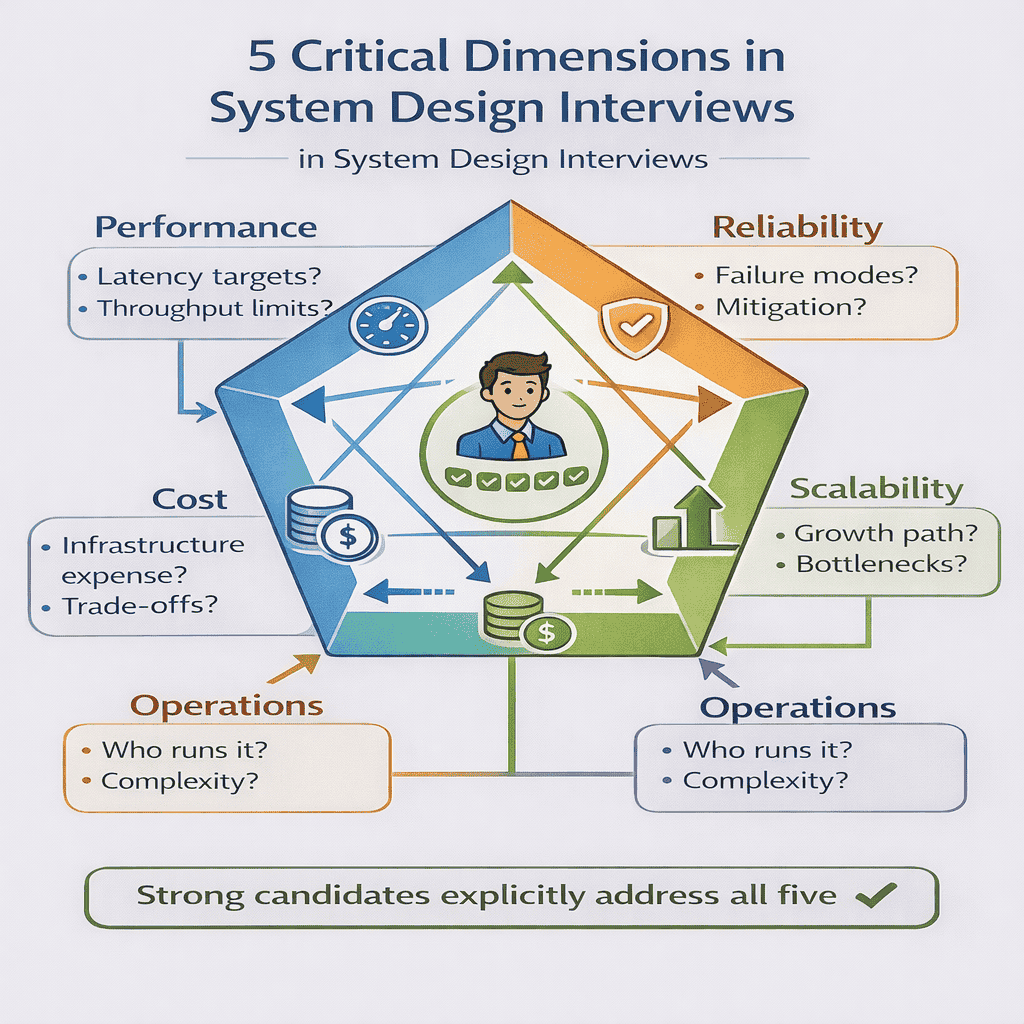
The Five Critical Dimensions Checklist
Every system design interview evaluates you across five dimensions. Strong candidates address all five explicitly, even if only briefly. Use this as your final mental checklist.
1. Performance: Have I addressed latency and throughput?
Don’t just mention that your system is “fast.” Specify which operations need low latency, what latency targets are acceptable, and how you achieve them. Discuss throughput limits—what’s the maximum load your design handles, and what becomes the bottleneck?
Quick self-check: “For the critical path [read/write operation], I’ve specified that we target [Xms] p99 latency by using [caching/replication/optimization technique]. The system handles [Y requests per second] before the [database/cache/network] becomes the bottleneck.”
If you haven’t addressed performance explicitly, add it: “Before we finish, let me touch on performance. The critical user operation is reading the feed, where we target sub-100ms p99 latency. We achieve this through Redis caching with 30-second TTL. For writes, we can tolerate 200-300ms since users don’t expect instant feedback when posting. The system handles approximately 10,000 requests per second before we’d need to scale the Redis cluster.”
2. Reliability: Have I discussed failure modes and mitigation?
Systems fail. Servers crash. Networks partition. Disks fill. Interviewers want to know you’ve thought about what breaks and how the system responds.
Quick self-check: “I’ve identified that [component X] is a single point of failure and mitigated it with [replication/redundancy]. During [specific failure scenario], the system [degrades gracefully/fails safe/maintains availability].”
If you haven’t discussed failures, add it: “For reliability, the main failure mode I’m concerned about is the database becoming unavailable. We mitigate this with a read replica that can serve reads during primary failure. Writes would fail during that window, but we’d return clear errors to users rather than accepting writes that might be lost. For cache failure, we fall back to reading from database—slower but functional.”
3. Scalability: Have I explained how the system grows?
Current scale is one thing. Future scale is another. Show you’ve designed for growth, or at least identified where you’d need to redesign.
Quick self-check: “I’ve specified that this design works up to [scale X]. Beyond that, we’d need to [specific architectural change]. The design scales horizontally by [adding servers/sharding database/expanding cache].”
If you haven’t discussed scalability, add it: “This design works well up to about 50 million users. Beyond that, we’d need to shard the database by user ID to maintain query performance. The application layer scales horizontally—we just add more servers behind the load balancer. The cache layer also scales horizontally by adding Redis nodes.”
4. Cost: Have I acknowledged the financial trade-offs?
Architecture decisions have cost implications. Running three database replicas across regions costs more than a single instance. Aggressive caching requires cache infrastructure. Acknowledging costs shows business awareness.
Quick self-check: “I’ve mentioned that [architectural choice] increases costs by [rough multiple] but provides [specific benefit] that justifies the expense for this use case.”
If you haven’t discussed costs, add it: “On cost, the main expense is running Redis cache clusters and database read replicas. This roughly doubles our infrastructure cost compared to a simple single-database setup, but it’s necessary to hit our latency targets at scale. If cost were a major constraint, we could reduce cache TTL and rely more on database queries, accepting higher latency.”
5. Operational Complexity: Have I considered who operates this?
Complex distributed systems require skilled operators. Managed services reduce operational burden but may cost more. Showing you think about operations demonstrates real-world experience.
Quick self-check: “I’ve noted that [complex component] requires [specific operational expertise/monitoring/tooling]. For a [team size/capability], we’d use [managed service/simpler alternative].”
If you haven’t discussed operations, add it: “Operationally, this design assumes we can use managed services like AWS RDS and ElastiCache, which handle backups, patching, and failover automatically. If we were running this ourselves, we’d need expertise in PostgreSQL replication and Redis cluster management. The monitoring requirements focus on cache hit rates, database query latency, and API error rates.”
📥 Download: Final Interview Checklist
This single-page checklist helps you verify you’ve covered all critical dimensions before concluding a system design interview. Print it and practice using it with mock interviews.
Download PDFHow to Deliver the Checklist Review
Don’t mechanically recite “performance, reliability, scalability, cost, operations.” Instead, frame it as a final verification of completeness.
Use this pattern: “Before we finish, let me make sure I’ve covered the key dimensions. On [DIMENSION], [brief summary of what you addressed]. On [DIMENSION], [brief summary]. Is there anything else you’d like me to dive deeper into?”
Example: “Before we finish, let me make sure I’ve covered the key dimensions. On performance, we’re targeting sub-100ms reads through caching and can handle 10,000 RPS before scaling the cache cluster. On reliability, database replication prevents single points of failure, and cache failure gracefully degrades to slower database reads. On scalability, we grow horizontally by adding app servers and cache nodes; database sharding would be needed beyond 50 million users. The main cost is running cache clusters, which doubles infrastructure expense but is justified by the latency requirements. Operationally, we’re assuming managed services for database and cache. Is there anything else you’d like me to dive deeper into?”
This delivery takes maybe 30 seconds. It signals you’re thoughtful and complete. And by ending with “is there anything else,” you invite the interviewer to probe areas they care about that you might have under-emphasized.
Common Gaps the Checklist Catches
Here are the most frequent gaps I see in system design interviews, and how the checklist catches them.
Gap: Forgetting to specify latency targets. Candidates say “it needs to be fast” without quantifying what “fast” means. The checklist forces you to specify: “Are we talking 10ms, 100ms, or 1000ms?”
Gap: Not discussing what happens when things break. Happy-path designs are easy. The checklist reminds you to explicitly state failure modes and mitigations.
Gap: Designing for current scale without considering growth. The system works for today’s requirements but has no growth path. The checklist prompts: “How does this scale to 10x?”
Gap: Ignoring operational reality. Complex designs that look great on paper but require teams of experts to operate. The checklist surfaces: “Who runs this, and can they?”
Gap: Not acknowledging cost trade-offs. Every architectural decision affects cost. The checklist ensures you’ve mentioned the financial dimension at least once.
When to Skip the Checklist
If you’re running out of time and the interviewer is actively asking follow-up questions, skip the formal checklist. They’re already probing the dimensions they care about. Don’t interrupt productive discussion to recite a list.
If you’ve naturally covered all five dimensions throughout your design (you mentioned latency early, discussed failures when introducing replication, talked about growth when explaining sharding choices), the explicit review is redundant. Use your judgment.
The checklist is insurance against gaps, not a mandatory ritual. If you’re confident you’ve covered everything, wrap up cleanly without forcing a review.
Turning the Checklist Into Habit
Eventually, the checklist becomes automatic. You naturally think about performance, reliability, scalability, cost, and operations as you design, not as a final review step.
To build this habit, practice deliberately. After each mock interview or practice question, review your transcript or notes:
- Did I specify latency targets and throughput limits?
- Did I discuss at least two failure scenarios and how the system handles them?
- Did I explain how the system scales beyond initial requirements?
- Did I acknowledge cost implications of my architectural choices?
- Did I consider operational complexity and who maintains this?
Track which dimensions you consistently forget. If you always miss cost, make a deliberate note to think about cost when choosing technologies. If you skip failure modes, force yourself to identify two failure scenarios for every major component.
Over time, comprehensive coverage becomes natural. The checklist transitions from explicit verification to implicit habit—the mark of senior architectural thinking.
Your Next Steps: From Reading to Interview-Ready
You’ve learned a complete framework for handling system design trade-offs. You understand how to identify them, gather context, compare options, justify decisions, handle changes, and verify completeness. Knowledge alone doesn’t get you hired—application does.
This section transforms what you’ve read into what you can do. It provides a specific practice path from beginner to interview-ready, including exercises, resources, and realistic timelines.
The 30-Day Practice Roadmap
Becoming fluent with trade-off reasoning takes deliberate practice, not passive study. This roadmap structures 30 days of progressively challenging exercises.
Week 1: Pattern Recognition (Days 1-7)
Focus: Learning to identify trade-offs in existing designs.
Daily exercise (30 minutes): Take a published system design from a tech blog (Netflix, Uber, Airbnb engineering blogs publish these regularly). Read the architecture. Identify three trade-offs they made. For each trade-off, write down: what they optimized for, what they sacrificed, why that made sense for their context.
Example: Netflix’s Zuul API gateway design optimizes for flexibility and resilience at the cost of latency (every request goes through multiple filter stages). This makes sense for Netflix because feature iteration speed and fault tolerance matter more than shaving 10ms off request time.
By day 7, you should be able to spot trade-offs instinctively when reading about any system.
Week 2: Verbal Justification (Days 8-14)
Focus: Practicing the four-part justification structure out loud.
Daily exercise (30 minutes): Pick a simple system design question (URL shortener, key-value store, rate limiter). Design it on paper. Then practice explaining one decision out loud using the structure: “I would use X. This optimizes for Y because Z. We’re trading A for B. For this system, B matters more than A because…”
Record yourself. Listen back. Identify filler words (“um,” “like”), vague language (“it’s better”), and missing justifications. Re-record until you can deliver a crisp 60-second justification.
By day 14, the justification structure should feel natural, not scripted.
Week 3: Constraint Changes (Days 15-21)
Focus: Practicing adaptation when requirements change.
Daily exercise (45 minutes): Design a system for given constraints. Then apply a constraint change from this list: 10x traffic, 100x traffic, strong consistency requirement, global users, data center failure tolerance. Practice the three-step adaptation response: acknowledge and identify impact, explain changes, state what stays same.
Variation: Have a friend ask the constraint change question without warning during your design presentation. This simulates interview pressure.
By day 21, constraint changes should feel like opportunities to demonstrate flexibility, not threats.
Week 4: Full Mock Interviews (Days 22-30)
Focus: Integrating all skills under time pressure.
Exercise: Complete 6-9 full 45-minute mock interviews. Use interview.io, Pramp, or find a practice partner. Focus on comprehensive coverage—hit all five dimensions (performance, reliability, scalability, cost, operations) in every session.
After each mock, review specifically: Did I identify trade-offs early? Did I justify every major decision? Did I handle constraint changes smoothly? Did I cover all five checklist dimensions?
By day 30, you should be able to design a system, justify decisions, and handle curveballs without significant pauses or uncertainty.
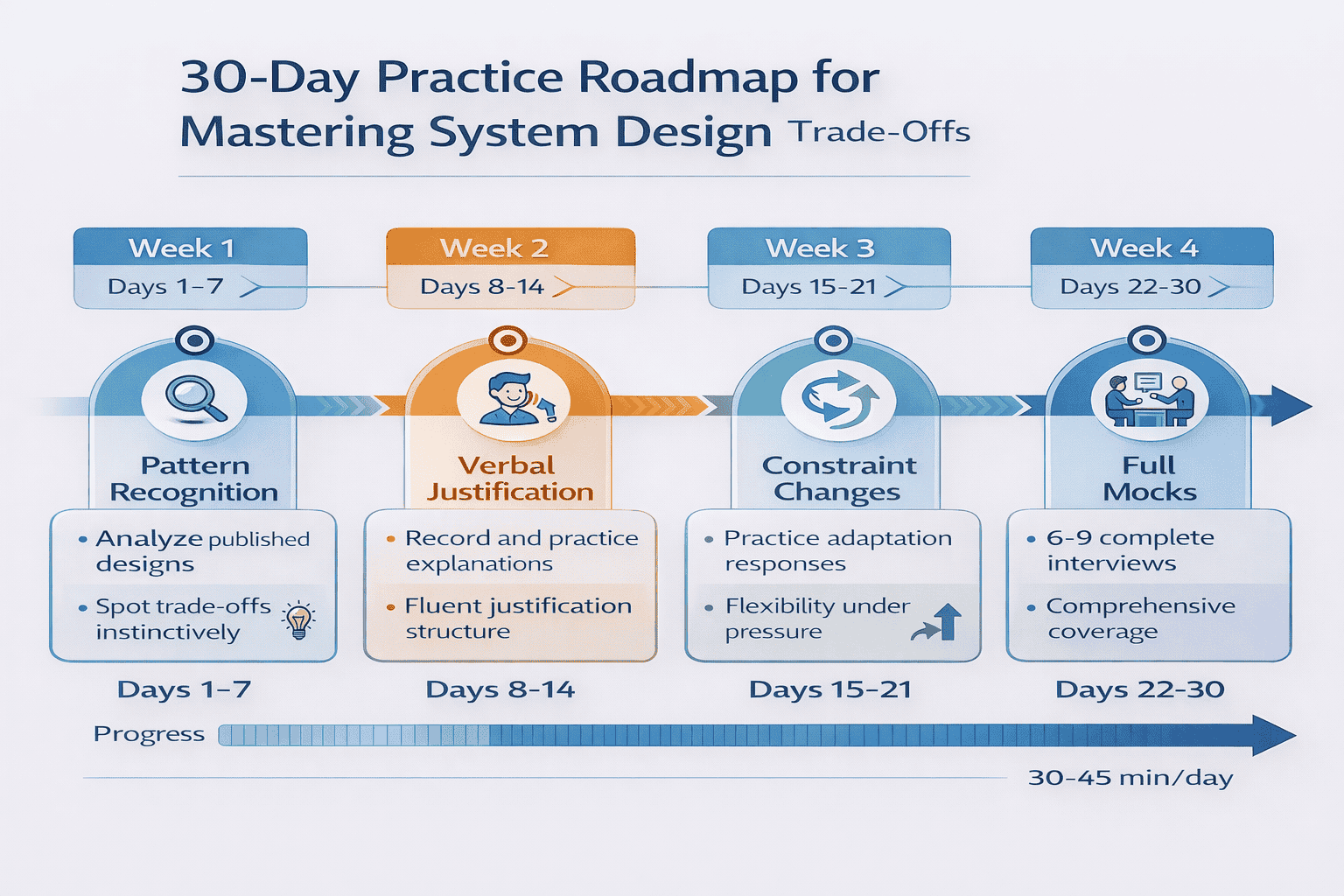
Essential Practice Questions to Master
Not all system design questions are created equal. These eight questions cover the breadth of trade-off categories you’ll encounter. Master these, and you can handle variants confidently.
1. URL Shortener – Teaches: database choice, caching strategy, scalability planning. Core trade-off: consistency versus performance.
2. Social Media Feed – Teaches: read-heavy optimization, ranking algorithms, real-time versus batch. Core trade-off: freshness versus latency.
3. Real-Time Messaging – Teaches: delivery guarantees, ordering, offline handling. Core trade-off: reliability versus complexity.
4. Rate Limiter – Teaches: distributed counting, accuracy requirements. Core trade-off: precision versus performance.
5. Video Streaming Platform – Teaches: CDN usage, adaptive bitrate, storage costs. Core trade-off: quality versus bandwidth versus cost.
6. Distributed Key-Value Store – Teaches: partitioning, replication, CAP theorem. Core trade-off: availability versus consistency.
7. Web Crawler – Teaches: politeness, deduplication, scale. Core trade-off: coverage versus crawl rate versus respect for servers.
8. Recommendation System – Teaches: online versus offline processing, cold start, personalization. Core trade-off: recommendation quality versus latency versus compute cost.
Practice each question at least twice: once optimizing for performance, once optimizing for cost. This forces you to make different trade-off decisions for the same problem.
Beyond Practice: Structured Learning Resources
While practice builds skill, structured learning builds depth. If you want to accelerate your preparation with expert guidance, comprehensive curriculum, and realistic mock interviews, System Design Course Pricing offers a complete system design interview course built specifically for senior engineers.
The course includes:
- 200+ practice problems with detailed trade-off analysis walkthroughs
- Live mock interviews with scored feedback from industry architects
- Real-world architecture patterns from production systems at scale
- Trade-off decision frameworks for every major system category
Whether you choose self-study or structured learning, the key is consistent, deliberate practice. Reading this guide gives you the framework. Practice makes it automatic. Feedback from experienced engineers accelerates improvement.
Tracking Your Progress
Create a practice log. After each mock interview or practice session, record:
- Trade-offs identified: Did I recognize them early? Which ones did I miss?
- Justification quality: Were my explanations crisp? Did I quantify impacts?
- Adaptation skill: How smoothly did I handle constraint changes?
- Coverage completeness: Did I address all five dimensions (performance, reliability, scalability, cost, operations)?
Over time, you’ll see patterns. Maybe you consistently forget to discuss operational complexity. Or you struggle with constraint changes involving consistency models. Identifying these patterns lets you target practice where it matters most.
Improvement isn’t linear. You’ll have sessions where everything clicks and sessions where you stumble over basic justifications. That’s normal. The trend over weeks matters more than individual session performance.
When You’re Ready for Real Interviews
You know you’re ready when:
- You can identify trade-offs within the first 2 minutes of hearing a question
- You ask 3-5 clarifying questions that expose decision-critical context
- You justify every major decision in under 60 seconds using the four-part structure
- You handle constraint changes without long pauses or complete redesigns
- You naturally cover performance, reliability, scalability, cost, and operations
If you’re hitting 4 out of 5 of these consistently in mock interviews, you’re ready to interview at top companies. Perfect isn’t the goal—competent and confident is.
Remember: interviewers aren’t looking for the one “right” answer. They’re evaluating whether you can reason about complex systems, make justified trade-offs, and communicate clearly under pressure. This guide gave you the framework. Practice gives you the fluency. You’ve got this.
Frequently Asked Questions
How do I know which trade-off to prioritize when multiple conflicts exist?
Prioritization comes from understanding the system’s primary purpose and user expectations. Start by asking what failure would be most damaging to users or the business. For a financial trading platform, showing incorrect account balances is catastrophic, so you prioritize consistency over performance. For a social media feed, slow loading causes more user churn than seeing posts 30 seconds late, so you prioritize performance over freshness. When multiple trade-offs collide, tie-break using the business context: which metric does the company optimize for (user growth, revenue, reliability)? If still unclear, ask the interviewer directly: “Both latency and consistency matter here—which is the higher priority for this system?” This demonstrates you recognize the conflict and seek context rather than guessing.
What if I choose the “wrong” architecture and the interviewer corrects me?
First, understand that in most system design questions, there’s no single “right” architecture—there are multiple valid approaches with different trade-offs. If an interviewer suggests a different approach, they’re likely exploring whether you can reason about alternatives, not telling you that you’re wrong. Respond by acknowledging their suggestion and comparing it to your choice: “That’s an interesting alternative. Approach X that you mentioned would optimize for [benefit] at the cost of [trade-off], while my approach Y optimizes for [different benefit] at the cost of [different trade-off]. Given [context from earlier], I chose Y because [reasoning]. Does that align with what you’re looking for, or are there additional constraints I should consider?” This shows flexibility without being defensive. If the interviewer reveals new constraints that genuinely invalidate your choice, adapt using the constraint change framework from Step 6: acknowledge the new information, identify what needs to change, explain modifications, and state what stays the same.
How technical should my justifications be? Should I discuss implementation details?
System design interviews operate at the architectural level, not the implementation level. Your justifications should focus on component choices, data flow, and architectural patterns rather than specific code or configuration details. For example, saying “I would use Redis for caching because it provides sub-millisecond read latency and supports various data structures” is appropriate. Going into “we’d configure Redis with maxmemory-policy allkeys-lru and set tcp-keepalive to 300” is too detailed unless the interviewer specifically asks about configuration. The exception: if discussing a specific technology’s capability is necessary to justify why you chose it over alternatives, brief implementation mentions are fine. “I’d use PostgreSQL over MongoDB here because we need ACID transactions for payment processing, and PostgreSQL’s MVCC implementation handles our concurrency requirements while maintaining consistency guarantees” shows you understand implementation implications without drowning in details. Follow the interviewer’s lead—if they drill into details, go deeper; if they stay high-level, match that altitude.
I’m experienced in backend development but weak on distributed systems concepts. How do I prepare?
Start with the fundamentals that underpin most trade-off discussions: CAP theorem (understanding the consistency-availability-partition tolerance triangle), database replication patterns (primary-replica, multi-primary), caching strategies (cache-aside, write-through, write-behind), and message queue basics (publish-subscribe, point-to-point). You don’t need deep theoretical knowledge—you need practical understanding of when to use each pattern and what trade-offs they involve. Spend two weeks reading about these concepts through practical resources like “Designing Data-Intensive Applications” by Martin Kleppmann or the engineering blogs of companies like Netflix, Uber, and Airbnb. Then immediately apply what you learn: take a simple system you’ve built and redesign it to handle 100x scale. What breaks first? How would you fix it? What trade-offs does your solution involve? This “learn concept, immediately apply it” cycle builds intuition faster than pure study. For structured learning with guided practice, GeekMerit System Design Course specifically bridges the gap between backend development experience and distributed systems architecture, with modules designed for senior developers transitioning to Staff-level roles.
How do I handle questions about technologies I’ve never used?
Focus on capabilities and trade-offs rather than specific technologies. If the interviewer asks about Kafka and you’ve never used it, reason from first principles: “I haven’t worked with Kafka directly, but I understand it’s a distributed message queue designed for high-throughput event streaming. For this use case where we need to process millions of events per second with ordering guarantees, a message queue architecture makes sense. The trade-off would be added operational complexity of running a distributed queue versus the simpler approach of direct database writes, but at this scale, the queue decouples producers from consumers and prevents the database from becoming a bottleneck.” This shows you can reason about architectural patterns even without hands-on experience with specific tools. If you’re completely unfamiliar with a concept the interviewer mentions, it’s acceptable to ask: “I’m not familiar with that specific technology—could you give me a quick overview of its key characteristics?” Interviewers often test whether you can learn and apply new information quickly, and asking clarifying questions demonstrates intellectual honesty rather than weakness.
Should I practice on a whiteboard or is digital drawing sufficient?
Practice in the medium you’ll interview in. Most interviews today happen remotely using digital whiteboarding tools (Miro, Excalidraw, or company-specific tools), so practice with digital drawing. However, the constraint of digital tools actually helps with system design: you’re forced to keep diagrams simple and clear rather than getting lost in implementation details. Practice drawing clean architecture diagrams with basic shapes: boxes for services, cylinders for databases, clouds for caches, arrows for data flow. Your diagrams should be readable at a glance—label everything, use consistent symbols, and organize components logically (user-facing services at top, data stores at bottom). For remote interviews, practice screen sharing while drawing and talking simultaneously; this skill takes time to develop. If you have an on-site interview with physical whiteboards, do at least 5-10 practice sessions on an actual whiteboard to get comfortable with spatial planning and making diagrams visible from across a room. The key difference: digital tools have unlimited undo, whiteboards don’t, so you need more planning before drawing. Regardless of medium, the content matters more than artistic quality—clear, simple diagrams with strong reasoning beat beautiful diagrams with weak justification every time.
Citations
- https://www.allthingsdistributed.com/2007/12/eventually_consistent.html
- https://martin.kleppmann.com/2015/05/11/please-stop-calling-databases-cp-or-ap.html
- https://netflixtechblog.com/netflix-edge-load-balancing-695308b5548c
- https://eng.uber.com/tech-stack-part-one-foundation/
- https://instagram-engineering.com/what-powers-instagram-hundreds-of-instances-dozens-of-technologies-adf2e22da2ad
- https://aws.amazon.com/builders-library/reliability-and-constant-work/
- https://www.microsoft.com/en-us/research/wp-content/uploads/2016/02/tr-2008-91.pdf
- https://research.google/pubs/pub36726/
Content Integrity Note
This guide was written with AI assistance and then edited, fact-checked, and aligned to expert-approved teaching standards by Ram Arun. Ram has 10 years of experience coaching system design candidates into top tech companies. System design principles, architectural patterns, and interview frameworks are sourced from industry-standard resources including published engineering blogs from Netflix, Uber, Google, Amazon, and academic research on distributed systems, and are cited throughout.